Image generationDocumented overviewLast checked Sep 29, 2026

fal: Pricing, Features & Best Use Cases

Developer platform offering API access to 1,000+ image, video, audio and 3D models plus serverless and dedicated GPUs.

Is fal right for you?

Pay-per-use generative media platform with 1,000+ production models and flexible GPU scaling, ideal for developers building AI features without upfront commitments. Based on the vendor's documentation, not on a hands-on test.

Best for: Developers building generative media apps

Also a good fit for

  • AI startups
  • ML teams needing GPUs

Consider another tool if need flat-rate pricing

Or if

  • Non-developer users preferring UI-first tools
  • Seeking training-focused infrastructure only

fal in the news

Headlines from US outlets, selected automatically — not endorsements. Updated Oct 12, 2026

fal pricing and usage limits

Prices checked Sep 29, 2026 on the official US pricing page. Official pricing ↗ Prices and limits change often.

Vendor pricing page re-checked automatically 12 days ago: no changes detected.

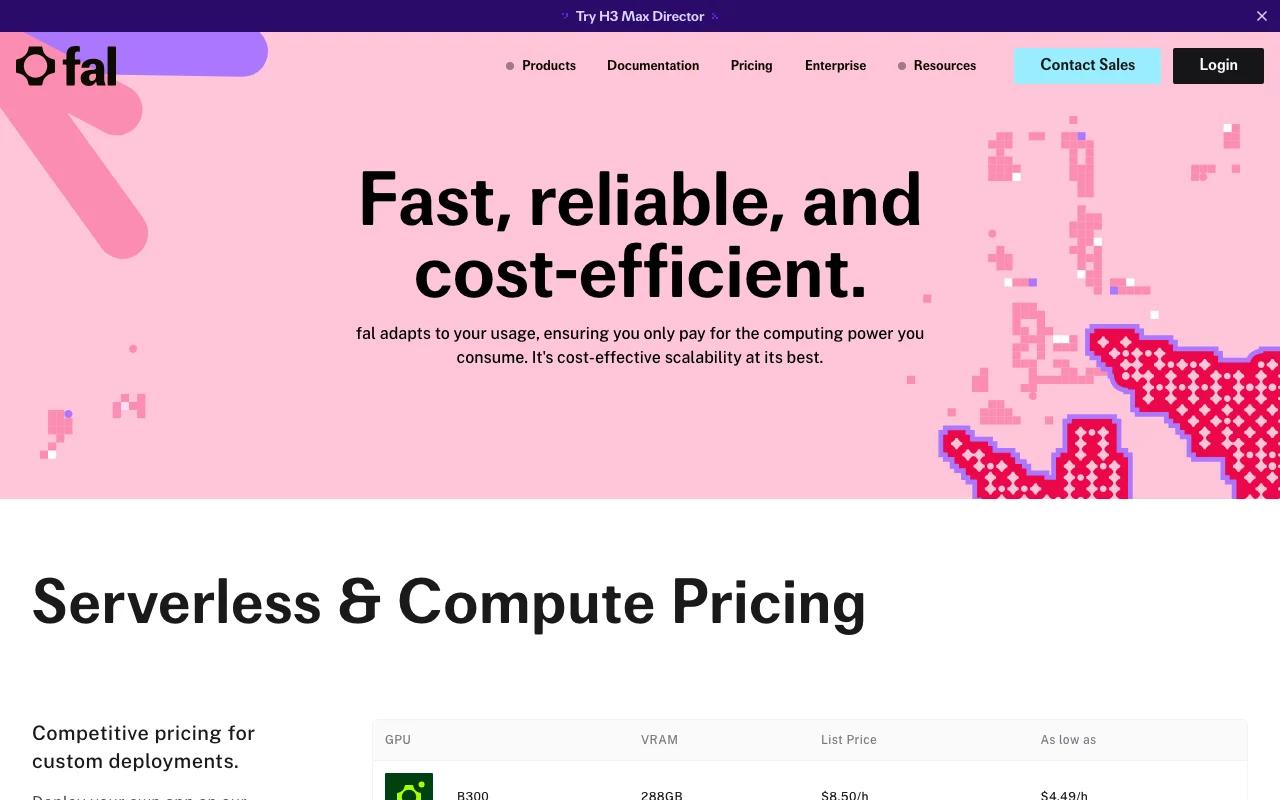
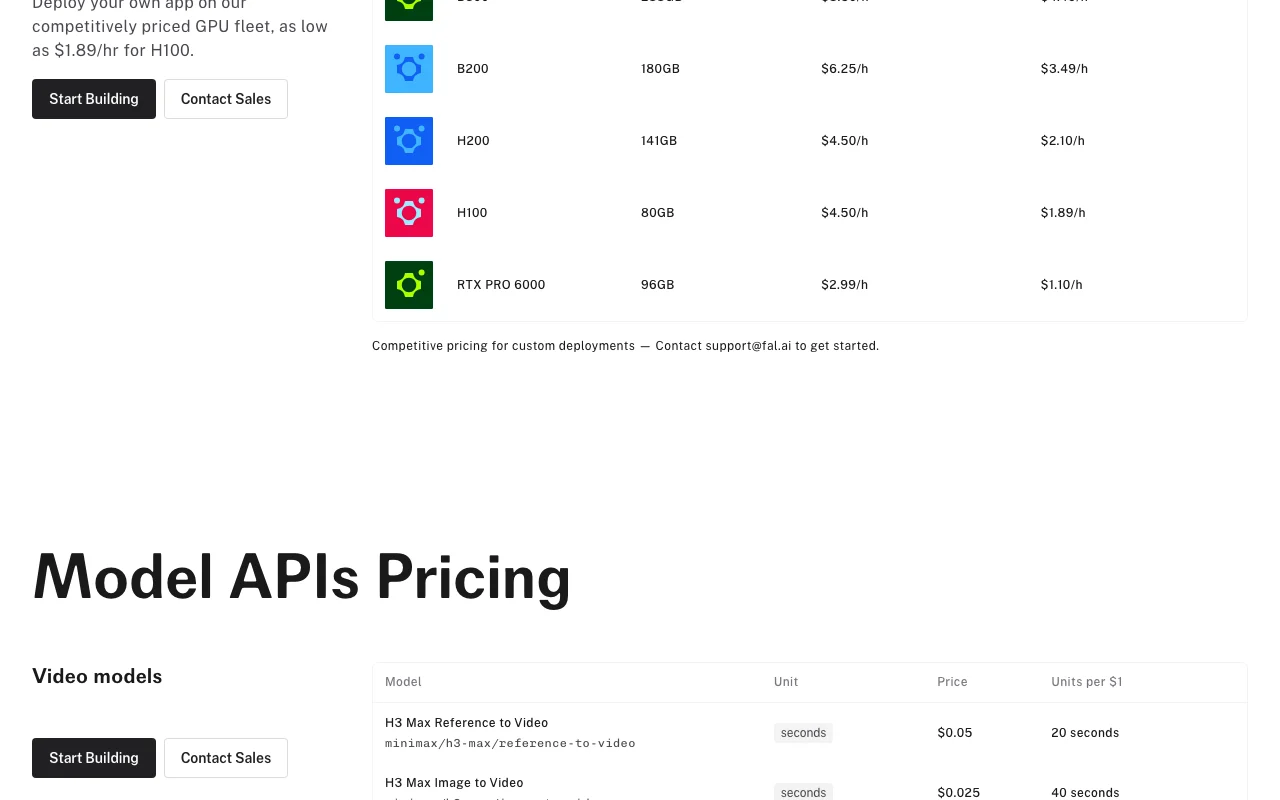
fal pricing page with plans and prices — screenshot of the image generation AI tool, Oct 1, 2026
The official fal pricing page as we saw it. fal.ai, captured Oct 1, 2026

Paid plans: what changes as you upgrade

Model APIs (Pay-Per-Use) API

Usage-based source (opens in a new tab)

Per API call

No minimum spend or commitment required

For: Building generative media features with minimal fixed overhead

Limits

  • No per-month or per-API-call caps
  • 1,000+ models available
1 more
  • Pricing varies by model and output type (e.g., video duration, image resolution)

Includes

  • 1,000+ production-ready models
  • Video, image, audio, 3D generation
2 more
  • Synchronous and async API calls
  • Real-time WebSocket streaming for some models

API included

Serverless GPU (H100) API

$1.89 per hour (billed per second of execution) source (opens in a new tab)

Hourly + per-second execution

No upfront commitment; custom pricing available on contact

For: Deploying custom or fine-tuned models with automatic scaling

Limits

  • Auto-scales from 0 to 1,000s of GPUs
  • Billed per-second when running; $0 when idle
1 more
  • Minimum execution ~1 second per request

Includes

  • 80GB H100 NVIDIA GPU
  • Auto-scaling with zero cold-start penalty
2 more
  • Private model deployment
  • Multi-GPU distributed training support

API included

Dedicated Compute (B300) API

$4.49 per hour (288GB VRAM) source (opens in a new tab)

Hourly

Volume discounts and annual commitments available via contact sales

For: Training, fine-tuning, and sustained compute workloads with guaranteed performance

Limits

  • Full SSH access (no autoscaling)
  • Billed for full hour regardless of usage
1 more
  • Dedicated instance (no sharing)

Includes

  • 288GB VRAM Blackwell GPU (B300)
  • Full SSH access for training/fine-tuning
2 more
  • InfiniBand connectivity for multi-GPU setups
  • Multi-region availability

API included

Dedicated Compute (H100) API

$1.89 per hour (80GB VRAM) source (opens in a new tab)

Hourly

Volume discounts available via contact sales

For: Single-GPU development and fine-tuning at lower cost than B300

Limits

  • Full SSH access
  • Billed hourly minimum
1 more
  • Single-GPU instance

Includes

  • 80GB VRAM H100 GPU
  • Full SSH control
2 more
  • Persistent storage for code and data
  • Development and fine-tuning optimized

API included

Usage caps, credits and extra costs

Third-party payment processor fees; egress bandwidth charges may apply for large outputs

What is fal, and how does it work?

fal is a generative media platform for developers. It hosts 1,000+ production-ready image, video, audio and 3D models behind a unified API, including third-party models such as FLUX, Veo, Kling and Seedream. Beyond model APIs, fal offers serverless GPU deployments for custom or fine-tuned models and dedicated compute clusters for training. Billing is pay-per-use, by output for model APIs and hourly for GPUs.

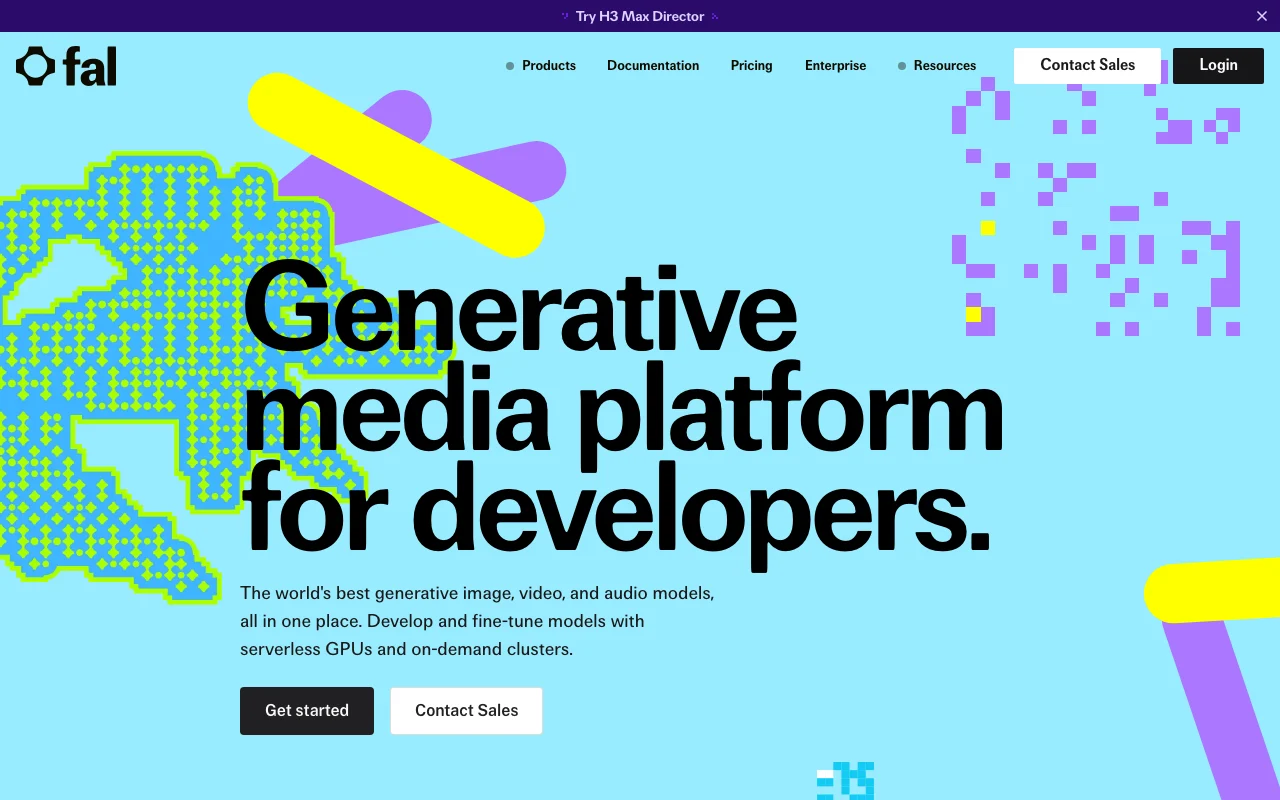
fal homepage — screenshot of the image generation AI tool, Oct 1, 2026
fal's official site: how the product presents itself. fal.ai, captured Oct 1, 2026

What you provide and what you get back

How fal works: what you provide, where it runs and what you get backYOU PROVIDEYour inputText promptsReference images or videosAudio filesCustom model code (for deployment)IMAGE GENERATIONfalWeb, APIfrom $1.89 (Dedicated Compute (H1…no free tieraccount requiredchecked Sep 29, 2026YOU GET BACKThe resultGenerated images, videos, audio,…Speech synthesis and sound effectsModel inference resultsinput → fal → output · from the vendor's own pages, no hands-on test unless stated
What you give fal and what comes back, from its documentation

You provide

  • Text prompts
  • Reference images or videos
  • Audio files
  • Custom model code (for deployment)

You get back

  • Generated images, videos, audio, and 3D models
  • Speech synthesis and sound effects
  • Model inference results

Where you can use it

Platforms
Web, API
Account
Required
Models / versions
1,000+ production-ready models

Best use cases for fal

Scenarios are worked out by our editors from the documentation; the actual result depends on your input and plan.

Adding image or video generation to an app

Who
Frontend/full-stack developers
You provide
Text prompts or reference images
Expected result
Generated images or videos via API call
Plan needed
Model APIs (Pay-Per-Use)
Limitation
Latency depends on model choice (typically sub-second) source (opens in a new tab)

Deploying fine-tuned or custom models

Who
ML engineers and ML teams
You provide
Python code with fal.App class or model weights
Expected result
Autoscaling API endpoint for inference
Plan needed
Serverless GPU or Dedicated Compute
Limitation
Requires Python code; first-time deployment takes ~2-5 minutes source (opens in a new tab)

Comparing many generative models via one API

Who
Product teams and AI researchers
You provide
Same input (text/image/audio) for multiple models
Expected result
Side-by-side outputs to evaluate model quality
Plan needed
Model APIs (Pay-Per-Use)
Limitation
Cost increases with model comparisons; limited to models in fal Marketplace source (opens in a new tab)

Key features and their practical limits

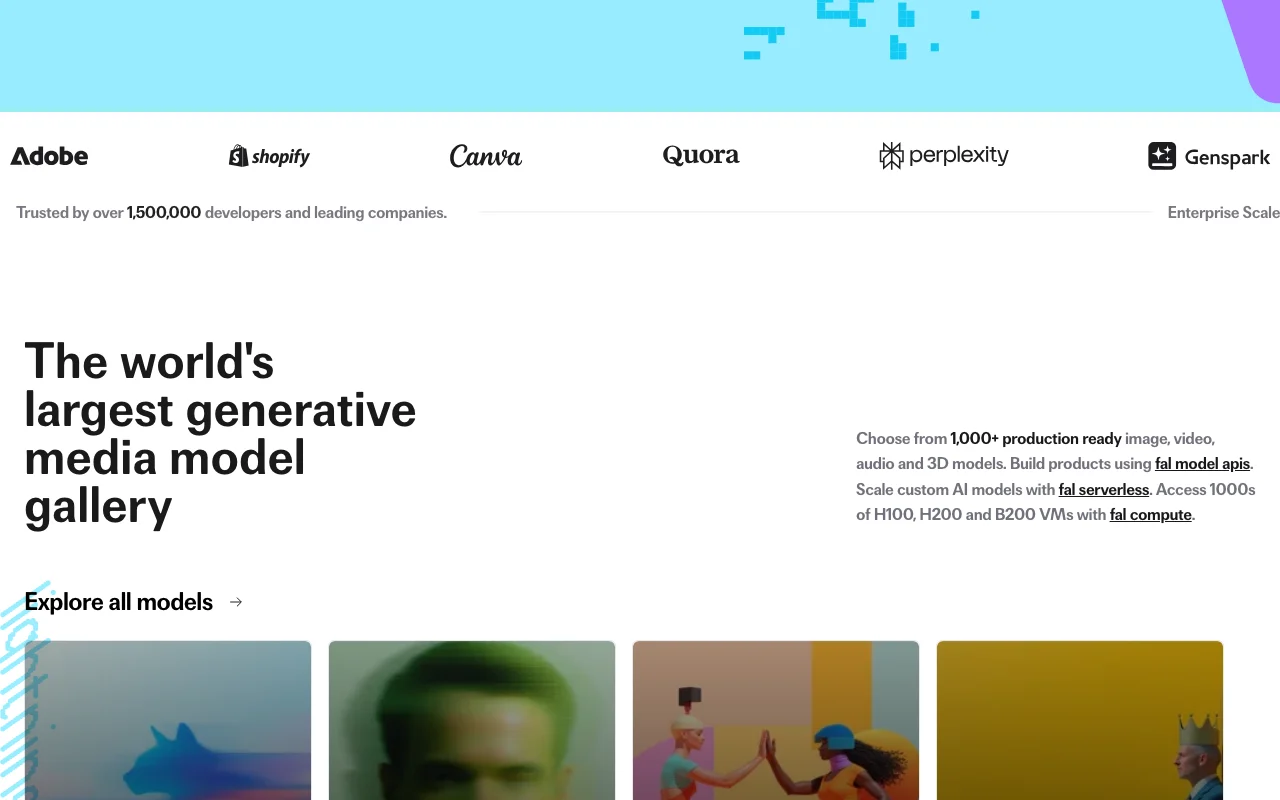
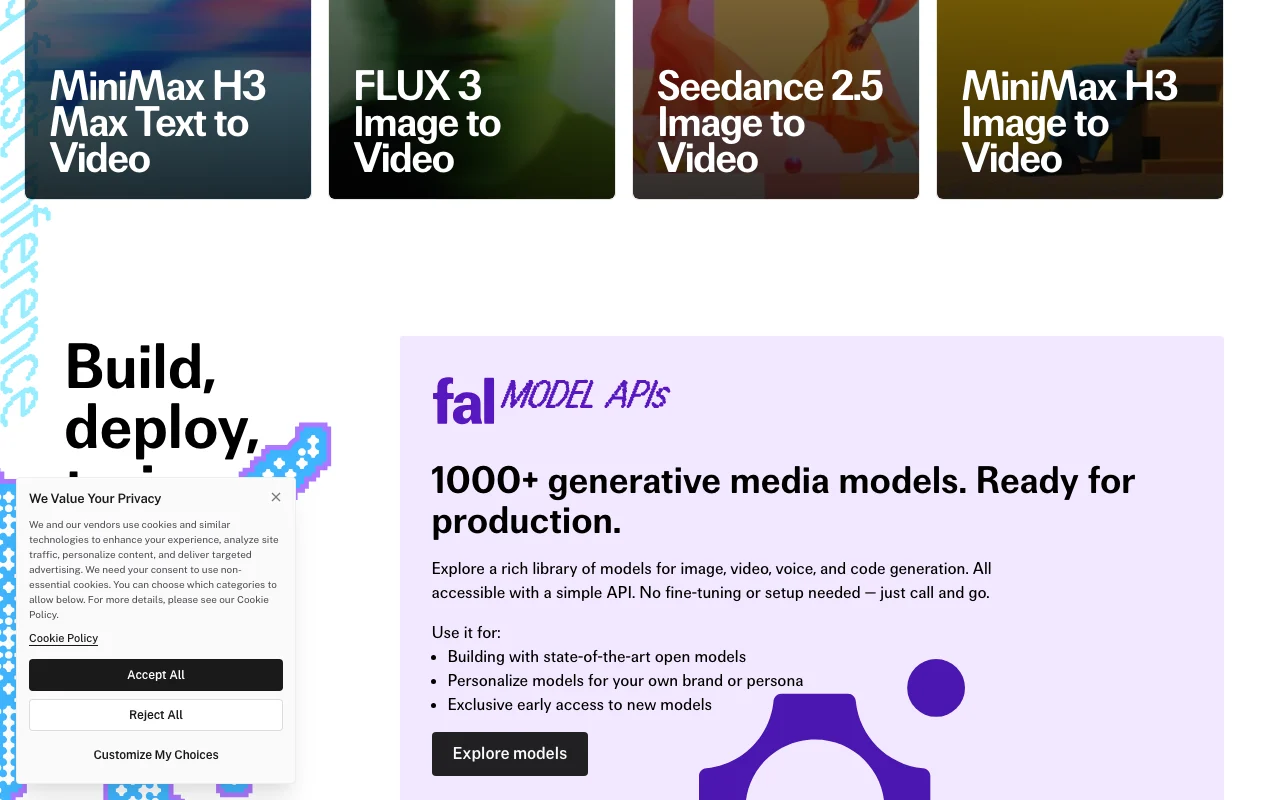
fal homepage — screenshot of the image generation AI tool, Oct 1, 2026
Feature overview on the official site. fal.ai, captured Oct 1, 2026

Unified API to 1,000+ generative models

Routes single API call to 1,000+ image, video, audio, music, 3D, and speech models Build once, test many models without re-architecting integrations

Access: API via fal SDKs (Python, JavaScript), REST, or web playgroundLimit: Model availability and performance vary; some models have regional restrictions source (opens in a new tab)

Web playground and sandbox

Browser-based UI to test any model, adjust parameters, and compare outputs Evaluate models before integrating without writing code

Access: Web app at fal.ai; no signup required for browsing, but inference requires API keyLimit: Playground is informational; production apps require API integration source (opens in a new tab)

Serverless GPU deployments

Deploy custom Python code with fal.App; auto-scales from 0 to 1000+ GPUs Run proprietary or fine-tuned models with zero cold-start optimization

Access: fal CLI (fal deploy) and web dashboard; billed per second of executionLimit: Python-only for deployment; requires fal.App abstraction source (opens in a new tab)

Dedicated H100/H200/B200/B300 compute

Rent entire GPU instances with full SSH access for training, fine-tuning, or batch jobs Run long-running workloads at fixed hourly rate without autoscaling overhead

Access: fal CLI (fal compute create) and dashboard; hourly billing for full instanceLimit: Requires manual scaling; billed full hour regardless of usage source (opens in a new tab)

fal: strengths and limits

Reasons to choose fal

  • Pay only for usage, with published per-output prices Predictable costs for light users; no hidden fees or subscription lock-in documented source (opens in a new tab)
  • Wide choice of image, video and audio models Users can experiment with cutting-edge models like FLUX, Kling, MiniMax without platform switching documented source (opens in a new tab)
  • GPU rates listed publicly (H100 from $1.89/h) Transparent pricing enables budget planning and comparison with alternatives documented source (opens in a new tab)
  • Docs, SDKs and playground Developers can prototype in browser before writing code; multiple language SDKs reduce friction documented source (opens in a new tab)

Check before paying for fal

  • No flat subscription; costs scale with usage Unpredictable monthly bills for high-volume apps; no cost cap unless manually enforced documented source (opens in a new tab)
  • Aimed at developers, requires API integration Non-technical users cannot use fal directly; only suitable for teams with engineering documented source (opens in a new tab)
  • Some models use GPU-based pricing Inference costs for GPU-heavy models can exceed alternative SaaS pricing documented source (opens in a new tab)
  • Requires an account and API key Authentication overhead; cannot use without signup and payment method on file documented source (opens in a new tab)

How to use fal for building a generative media application with API-first AI models

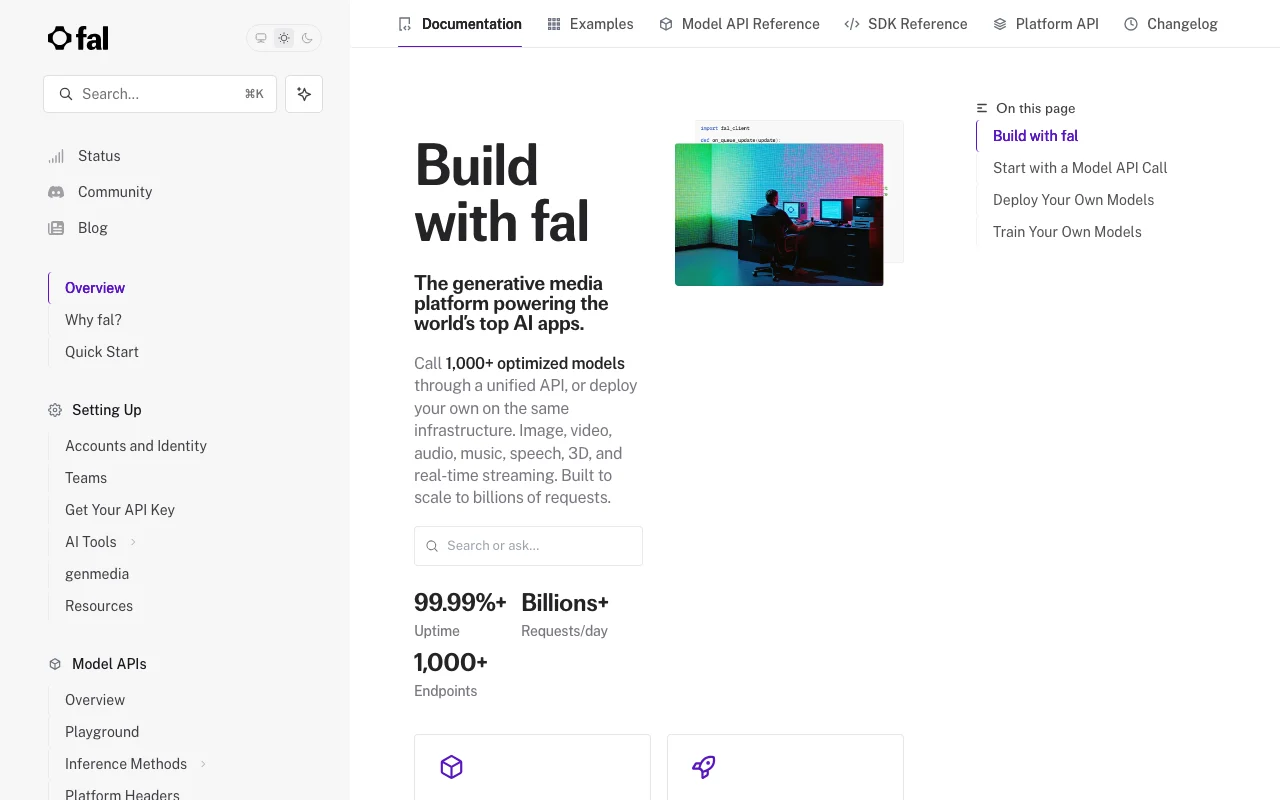
fal documentation — screenshot of the image generation AI tool, Oct 1, 2026
fal documentation: where the steps below come from. fal.ai, captured Oct 1, 2026

Set up fal

  1. Create fal account at https://fal.ai and verify email
  2. Generate API key in dashboard (Settings > API Keys)
  3. Install fal SDK: pip install fal (Python) or npm install @fal-ai/client (JavaScript)

Example: building a generative media application with API-first AI models

  1. Select model from Marketplace (e.g., fal-ai/flux/schnell for images)
  2. Format input as JSON: {"prompt": "a sunset over mountains"}
  3. Call API with SDK: fal_client.subscribe(model_id, arguments=input)

Review and export the result

  1. Verify response contains output_url or image/video/audio field
  2. Check dashboard > Usage for cost tracking and request logs
Example prompt suggested by our editors (not a recorded output of the product)
a sunset over mountains

fal integrations and API

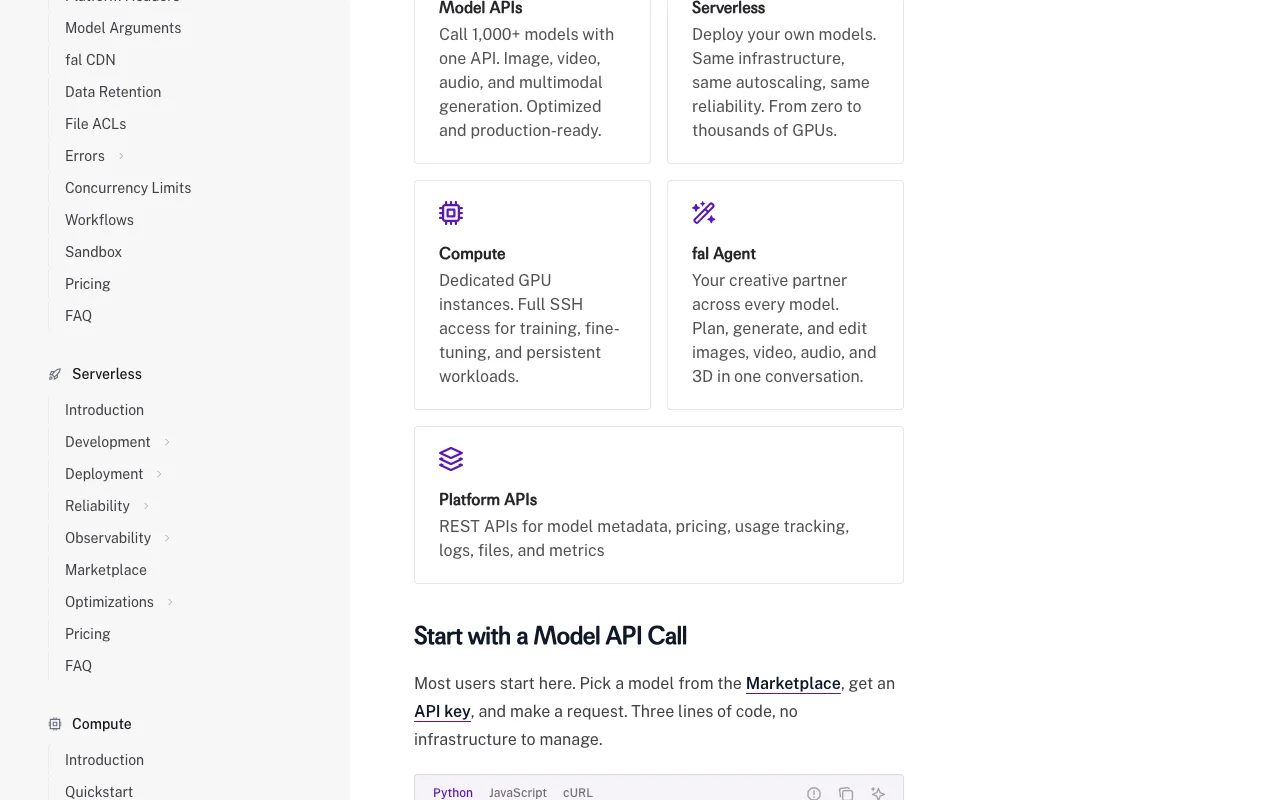
fal documentation — screenshot of the image generation AI tool, Oct 1, 2026
fal documentation (continued). fal.ai, captured Oct 1, 2026

Native integrations and export formats

Export: Images: PNG, JPG, WebP (model-dependent), Videos: MP4, WebM (varies by model), Audio: WAV, MP3, OGG (varies by model)

API access and separate billing

fal has no public API in its official documentation. REST and WebSocket APIs; async and real-time streaming supported API documentation ↗

Privacy, data use and commercial rights

Summarized from the vendor's current policies; this is not legal advice and a vendor's badge is not an independent audit.

How your inputs and outputs are handled

User prompts, uploaded files, and generated outputs stored for service delivery and usage tracking

fal may use inputs/outputs for model improvement; enterprise contracts can restrict this

Retained according to service terms; exact period not specified in privacy excerpt

Commercial use and plan restrictions

Enterprise customers can restrict commercial use of their data via contract

Enterprise contracts available to restrict data usage and processing locations

Controls for business users

  • Single sign-on (SSO)
  • Private model endpoints
  • Usage analytics and audit logs
  • SOC 2 Type II compliance

Policies: fal.ai/legal/privacy-policy

Best fal alternatives for different needs

"Better suited" is based on documented features and pricing, not on a head-to-head test.

Runway: better suited to multi-modal AI video and image generation

Leonardo.Ai: better suited to image generation with style/artistic control

Midjourney: better suited to high-quality image generation with strong community

Kling AI: better suited to advanced video generation (via fal or direct)

Alternatives
AlternativeWhen to choose itPricingLimitation
RunwayPrefer UI-first tools with built-in editing; need Gen-2/Gen-3 models specificallyFreemium ($0–$588/month); credits-based usage source (opens in a new tab)Smaller model catalog; UI-focused, not API-first for developers
Leonardo.AiPrefer fixed monthly subscriptions; need real-time canvas editingFreemium ($120–$1,000/month); fixed monthly credits source (opens in a new tab)Image-focused; less suitable for video/audio; UI not developer-friendlyCompare
MidjourneyPrefer UI in Discord; willing to pay monthly subscription regardless of usageFreemium ($10–$120/month); fixed monthly credits source (opens in a new tab)No API; Discord-only interface; image generation onlyCompare
Kling AIPrefer ByteDance's Kling model directly; need Chinese language supportFreemium ($0–$50/month via Kling UI); available on fal at $0.07–$0.14/s source (opens in a new tab)Direct platform has limited English support; fal offers better integration

Explore fal further

Tools and guides near fal

fal user reviews

No user reviews yet.

Used fal? Be the first to share your experience.

Write a review

Reviews are checked by a moderator before they appear. Your email is never published. Plain text only.

Your rating (required)

Show what you made or what went wrong. Images are published only if the review is approved; location data is removed.

    fal FAQ

    What's included in the free tier?

    fal does not offer a free tier; all usage is pay-per-call. No free credits are mentioned in official pricing documentation. source (opens in a new tab)

    Can I deploy my own custom models?

    Yes. Use fal Serverless to deploy Python code with fal.App; infrastructure scales automatically. Dedicated Compute is available for training and fine-tuning with full SSH access. source (opens in a new tab)

    What's the latency for a typical API call?

    Model APIs typically respond sub-second; video generation can take 5–30 seconds depending on model and parameters. Serverless deployments have zero cold-start penalty after first use. source (opens in a new tab)

    Do you support real-time streaming?

    Yes. Many models support synchronous and async queue calls; WebSocket connections available for real-time inference on selected models. source (opens in a new tab)

    Can I use fal with enterprise security requirements?

    Yes. Enterprise customers get SOC 2 Type II compliance, SSO, private endpoints, and contract-based data handling restrictions. source (opens in a new tab)

    Sources and review methodology

    Official sources and verification dates

    • fal homepage homepage · checked Oct 1, 2026 · Product overview, Enterprise features, Customer testimonials, Pricing summary
    • fal pricing pricing · checked Oct 1, 2026 · Model API pricing (video, image, audio, 3D), GPU pricing (H100, H200, B200, B300, RTX PRO 6000), Serverless and compute tiers
    • fal documentation docs · checked Oct 1, 2026 · Model API quickstart, Serverless deployment guide, SDK references (Python, JavaScript), Compute provisioning
    • fal privacy policy policy · checked Oct 1, 2026 · Personal data collection and use, Third-party payment processor, GitHub OAuth option, Enterprise data handling

    Not verified: free_access: No free tier or free credits mentioned in official materials; trial: No trial period documented; taxes: Tax treatment and exemptions not specified; Data retention period: Exact retention window not stated in privacy policy excerpt; SLA details: 99.99% uptime claimed; formal SLA not provided; Export/import capabilities: Data portability options not documented.

    How we documented and maintain this page

    Every fact about fal above comes from the 4 official pages listed here, last compared on Sep 29, 2026; we have not run fal ourselves, so it has no editorial score. How we check and re-check pages.

    Article updated Oct 2, 2026; prices checked Sep 29, 2026. Outbound links to vendors are plain links; we do not earn commissions. How we review · Report an error