Our take: Choose MemMachine if you are a developer who wants an open-source memory layer that keeps user facts and conversation context across sessions, agents and different language models.
Main limitation: It is a developer component reached through REST API, Python SDK or MCP server, not an end-user app, and the Pro price mapping to the billing toggle is unclear.
By the AI Tool Atlas editors.
Based on the vendor's official documentation; we have not tested this product hands-on. What “documented overview” means
Who should use MemMachine
Choose MemMachine if you are a developer who wants an open-source memory layer that keeps user facts and conversation context across sessions, agents and different language models. Based on the vendor's documentation, not on a hands-on test.
Best for: Agent developers
Also a good fit for
Teams building production AI agents
Organizations needing self-hosted memory
Consider another tool if primarily for developers, not end users
Or if
Self-hosting requires your own infrastructure
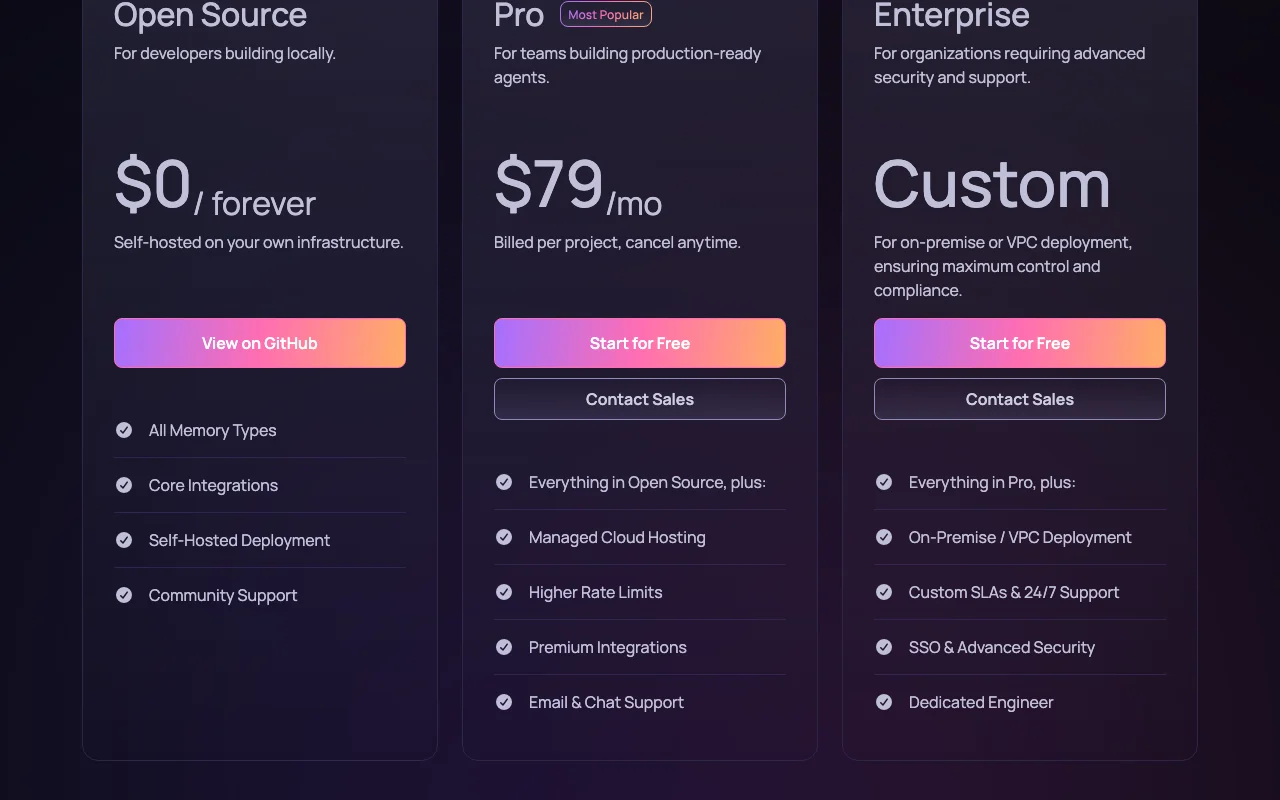
Pro plan is billed per project at $79/mo
MemMachine pricing and usage limits
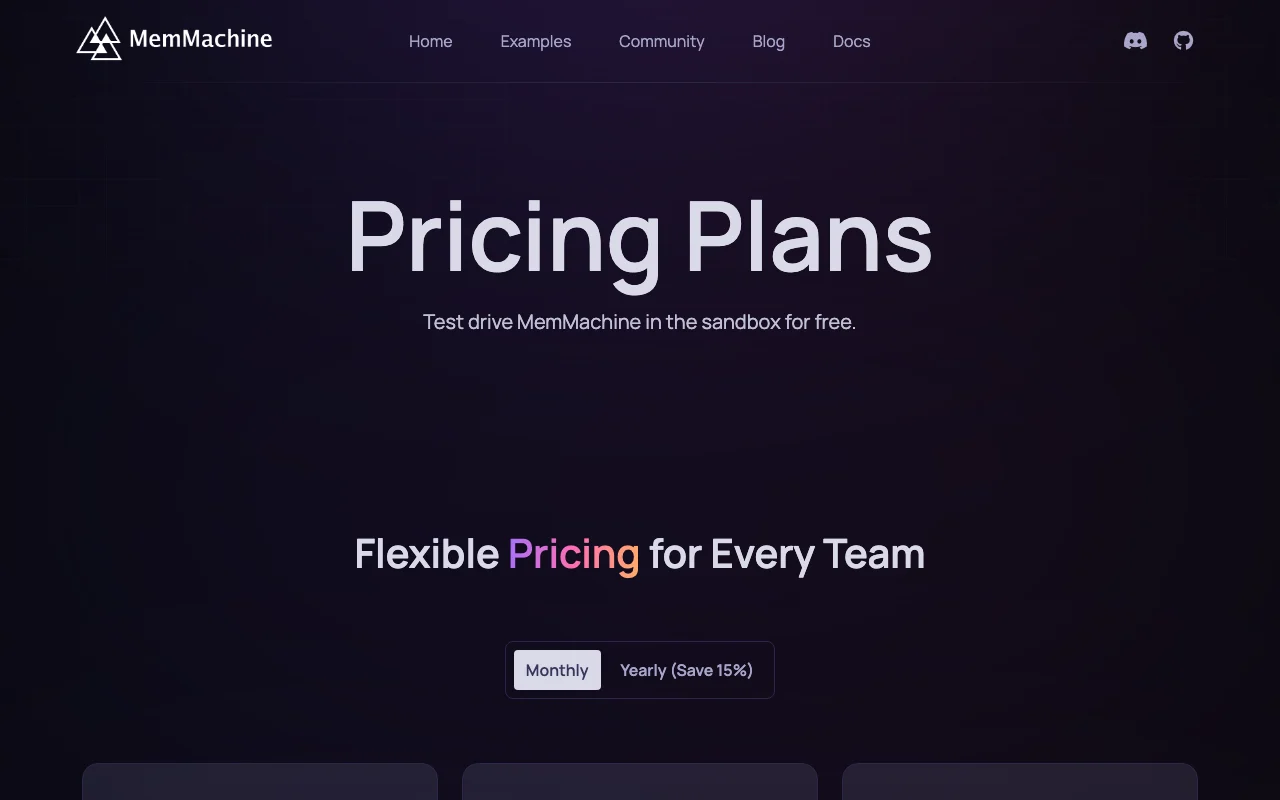
Prices checked Oct 2, 2026 on the official US pricing page. Official pricing ↗ Prices and limits change often.
The official MemMachine pricing page as we saw it. memmachine.ai, captured Oct 2, 2026
Free access and trial conditions
Open Source edition is $0 forever and self-hosted; the site also advertises a free sandbox.
Pro lists a Start for Free button; trial length is not stated.
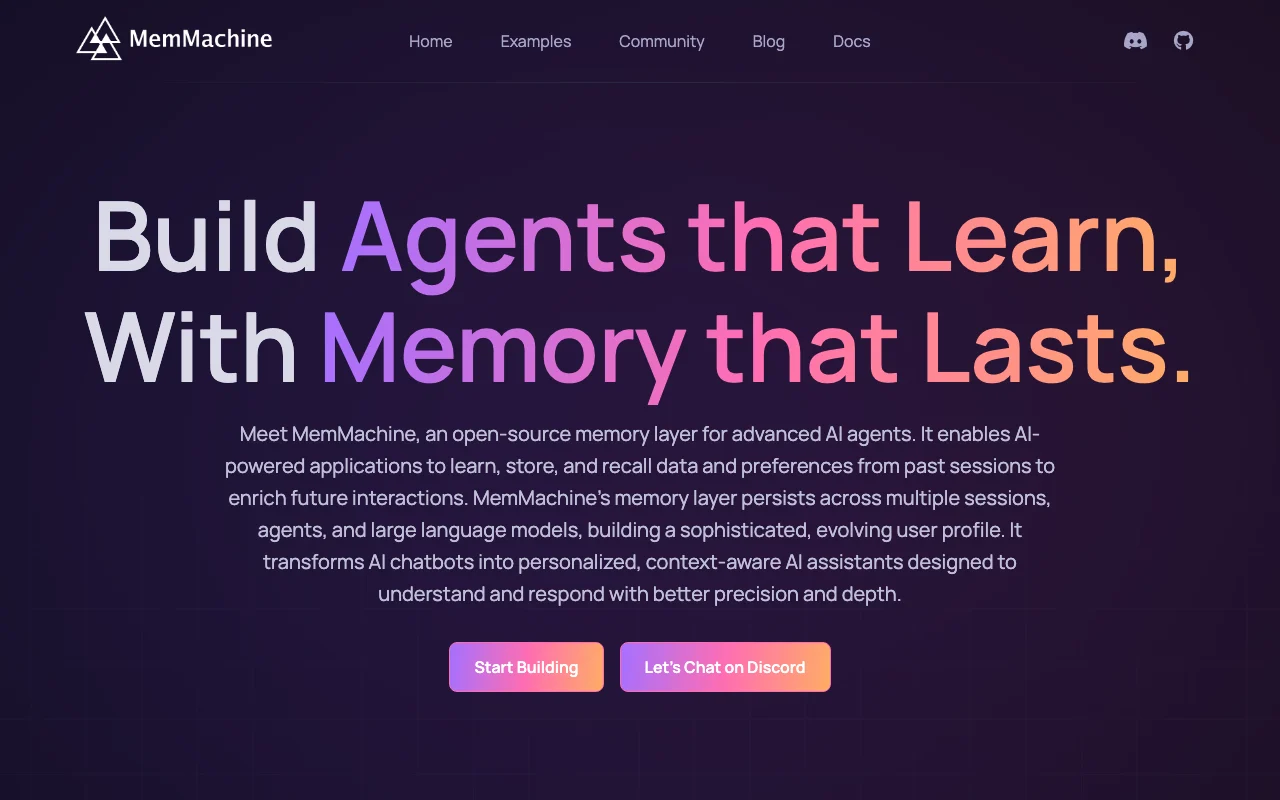
MemMachine is an open-source memory layer for AI agents. It lets applications learn, store and recall data and preferences from past sessions, and its memory persists across sessions, agents and language models.
It is aimed at agent developers and organizations. It can be self-hosted for free or used as a managed cloud service on a paid plan.
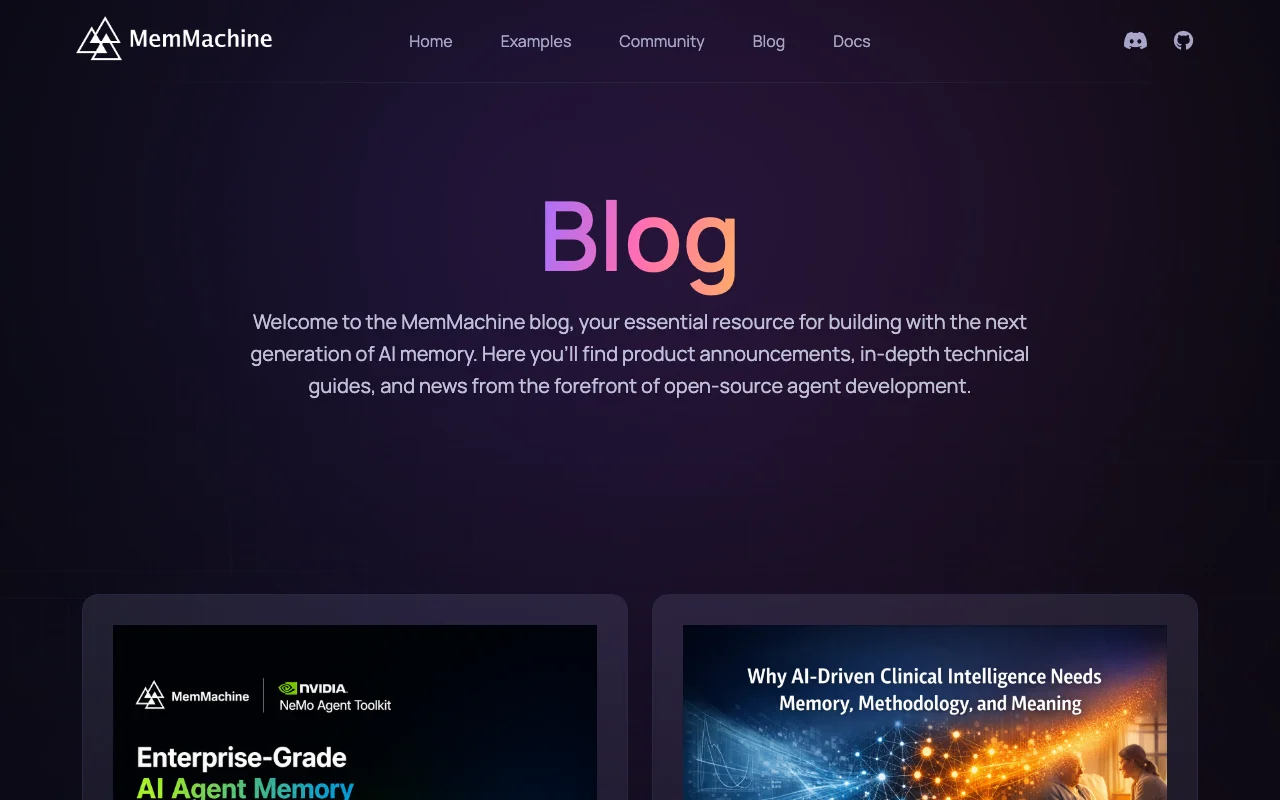
MemMachine's official site: how the product presents itself. memmachine.ai, captured Oct 2, 2026
What you provide and what you get back
What you give MemMachine and what comes back, from its documentation
You provide
Agent conversation messages
User facts and preferences
API calls from a REST client, Python SDK or MCP server
You get back
Recalled episodic conversation context
Stored profile memory about each user
Context passed back into the agent prompt
Where you can use it
Platforms
API
Access methods
REST API, Python SDK, MCP server
Memory types
Short-term, long-term, personalization; episodic and profile storage
Storage
Graph database for episodic, SQL database for profile
Hosting
Self-hosted (free), managed cloud (Pro), on-premise or VPC (Enterprise)
Support
Community; email and chat on Pro; 24/7 on Enterprise
Where MemMachine is most useful
Scenarios are worked out by our editors from the documentation; the actual result depends on your input and plan.
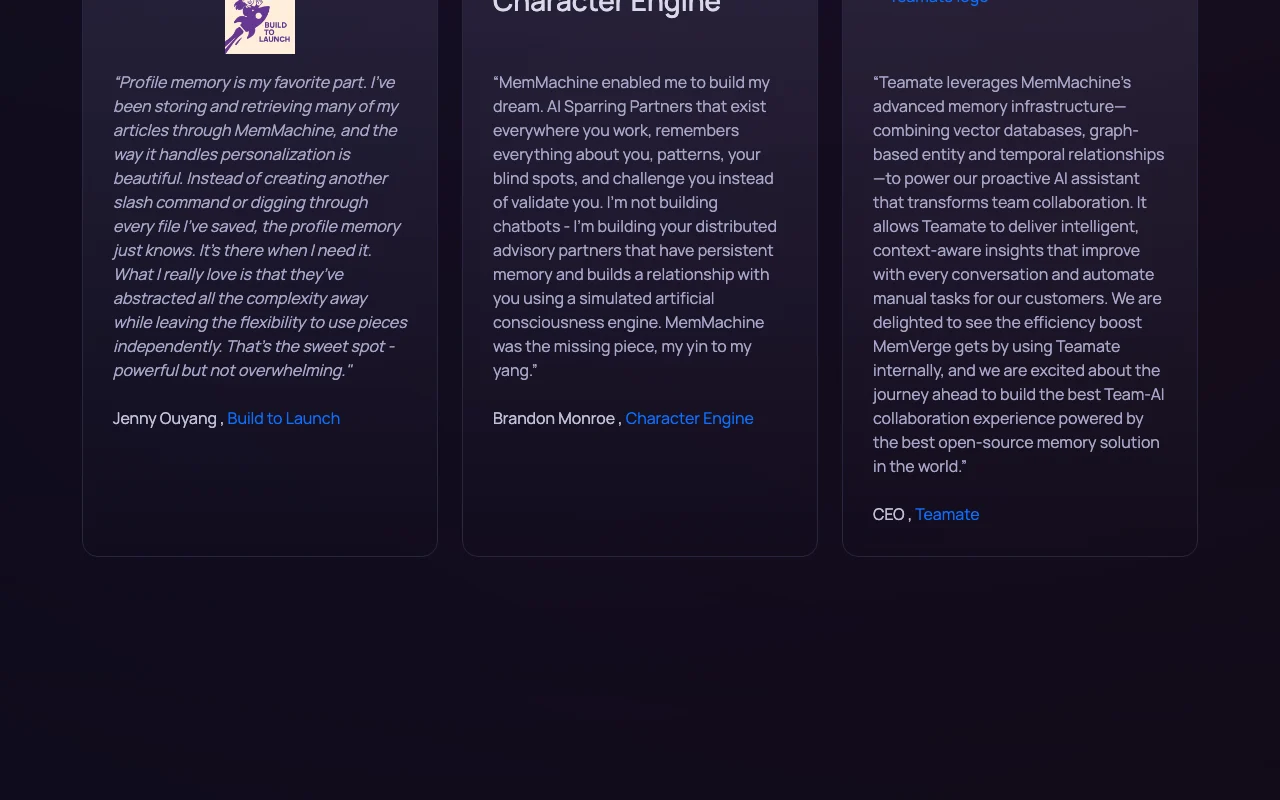
Feature overview on the official site. memmachine.ai, captured Oct 2, 2026
Short-term, long-term and personalization memory types
Stores conversational context as episodic memory and long-term user facts as profile memory, in addition to short-term memory. Lets agents recall earlier sessions and personal facts.
Access: All plans list all memory typesLimit: Episodic memory runs on a graph database that must be set up when self-hosting.source (opens in a new tab)
Model-agnostic memory across multiple LLMs
Keeps memory outside any single model vendor so several LLMs can read the same memory. Avoids lock-in to one vendor memory service.
Access: All plansLimit: Each model integration needs to be wired up by the developer.source (opens in a new tab)
Open-source self-hosted deployment
Offers the open-source edition for self-hosting on your own infrastructure with community support. Keeps data on infrastructure you control.
Access: Open Source plan, $0 foreverLimit: Support is community only through Discord and GitHub.source (opens in a new tab)
Managed cloud hosting on the Pro plan
Runs MemMachine as a managed cloud service billed per project, with higher rate limits and premium integrations. Removes hosting work for production agents.
Open-source edition is free forever and self-hosted Lets teams run it at no license cost.documentedsource (opens in a new tab)
Works with multiple AI models, not tied to one vendor Lets teams keep several LLM vendors without losing memory.documentedsource (opens in a new tab)
Public documentation with many framework integration guides Makes it easier for developers to find setup steps, though the docs URL returned 404 when fetched.documentedsource (opens in a new tab)
Check before paying for MemMachine
Primarily for developers, not end users Product managers and non-coders cannot use it directly.documentedsource (opens in a new tab)
Self-hosting requires your own infrastructure Teams need to run databases and hosting themselves for the free edition.documentedsource (opens in a new tab)
Pro plan is billed per project at $79/mo Cost is per project, so teams with several projects pay for each.documentedsource (opens in a new tab)
Enterprise pricing is custom and requires contacting sales Large organizations must go through sales for on-premise or VPC.documentedsource (opens in a new tab)
How to use MemMachine for adding persistent memory to an AI agent
Set up MemMachine
Open the MemMachine GitHub repository from the pricing page for the self-hosted edition.
Deploy the memory core on your own infrastructure with its graph and SQL databases.
Pick an access method: REST API, Python SDK or MCP server.
Point your agent at the MemMachine endpoint.
Example: adding persistent memory to an AI agent
Send a user message from your chatbot to the memory API.
Store a stated preference such as a preferred appointment time as profile memory.
Start a new session and query memory for that user.
Insert the recalled facts into the agent prompt.
Review and export the result
Ask the agent in a new session about the stored preference and confirm it answers correctly.
Inspect the stored profile entry for the expected user.
MemMachine API
Plan comparison on the official pricing page. memmachine.ai, captured Oct 2, 2026
API access and separate billing
MemMachine has no public API in its official documentation. RESTful API, Python SDK and MCP server are named on the homepage; docs URL returned 404 when fetched. API documentation ↗
Privacy, data use and commercial rights
Summarized from the vendor's current policies; this is not legal advice and a vendor's badge is not an independent audit.
How your inputs and outputs are handled
Memory is stored in a graph database (episodic) and an SQL database (profile).
Commercial use and plan restrictions
Open source edition can be deployed in a private cloud or on-premises for full control over data; Enterprise adds on-premise or VPC deployment.
Controls for business users
SSO and advanced security on Enterprise
On-premise or VPC on Enterprise
MemMachine alternatives by need
"Better suited" is based on documented features and pricing, not on a head-to-head test.
MemMachine says it is primarily designed for agent developers and organizations building AI applications. source (opens in a new tab)
How much does MemMachine Pro cost?
The pricing page shows Pro at $79 per month billed per project, with a Monthly/Yearly toggle (yearly saves 15%); the page does not state which toggle state the $79 belongs to. source (opens in a new tab)
Who develops MemMachine?
The project was incubated by MemVerge and is now community-driven, with MemVerge continuing to assign engineers. source (opens in a new tab)
What are the MemMachine memory types?
It offers short-term, long-term and personalization memory; episodic memory sits in a graph database and profile memory in an SQL database. source (opens in a new tab)
Where does MemMachine support come from on the open-source edition?
Not verified: Pro price mapping to the Monthly/Yearly toggle; Free trial duration; Privacy policy (404); Documentation page (404); Rate limits; Data retention.
How we documented and maintain this page
Every fact about MemMachine above comes from the 3 official pages listed here, last compared on Oct 2, 2026; we have not run MemMachine ourselves, so it has no editorial score. How we check and re-check pages.
Article updated Oct 2, 2026; prices checked Oct 2, 2026. Outbound links to vendors are plain links; we do not earn commissions. How we review · Report an error


 (open full size in a new tab)
 (open full size in a new tab)
 (open full size in a new tab)
 (open full size in a new tab)
 (open full size in a new tab)
 (open full size in a new tab)