Our take: Best for AI engineers building agents with persistent memory; free tier with 10k add requests/month, paid plans from $29/mo.
Main limitation: Developer-oriented; requires coding to use
By the AI Tool Atlas editors.
Based on the vendor's official documentation; we have not tested this product hands-on. What “documented overview” means
MemorySync pricing and usage limits
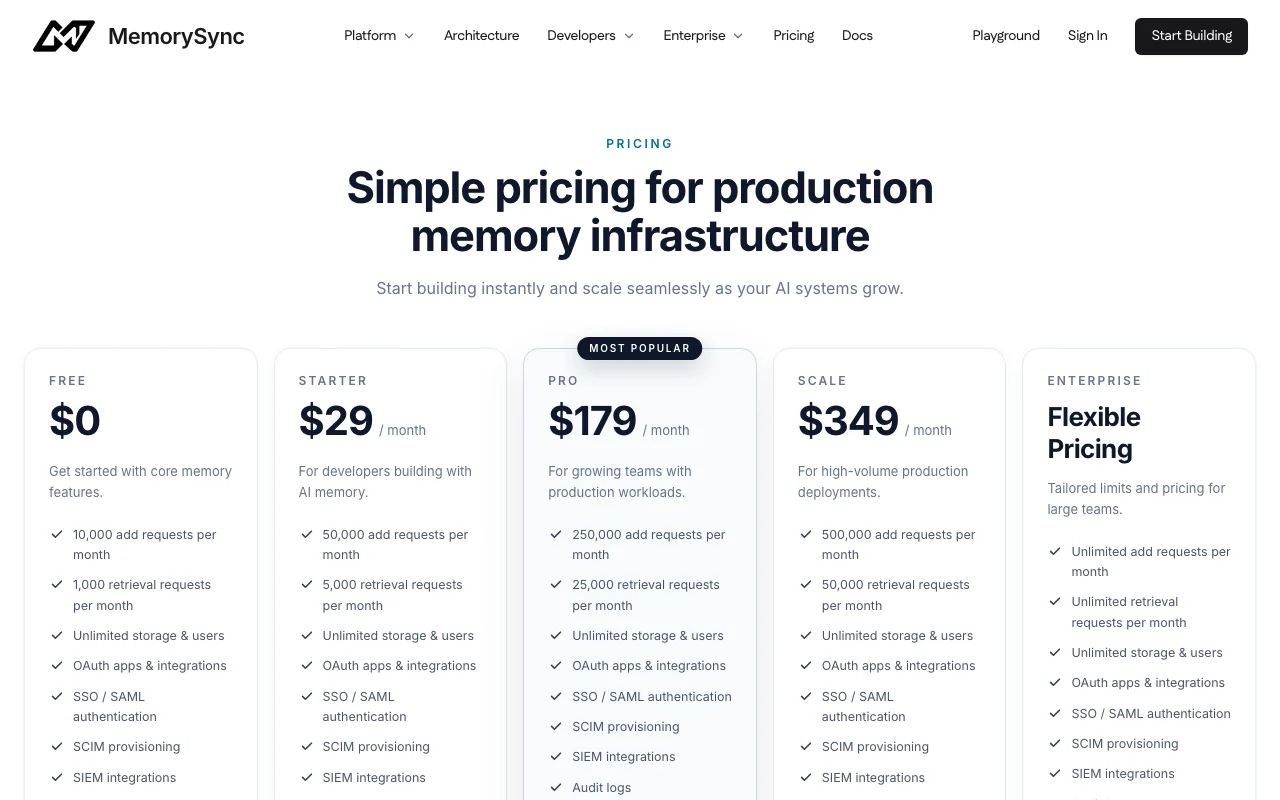
Prices checked Oct 1, 2026 on the official US pricing page. Official pricing ↗ Prices and limits change often.
The official MemorySync pricing page as we saw it. memorysync.io, captured Oct 1, 2026
Free access and trial conditions
10,000 add and 1,000 retrieval requests per month; no credit card required
Free tier serves as unlimited trial
Paid plans: what changes as you upgrade
Free self-serve
Free
Month
For: Testing MemorySync; small projects
Limits
10,000 add requests/month
1,000 retrieval requests/month
1 more
Unlimited storage & users
Includes
Core memory APIs
Basic retrieval
2 more
Memory graph and clusters
Web dashboard
API included
Starter self-serve
$29/mo
Month
For: Developers building with AI memory
Limits
50,000 add requests/month
5,000 retrieval requests/month
1 more
Unlimited storage & users
Includes
All Free features
Enhanced intelligence system
2 more
Routed search
Standard support
API included
Pro self-serve
$179/mo
Month
For: Growing teams with production workloads
Limits
250,000 add requests/month
25,000 retrieval requests/month
1 more
Unlimited storage & users
Includes
All Starter features
Advanced intelligence system
2 more
Semantic ranking
Priority support
API included
Scale self-serve
$349/mo
Month
For: High-volume production deployments
Limits
500,000 add requests/month
50,000 retrieval requests/month
1 more
Unlimited storage & users
Includes
All Pro features
Optimized intelligence system
1 more
Dedicated support
API included
Enterprise sales
Custom pricing
Month
Custom terms
For: Large enterprises
Limits
Unlimited requests
Custom infrastructure
Includes
Full platform capabilities
Dedicated support
API included
Usage caps, credits and extra costs
No overage billing; usage capped at plan allowance
USD pricing
What is MemorySync, and how does it work?
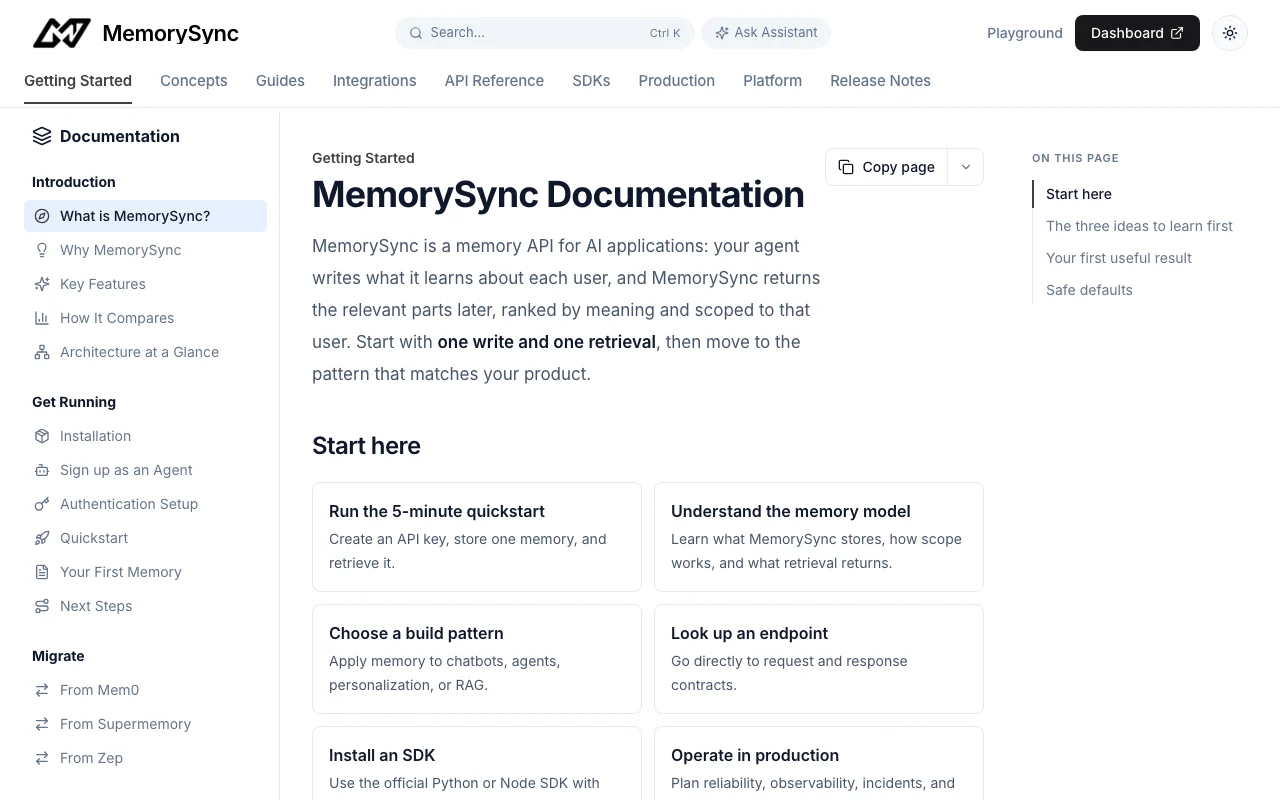
MemorySync is a developer platform that gives AI systems persistent, contextual memory. It ingests data from connected sources, builds a memory graph with tiering, and assembles retrieved context for production agents. Uses REST API and Python/Node SDKs with integrations for LangChain, LangGraph, OpenAI Agents SDK, CrewAI and LlamaIndex.
MemorySync's official site: how the product presents itself. memorysync.io, captured Oct 1, 2026
What you provide and what you get back
What you give MemorySync and what comes back, from its documentation
You provide
API keys and authentication
Text memories, documents, or structured data
Source labels and tags for retrieval filtering
End-user identifiers for multi-tenant isolation
You get back
Ranked memory results from semantic retrieval
Memory graph visualization and intelligence reports
Context-assembled responses for LLM prompts
Audit logs and governance reports
Where you can use it
Platforms
API, SDK
Account
Required
Where MemorySync is most useful
Scenarios are worked out by our editors from the documentation; the actual result depends on your input and plan.
Adding long-term memory to AI agents
Who
AI engineers, startups building agents
You provide
Text or structured data about user preferences, interactions, or domain knowledge
Expected result
Agent recalls relevant context on next interaction without retraining
Plan needed
Free tier for testing; Starter ($29/mo) for production agents
Store, modify, condense and delete memories programmatically via REST API Manage memory lifecycle; implement retention policies; clean up user data on request
Access: All plans via Python SDK, Node.js SDK, or REST APILimit: API rate limits per plan; bulk operations may require batchingsource (opens in a new tab)
Fetch ranked memories, combine results from multiple sources, synthesize into coherent context Assemble optimal context windows for higher-quality LLM responses
Access: All plansLimit: Retrieval counts capped per plan; semantic ranking quality improves with more memoriessource (opens in a new tab)
Memory graph, clusters and intelligence reports
Visualize relationships between memories; auto-identify topics and entities; generate auditable reports Understand what agents have learned; detect duplicate or conflicting memories; audit memory contents
Access: All plans via dashboardLimit: Graph visualization works best with 100+ memories; report generation latency at scalesource (opens in a new tab)
Connectors for Slack, Drive, S3 and more
Automatically ingest data from external sources; map fields to memory structure Feed agents with real-time data from business systems without manual integration
Access: Pro+ plansLimit: Connector setup requires engineering; sync frequency and latency depend on sourcesource (opens in a new tab)
Pros, cons and deal-breakers
Reasons to choose MemorySync
Documented REST API with Python and Node.js SDKs Easy integration into any stack; clear examples and typed interfacesdocumentedsource (opens in a new tab)
Framework integrations with LangChain, LangGraph, CrewAI, OpenAI Agents, LlamaIndex, Vercel AI Plug-and-play memory layer for popular agent frameworksdocumentedsource (opens in a new tab)
Enterprise features: SSO, SCIM, audit logs, retention controls, data isolation Suitable for regulated industries and compliance-heavy teamsdocumentedsource (opens in a new tab)
Multi-tenant isolation with scope-based access control Safe for SaaS platforms serving multiple end-usersdocumentedsource (opens in a new tab)
Free tier includes 10,000 add requests and 1,000 retrieval requests per month with no credit card A prototype agent memory can be tested indefinitely before paying.documentedsource (opens in a new tab)
Check before paying for MemorySync
Developer-oriented; requires coding to use No-code interface not available; teams need engineering resourcesdocumentedsource (opens in a new tab)
Pricing structure based on request counts (add/retrieval) not storage Heavy usage workloads may accumulate costs quicklydocumentedsource (opens in a new tab)
Requires account and API key setup Additional security responsibility for managing credentialsdocumentedsource (opens in a new tab)
Retrieval requests are limited to 1,000 on Free, 5,000 on Starter ($29) and 25,000 on Pro ($179) per month Read-heavy agents hit the retrieval cap well before the add cap.documentedsource (opens in a new tab)
How to use MemorySync for add a memory and retrieve it via API
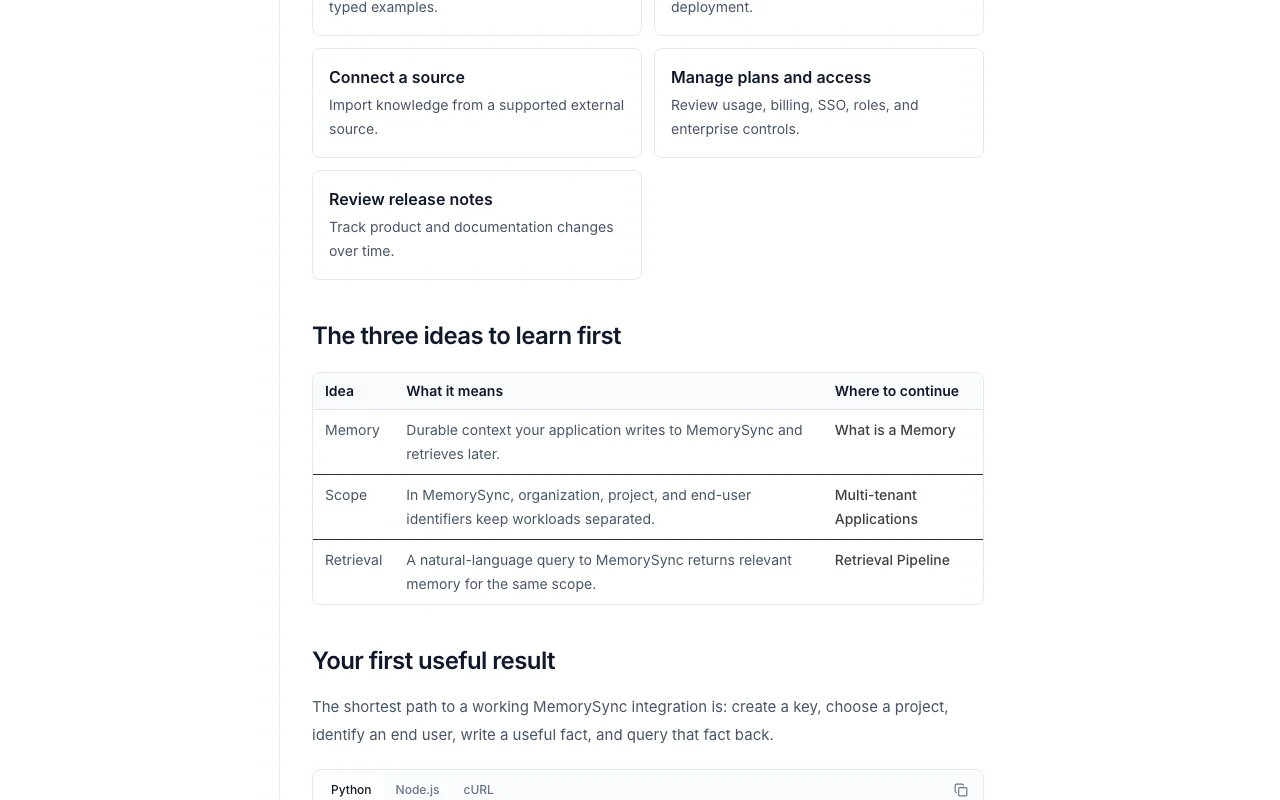
MemorySync documentation: where the steps below come from. docs.memorysync.io, captured Oct 1, 2026
Set up MemorySync
Sign up for free account at memorysync.io
Create an API key in the dashboard
Install Python SDK: pip install memorysync
Example: add a memory and retrieve it via API
Create client with API key and project ID
Add memory: client.add('User prefers dark mode', source='chat')
Query: client.query('What are user preferences?', k=5)
Retrieve ranked results with scores
Use context to augment LLM prompts
Review and export the result
Verify API key is valid and has remaining requests
Check dashboard for memory count
Test query results match expected memories
MemorySync API
MemorySync documentation (continued). docs.memorysync.io, captured Oct 1, 2026
API access and separate billing
MemorySync has no public API in its official documentation. API documentation ↗
Privacy, data use and commercial rights
Summarized from the vendor's current policies; this is not legal advice and a vendor's badge is not an independent audit.
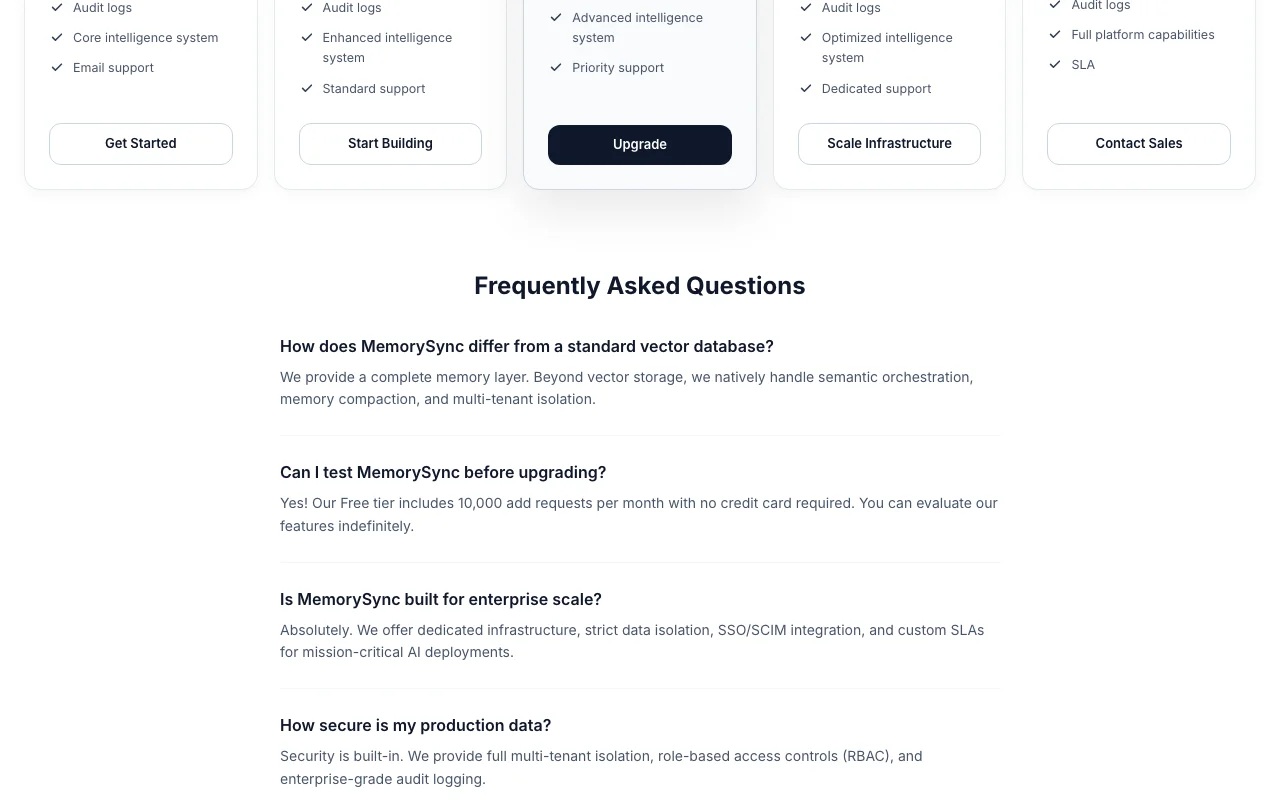
How does MemorySync differ from a standard vector database?
MemorySync is a complete memory layer. It handles semantic orchestration, memory compaction, multi-tenant isolation, and policy enforcement. Vector databases are storage-only. source (opens in a new tab)
Can I test MemorySync before upgrading?
Yes. The Free tier includes 10,000 add requests and 1,000 retrieval requests per month with no credit card required. source (opens in a new tab)
Is MemorySync built for enterprise scale?
Yes. Dedicated infrastructure, strict data isolation, SSO/SCIM integration, and custom SLAs are available. source (opens in a new tab)
How secure is my production data?
Security is built-in: multi-tenant isolation, role-based access controls, and enterprise-grade audit logging. Encryption in transit and at rest is standard. source (opens in a new tab)
How fast is memory retrieval?
MemorySync delivers low-latency semantic recall. Even at scale, AI agents remain instantly responsive. source (opens in a new tab)
Not verified: Exact embedding model backend; Specific latency guarantees at scale; Volume discounts for Enterprise; Credit rollover policies.
How we documented and maintain this page
Every fact about MemorySync above comes from the 4 official pages listed here, last compared on Oct 1, 2026; we have not run MemorySync ourselves, so it has no editorial score. How we check and re-check pages.
Article updated Oct 10, 2026; prices checked Oct 1, 2026. Outbound links to vendors are plain links; we do not earn commissions. How we review · Report an error