Productivity & writingDocumented overviewLast checked Sep 29, 2026

MemoryLake: Pricing, Features & Best Use Cases

Portable AI memory layer that stores documents, chats and media and connects to Claude, ChatGPT and agents via MCP.

Is MemoryLake right for you?

MemoryLake suits people who use several AI assistants and want one portable memory, with a free 300,000-token tier and a $19 Pro plan for regular use. Based on the vendor's documentation, not on a hands-on test.

Best for: Developers using multiple AI agents

Also a good fit for

  • Teams wanting shared AI memory

Consider another tool if free plan limited to 300,000 tokens per month

Or if

  • Usage metered by tokens; extra usage billed from $3.125 per 1M tokens
  • Memory writes such as page processing consume tokens

MemoryLake pricing and usage limits

Prices checked Sep 29, 2026 on the official US pricing page. Official pricing ↗ Prices and limits change often.

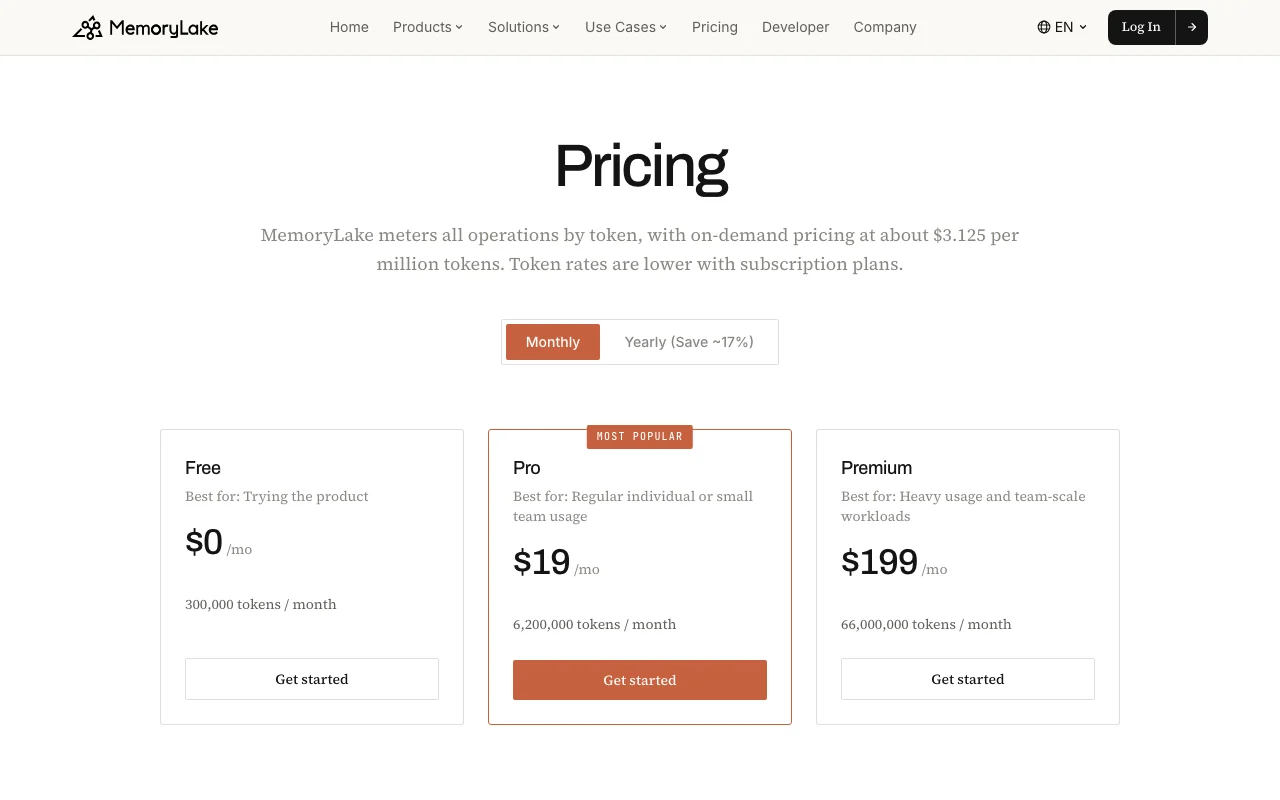
MemoryLake pricing page with plans and prices — screenshot of the productivity & writing AI tool, Oct 1, 2026
The official MemoryLake pricing page as we saw it. memorylake.ai, captured Oct 1, 2026

Free access and trial conditions

Free plan, 300,000 tokens per month.

Paid plans: what changes as you upgrade

Free web

Free source (opens in a new tab)

Month

For: Trying the product

Limits

  • 300,000 tokens per month
  • About 40 PDF pages or 1,200 retrieval calls

Includes

  • Typed memory categories
  • MCP server

API included

Pro web

$19/mo source (opens in a new tab)

Month

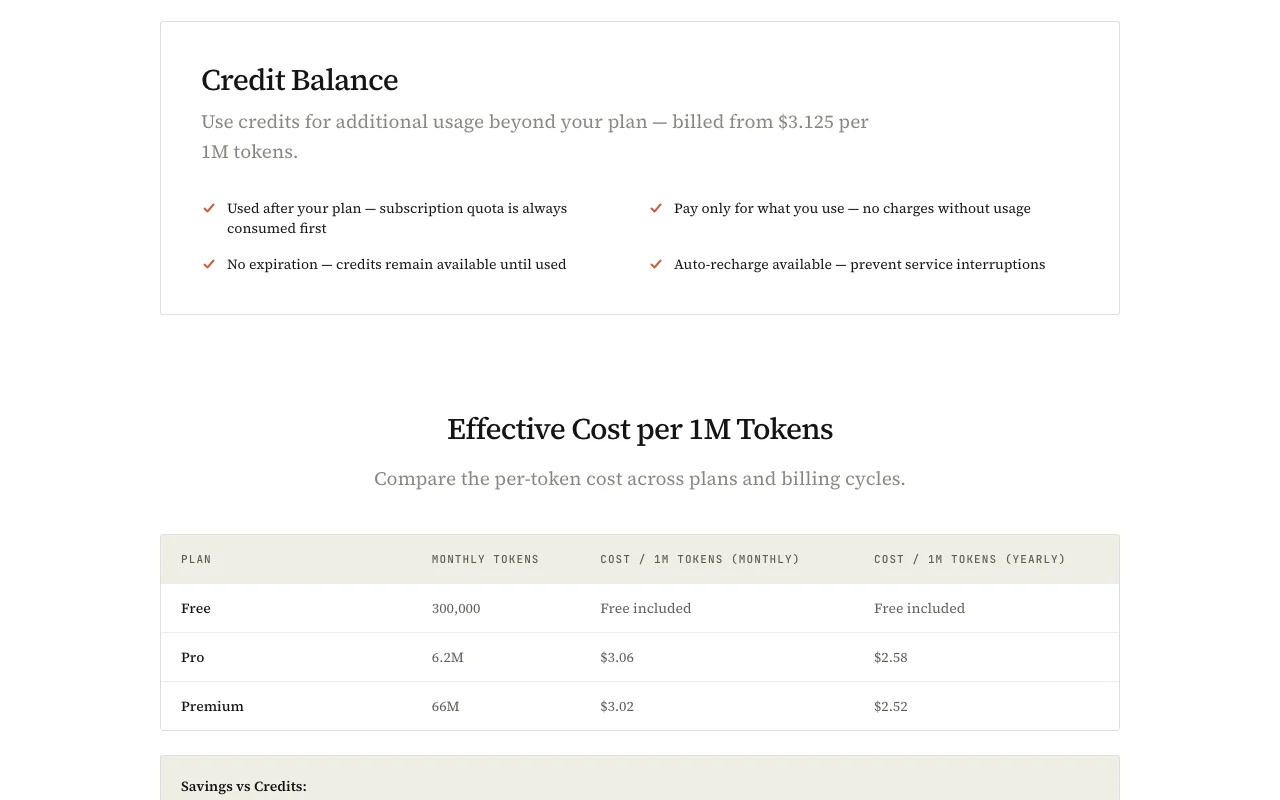
Yearly billing saves about 17%; $2.58 per 1M tokens

For: Regular individual or small team use

Limits

  • 6,200,000 tokens per month
  • About 826 pages or 24,800 retrieval calls

Includes

  • Effective $3.06 per 1M tokens monthly
  • Credit balance for extras

API included

Premium web

$199/mo source (opens in a new tab)

Month

Yearly billing saves about 19%

For: Heavy and team-scale workloads

Limits

  • 66,000,000 tokens per month
  • About 8,800 pages or 264,000 retrieval calls

Includes

  • Effective $3.02 per 1M tokens monthly
  • Credit balance for extras

API included

Credit balance web

$3.13 per 1M tokens source (opens in a new tab)

One-time

For: Overflow usage

Limits

  • Used after plan quota
  • Credits never expire

Includes

  • Auto-recharge available

API included

Usage caps, credits and extra costs

Extra usage from $3.125 per 1M tokens; per-operation prices such as $0.0225 per PDF page.

Not stated.

What is MemoryLake, and how does it work?

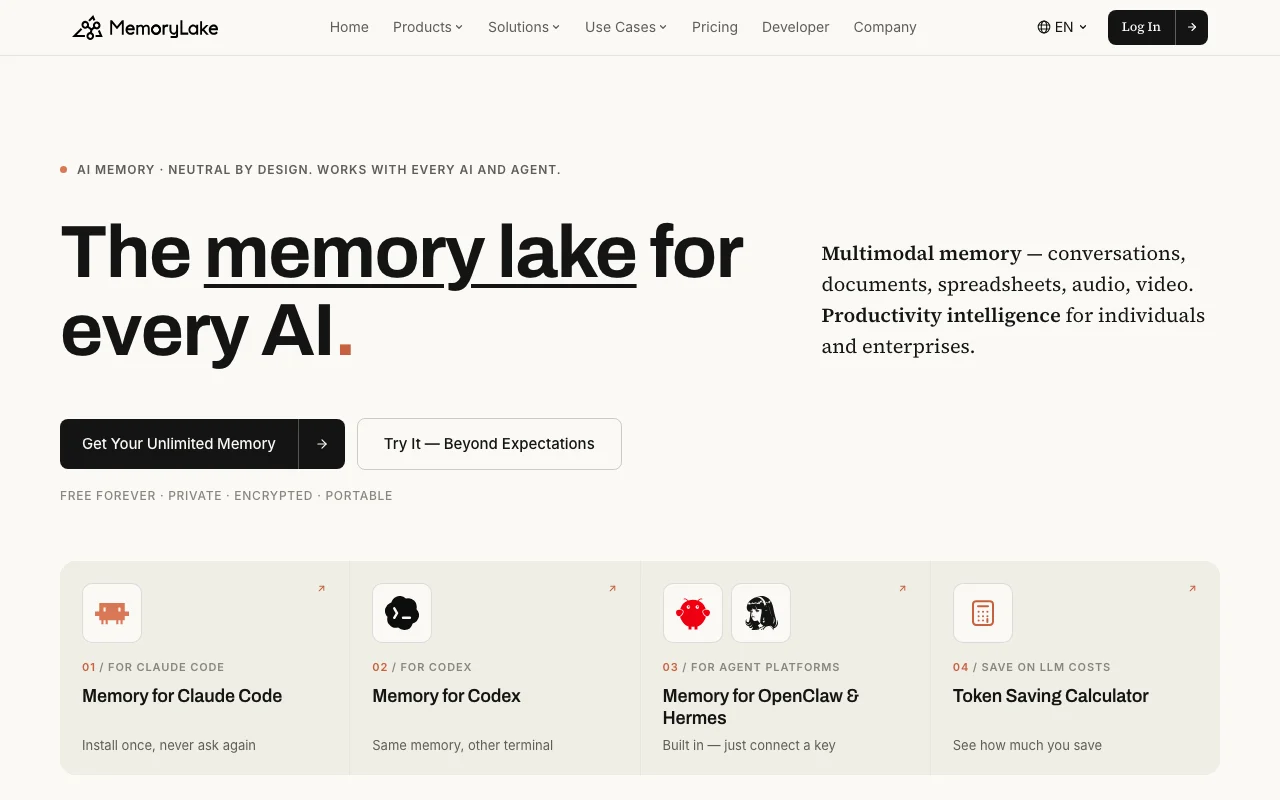
MemoryLake is a memory service that keeps typed, versioned memories from conversations, documents, spreadsheets, audio and video so different AI tools can reuse them. It offers integrations for Claude Code, Codex, OpenClaw, Hermes and a native MCP server. The pricing page lists a Free plan, Pro and Premium subscriptions, and pay-as-you-go credits metered by tokens.

MemoryLake homepage — screenshot of the productivity & writing AI tool, Oct 1, 2026
MemoryLake's official site: how the product presents itself. memorylake.ai, captured Oct 1, 2026

What you provide and what you get back

How MemoryLake works: what you provide, where it runs and what you get backYOU PROVIDEYour inputDocuments, spreadsheets, images,…Conversations from Claude, ChatGP…Text memory inputPRODUCTIVITY & WRITINGMemoryLakeWeb, APIfrom $19/mo (Pro)free tier availableaccount requiredchecked Sep 29, 2026YOU GET BACKThe resultRetrieved memories for any connec…Typed, versioned memory recordsWeb search resultsinput → MemoryLake → output · from the vendor's own pages, no hands-on test unless stated
What you give MemoryLake and what comes back, from its documentation

You provide

  • Documents, spreadsheets, images, audio and video
  • Conversations from Claude, ChatGPT and agents
  • Text memory input

You get back

  • Retrieved memories for any connected AI
  • Typed, versioned memory records
  • Web search results

Where you can use it

Platforms
Web, API
Account
Required
Memory types
Background, fact, event, dialogue, reflection, skill
Inputs
Docs, sheets, images, audio, video
Retrieval price
$0.00075 per call
Web search
$0.015 per search
Integrations
Claude Code, Codex, OpenClaw, Hermes

Best use cases for MemoryLake

Scenarios are worked out by our editors from the documentation; the actual result depends on your input and plan.

Give Claude Code persistent memory

Who
Developers using Claude Code or Codex
You provide
Project context stored through the MCP server
Expected result
Assistants recall past decisions in new sessions
Plan needed
Free or Pro
Limitation
Writes such as page processing consume tokens source (opens in a new tab)

Share context across several AI assistants

Who
People switching between ChatGPT, Claude and Gemini
You provide
Chats and preferences
Expected result
One shared memory across assistants
Plan needed
Pro
Limitation
Needs each assistant connected via MCP or API source (opens in a new tab)

Store and query documents and spreadsheets

Who
Analysts with many files
You provide
PDFs, Excel and CSV files
Expected result
Queryable memory over documents and spreadsheets
Plan needed
Pro or Premium
Limitation
Each worksheet costs $0.135 source (opens in a new tab)

MemoryLake features and their limits

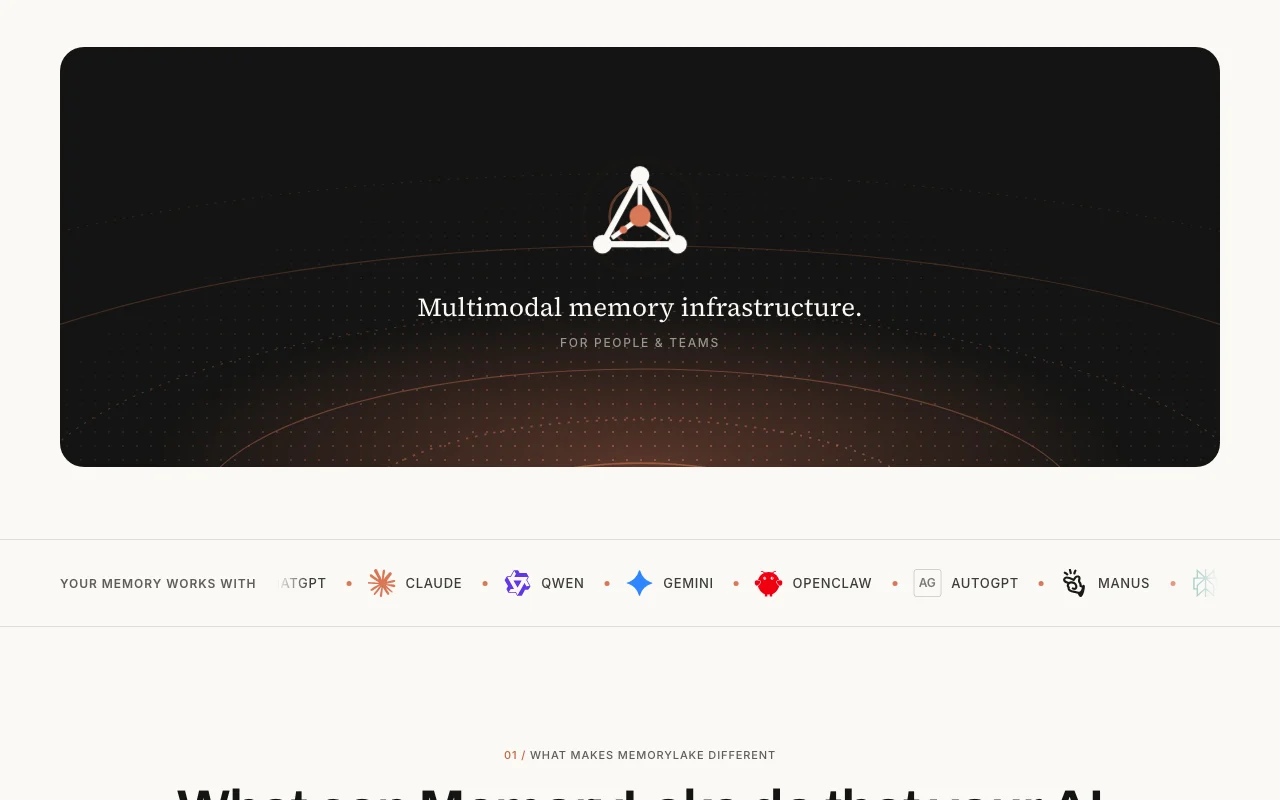
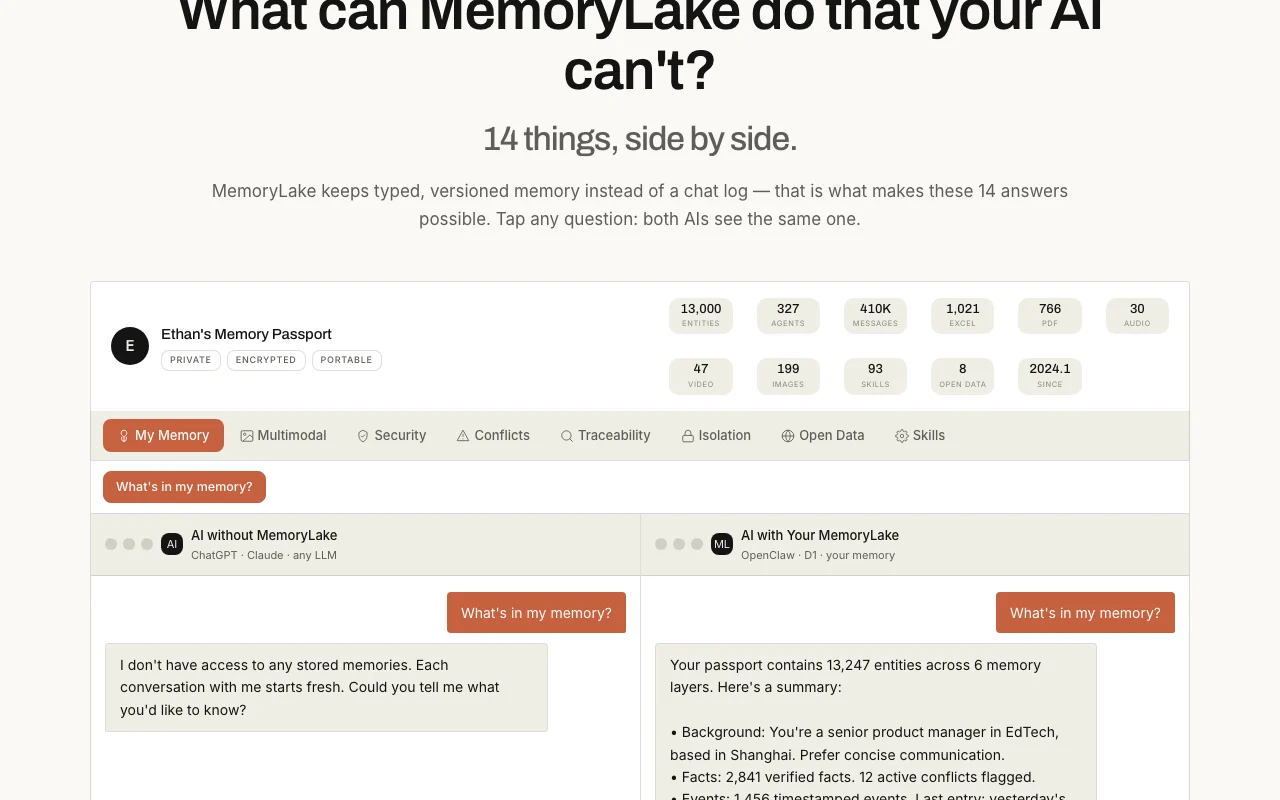
MemoryLake homepage — screenshot of the productivity & writing AI tool, Oct 1, 2026
Feature overview on the official site. memorylake.ai, captured Oct 1, 2026

Six typed memory categories

Stores background, fact, event, dialogue, reflection and skill memories separately Retrieval targets the right kind of memory

Access: All plansLimit: Memory quality depends on inputs source (opens in a new tab)

Multimodal input

Takes in text, documents, spreadsheets, images, audio and video Single store for mixed material

Access: All plans, metered by tokenLimit: Processing priced per page or sheet source (opens in a new tab)

Native MCP server

Provides a native MCP server Connects Claude Code, Codex, OpenClaw and Hermes

Access: All plansLimit: Client setup required source (opens in a new tab)

Integrations for Claude Code, Codex, OpenClaw, Hermes

Checks facts for conflicts and versions them Keeps traceable sources

Access: Described on homepageLimit: Conflict handling not detailed on pricing page source (opens in a new tab)

Pros, cons and deal-breakers

Where MemoryLake is strong

Limitations to check before paying

How to use MemoryLake for giving Claude Code a persistent memory

Set up MemoryLake

  1. Create a free MemoryLake account
  2. Open the MCP integration page for your client
  3. Add the MemoryLake MCP server to Claude Code or Codex using your key
  4. Upload a few project documents as memory writes

Example: giving Claude Code a persistent memory

  1. Ask the assistant to remember your coding conventions
  2. Start a new session and ask what conventions you use
  3. Upload a spec PDF
  4. Ask a question that needs that PDF

Review and export the result

  1. Confirm the recalled fact matches the stored one
  2. Check token use in the dashboard against 300,000
Example prompt suggested by our editors (not a recorded output of the product)
Remember that this project uses pnpm, strict TypeScript and Vitest, and recall that in later sessions.

MemoryLake API

MemoryLake pricing page with plans and prices — screenshot of the productivity & writing AI tool, Oct 1, 2026
Plan comparison on the official pricing page. memorylake.ai, captured Oct 1, 2026

API access and separate billing

MemoryLake has no public API in its official documentation. Native MCP server and API. API documentation ↗

Privacy, data use and commercial rights

Summarized from the vendor's current policies; this is not legal advice and a vendor's badge is not an independent audit.

How your inputs and outputs are handled

Documents and conversations are stored as private memory.

Controls for business users

  • Described as private, encrypted and portable

MemoryLake alternatives by need

"Better suited" is based on documented features and pricing, not on a head-to-head test.

Claude: better suited to

ChatGPT: better suited to

Gemini Notebook (formerly NotebookLM): better suited to

Cursor: better suited to

Alternatives
AlternativeWhen to choose itPricingLimitation
Claude——
ChatGPT——
Gemini Notebook (formerly NotebookLM)——
Cursor——

Explore MemoryLake further

Related to MemoryLake

MemoryLake user reviews

No user reviews yet.

Used MemoryLake? Be the first to share your experience.

Write a review

Reviews are checked by a moderator before they appear. Your email is never published. Plain text only.

Your rating (required)

Show what you made or what went wrong. Images are published only if the review is approved; location data is removed.

    MemoryLake FAQ

    How much does MemoryLake cost?

    Free is $0 for 300,000 tokens per month, Pro $19 for 6.2M tokens and Premium $199 for 66M tokens; yearly billing saves about 17%. source (opens in a new tab)

    What do credits cost?

    Credit balance is billed from $3.125 per 1M tokens, never expires and is used after your plan quota. source (opens in a new tab)

    How much does processing a PDF cost?

    $0.0225 per page; images are the same, Excel worksheets and CSV files $0.135 each. source (opens in a new tab)

    What counts as a query?

    Retrieval calls cost $0.00075 each; file and text processing are memory writes, not queries. source (opens in a new tab)

    Which assistants can use MemoryLake?

    The site lists Claude, ChatGPT, Qwen, Gemini, OpenClaw, Perplexity and any API, with Claude Code and Codex integrations. source (opens in a new tab)

    Sources and review methodology

    Official sources and verification dates

    Not verified: privacy and retention terms; team seats; data location.

    How we documented and maintain this page

    Every fact about MemoryLake above comes from the 3 official pages listed here, last compared on Sep 29, 2026; we have not run MemoryLake ourselves, so it has no editorial score. How we check and re-check pages.

    Article updated Oct 10, 2026; prices checked Sep 29, 2026. Outbound links to vendors are plain links; we do not earn commissions. How we review · Report an error