Free Web
Free source (opens in a new tab)
Month, annual commitment
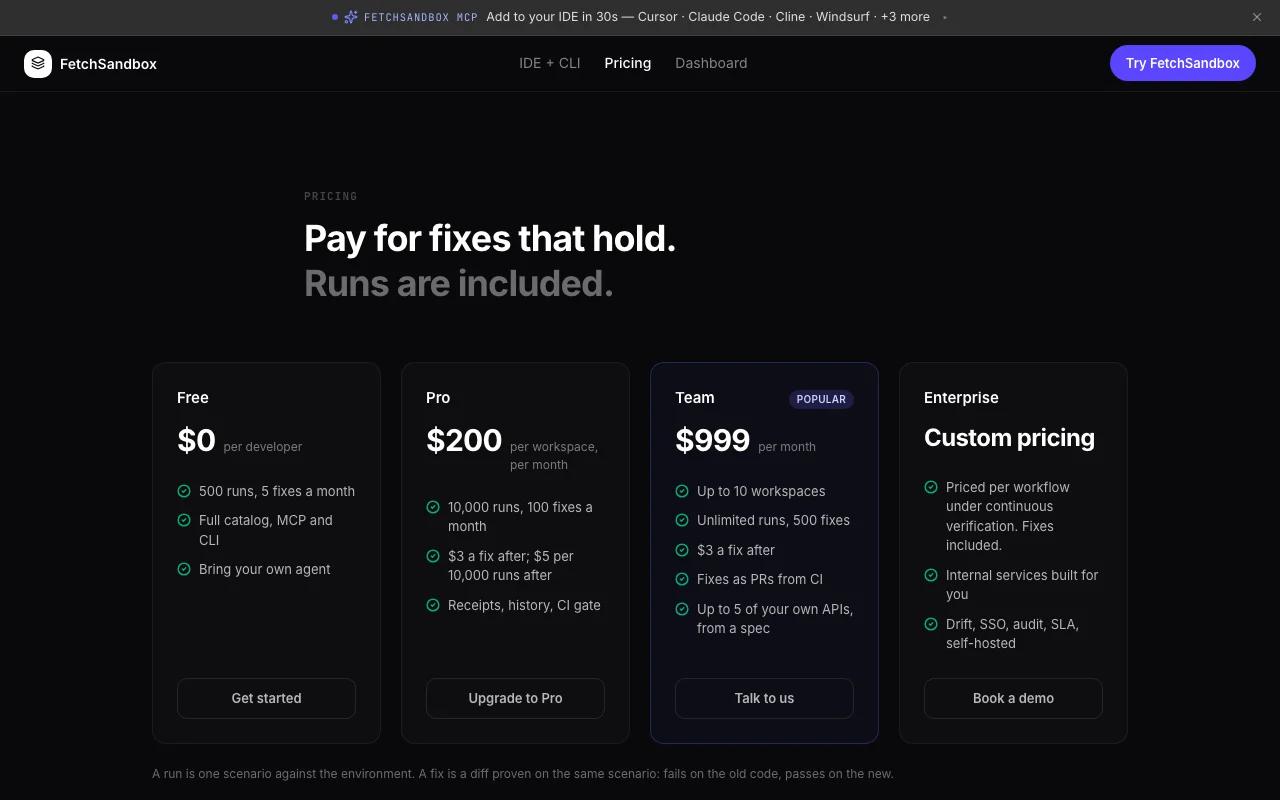
For: Checking whether an integration works
Limits
- 500 runs per month
- 5 fixes per month
Includes
- Full API catalog
- MCP server and CLI
1 more
- Bring your own agent
CodingDocumented overviewLast checked Oct 1, 2026
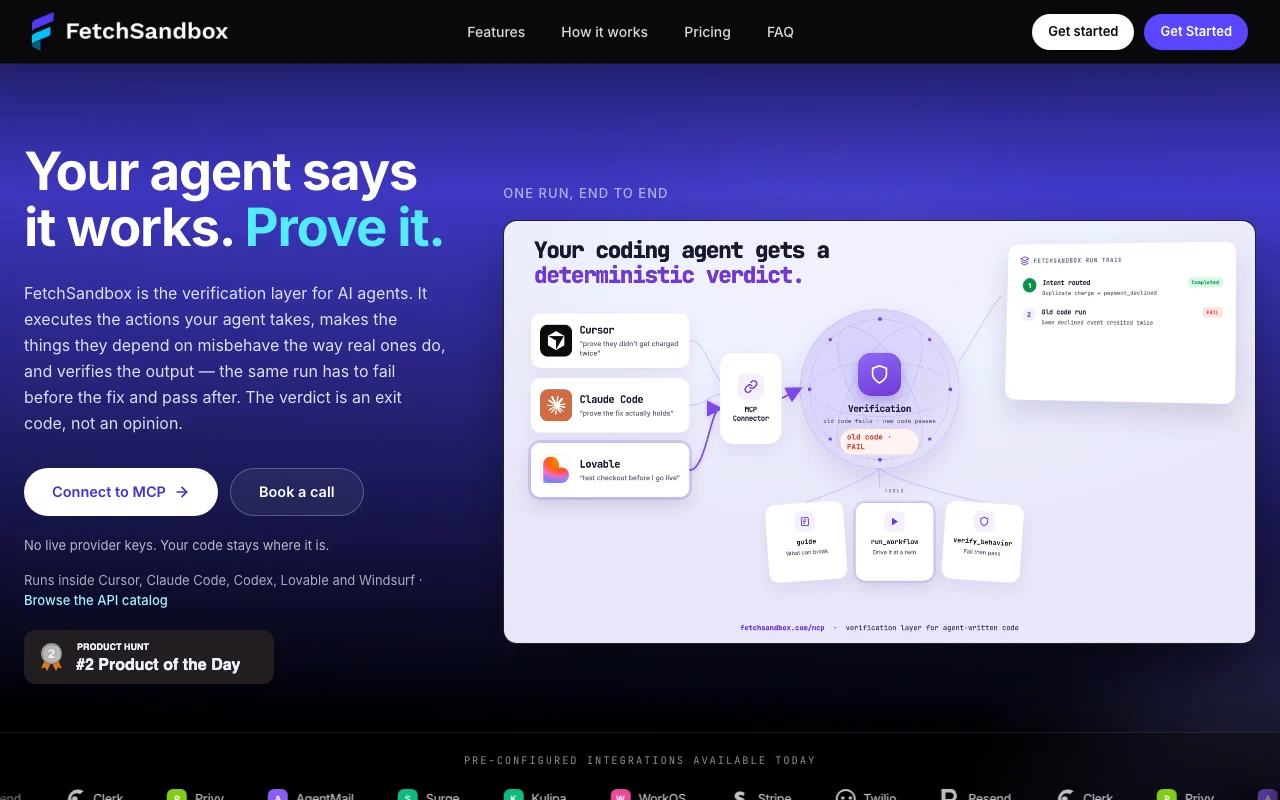
Verification engine for AI coding agents: runs API integration scenarios in sandboxes that simulate webhooks, retries and failures, via MCP and CLI.
 (open full size in a new tab)
 (open full size in a new tab)
 (open full size in a new tab)
 (open full size in a new tab)
 (open full size in a new tab)
Our take: FetchSandbox fits developers who let AI coding agents write API integrations and want each fix proven on a deterministic sandbox scenario, with a free tier of 500 runs and 5 fixes per month.
Main limitation: Free is capped at 5 fixes a month, Pro costs $200 per workspace, and self-hosting plus SSO are Enterprise-only.
FetchSandbox fits developers who let AI coding agents write API integrations and want each fix proven on a deterministic sandbox scenario, with a free tier of 500 runs and 5 fixes per month. Based on the vendor's documentation, not on a hands-on test.
Also a good fit for
Or if
Prices checked Oct 1, 2026 on the official US pricing page. Official pricing ↗ Prices and limits change often.
Free plan, no card required
No separate trial; free tier is permanent
Free source (opens in a new tab)
Month, annual commitment
For: Checking whether an integration works
Limits
Includes
$200/mo per workspace per month source (opens in a new tab)
Month, annual commitment
For: Teams shipping agent-built integrations
Limits
Includes
$999/mo source (opens in a new tab)
Month, annual commitment
For: Larger organizations verifying many workflows
Limits
Includes
Custom pricing source (opens in a new tab)
Unknown, annual commitment
For: Companies with compliance and on-prem needs
Includes
Pro overages: $3 per fix and $5 per 10,000 runs; Team $3 per fix after 500
Not stated
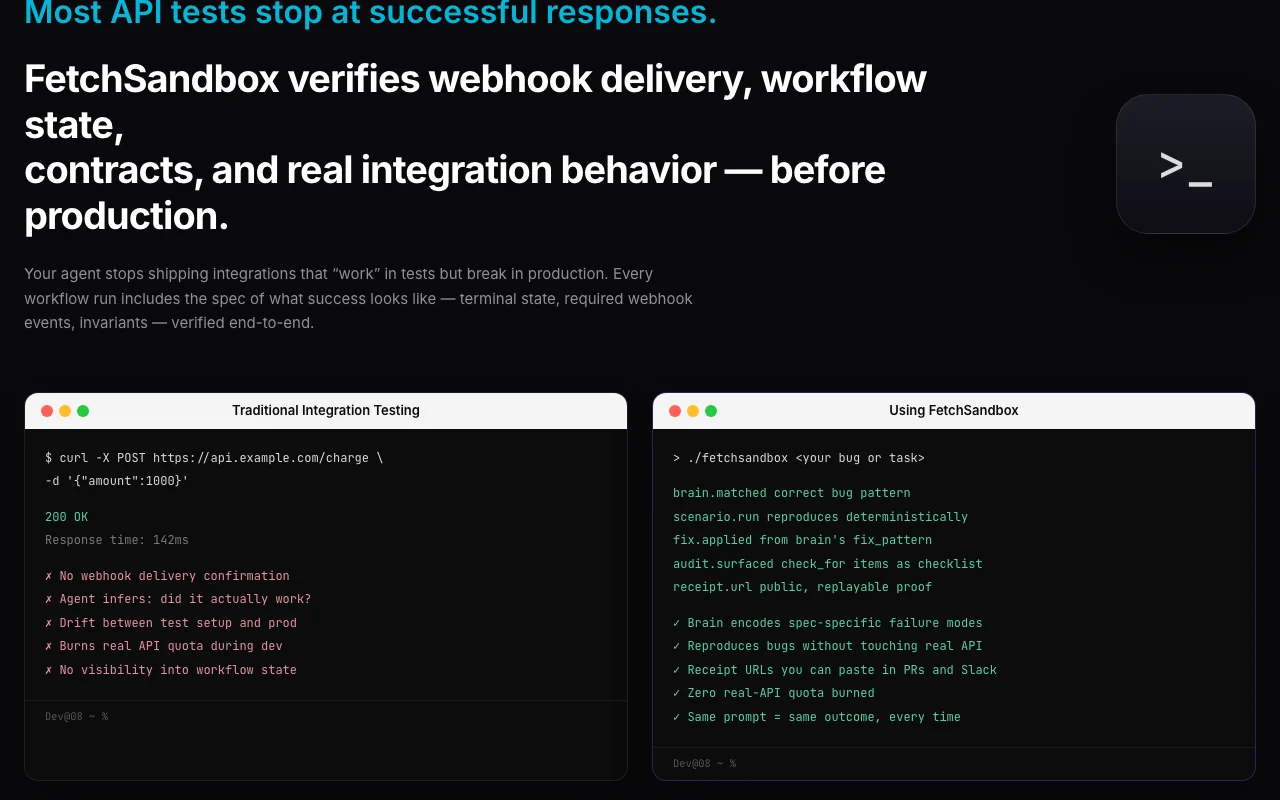
FetchSandbox lets coding agents (Cursor, Claude Code, Codex, Lovable, Windsurf) test integrations against sandboxed versions of third-party APIs without real keys or charges. A run executes a full scenario — for example a Stripe payment flow with state carried between steps and the resulting webhooks — and can deliberately duplicate webhooks, deliver events out of order or fire stale events to reproduce production-style bugs. A 'fix' is a diff verified on the same scenario, failing before and passing after, with a shareable receipt URL. The MCP server and CLI are open source (MIT); the hosted engine, workflows and webhook simulation are the paid service. Pre-configured integrations include Stripe, Twilio, Resend, Clerk, Privy, AgentMail, Surge, Kulipa and WorkOS.
You provide
You get back
Scenarios are worked out by our editors from the documentation; the actual result depends on your input and plan.
Runs an MCP server and CLI that plug into Cursor, Claude Code, Codex, Lovable and Windsurf Lets the agent test without leaving the editor
Simulates stateful third-party APIs that fire webhooks like the real ones Avoids real keys, charges and production data
Injects duplicate, out-of-order and stale webhook events Reproduces hard production bugs on demand
Verifies a fix as failing before and passing after and issues a replayable receipt URL Gives reviewers proof, not claims
Run the Stripe accept_payment scenario with duplicate webhooks against my invoice.paid handler, fix any bug you find, and give me the receipt URL.
Export: Receipt URLs
FetchSandbox has no public API in its official documentation. MCP and CLI (MIT) are public; docs root returned 404
Summarized from the vendor's current policies; this is not legal advice and a vendor's badge is not an independent audit.
Account email, MCP usage events and working copies of code during jobs
Policy states no model is trained on your code
Working copies deleted when the job finishes; account data kept until deletion requested; run history retained while account active
unknown
unknown
Policies: fetchsandbox.com/privacy
"Better suited" is based on documented features and pricing, not on a head-to-head test.
| Alternative | When to choose it | Pricing | Limitation | |
|---|---|---|---|---|
| Cursor | — | — | Compare | |
| GitHub Copilot | — | — | Compare | |
| Devin Desktop (formerly Windsurf) | — | — | Compare | |
| Lovable | — | — | Compare |
No user reviews yet.
Used FetchSandbox? Be the first to share your experience.
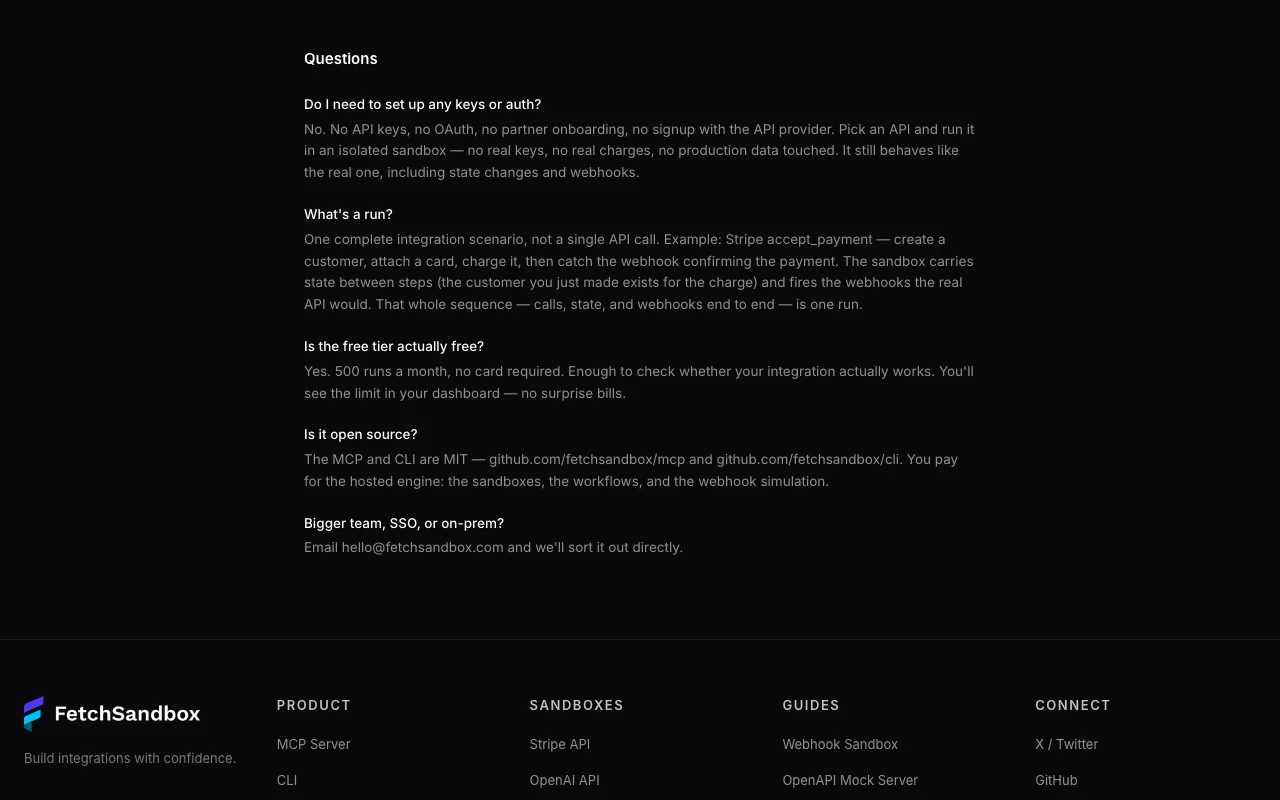
Yes, the Free plan gives 500 runs and 5 fixes per month for each developer with no card required. source (opens in a new tab)
A run is one complete scenario against the sandbox, such as a Stripe payment flow with webhooks; a fix is a diff proven to fail on the old code and pass on the new. source (opens in a new tab)
No, sandboxed APIs need no real keys, OAuth or partner onboarding and touch no production data. source (opens in a new tab)
The MCP server and CLI are MIT-licensed; the hosted engine with sandboxes and webhook simulation is paid. source (opens in a new tab)
The privacy policy says no model is trained on your code and working copies are deleted when a job finishes. source (opens in a new tab)
Not verified: API docs (docs root 404); Commercial-use terms.
Every fact about FetchSandbox above comes from the 2 official pages listed here, last compared on Oct 1, 2026; we have not run FetchSandbox ourselves, so it has no editorial score. How we check and re-check pages.
Article updated Oct 10, 2026; prices checked Oct 1, 2026. Outbound links to vendors are plain links; we do not earn commissions. How we review · Report an error
compare>