CodingDocumented overviewLast checked Oct 1, 2026

OktoLabs (Okto Pulse, Nexus, Neuron): Pricing, Features & Best Use Cases

Open-source toolset for governing software delivery with AI coding agents: specs and tasks, agent coordination, cited team memory.


Who should use OktoLabs (Okto Pulse, Nexus, Neuron)

Choose OktoLabs if you run several AI coding agents and want local open-source tools that tie specs, tasks, agent handoffs and cited team memory together. Based on the vendor's documentation, not on a hands-on test.

Best for: Engineering teams building with multiple AI coding agents

Also a good fit for

  • Developers wanting traceable specs and evidence for agent work
  • Teams that need shared, cited project memory for agents

Consider another tool if requires local installation (pip / Docker) and Python tooling

Or if

  • No hosted or web version offered
  • Early-stage software (Pulse at v0.2.6)

OktoLabs (Okto Pulse, Nexus, Neuron) pricing and usage limits

Prices checked Oct 1, 2026 on the official US pricing page. Prices and limits change often.

Vendor pricing page re-checked automatically 11 days ago: no changes detected.

Free access and trial conditions

Site states the products are free to run locally and open source; no account required.

Paid plans: what changes as you upgrade

Open source, local install web

Free source (opens in a new tab)

Unknown

For: Teams that can self-host

Limits

  • No hosted version
  • No support plans published

Includes

  • Okto Pulse, Nexus, Neuron
  • Local MCP endpoint
1 more
  • REST API and CLI

API included

Usage caps, credits and extra costs

Your own agents and their model subscriptions.

What is OktoLabs (Okto Pulse, Nexus, Neuron), and how does it work?

OktoLabs is a product lab that builds locally installed, open-source tools for teams shipping software with AI coding agents. Okto Pulse turns product intent into specifications, agent-ready tasks and validation evidence and exposes a local MCP endpoint plus a REST API. Okto Nexus coordinates multiple agents (Claude, Codex, Cursor, custom) through shared messages, handoffs and approvals, and Okto Neuron builds a cited knowledge graph from a team's Markdown notes. All three products are installed via pip or an install script and run locally without an account. Documentation covers install (including Docker), MCP setup for Claude Code, Cursor and Cline, a permission model and a REST route catalog. No paid plans or pricing page were found on the site.

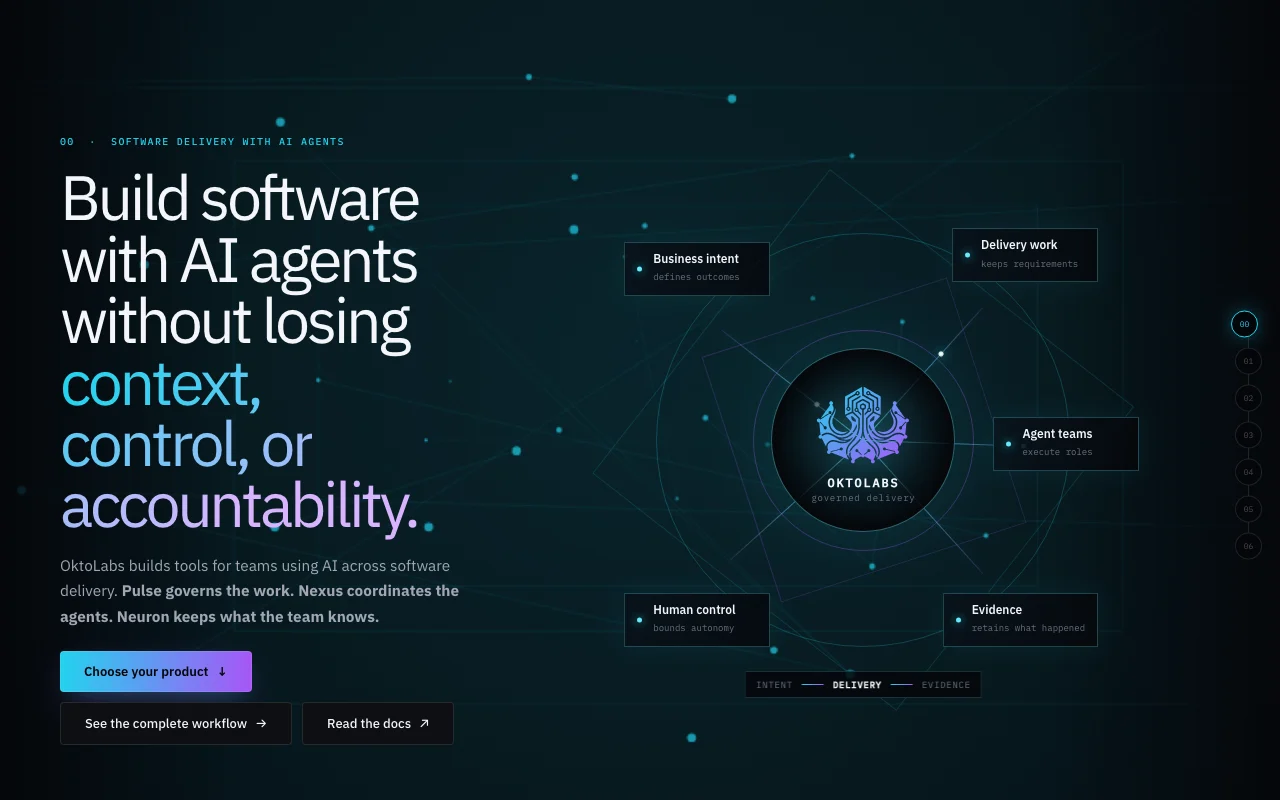
OktoLabs (Okto Pulse, Nexus, Neuron) homepage — screenshot of the coding AI tool, Oct 1, 2026
OktoLabs (Okto Pulse, Nexus, Neuron)'s official site: how the product presents itself. oktolabs.ai, captured Oct 1, 2026

What you provide and what you get back

How OktoLabs (Okto Pulse, Nexus, Neuron) works: what you provide, where it runs and what you get backYOU PROVIDEYour inputFeature requests and product inte…Markdown notesAgent messages via MCPCODINGOktoLabs (Okto Pulse, Nexus,…Desktop, APIfree tier, paid price not publish…free tier availableaccount requiredchecked Oct 1, 2026YOU GET BACKThe resultSpecs and acceptance criteriaAgent-ready task cardsCited knowledge-graph answersinput → OktoLabs (Okto Pulse, Nexus, Neuron) → output · from the vendor's own pages, no hands-on test unless stated
What you give OktoLabs (Okto Pulse, Nexus, Neuron) and what comes back, from its documentation

You provide

  • Feature requests and product intent
  • Markdown notes
  • Agent messages via MCP

You get back

  • Specs and acceptance criteria
  • Agent-ready task cards
  • Cited knowledge-graph answers

Where you can use it

Platforms
Desktop, API
Account
Required
Install
pip, install script or Docker
Interfaces
MCP, REST, CLI
Hosting
Local only
Pulse version
v0.2.6

What people use OktoLabs (Okto Pulse, Nexus, Neuron) for

Scenarios are worked out by our editors from the documentation; the actual result depends on your input and plan.

Turning feature requests into specs, acceptance criteria and agent-ready tasks

Who
Product managers and tech leads
You provide
Feature requests
Expected result
Specs, acceptance criteria and agent-ready tasks linked to the request
Plan needed
Free, local
Limitation
Python tooling required source (opens in a new tab)

Coordinating several coding agents with explicit handoffs and ownership

Who
Teams running Claude, Codex and Cursor together
You provide
Several agents on one project
Expected result
Explicit claims, handoffs and approvals with durable history
Plan needed
Free, local
Limitation
Coordination only covers MCP-capable agents source (opens in a new tab)

Keeping architecture decisions queryable across agent sessions

Who
Teams keeping architecture decisions
You provide
Markdown notes and ADRs
Expected result
Cited answers any agent can query across sessions
Plan needed
Free, local
Limitation
Quality depends on the notes written source (opens in a new tab)

Key features and their practical limits

OktoLabs (Okto Pulse, Nexus, Neuron) homepage — screenshot of the coding AI tool, Oct 1, 2026
Feature overview on the official site. oktolabs.ai, captured Oct 1, 2026

Spec-driven and test-driven workflow (ideation → refinement → spec → sprint → cards)

Moves work from ideation to refinement, spec, sprint and cards, with tests and validation evidence attached. Keeps requirements traceable to code.

Access: Free, localLimit: Early-stage at v0.2.6. source (opens in a new tab)

Local MCP endpoint for Claude Code, Cursor, Cline and other MCP agents

Runs a local MCP endpoint that Claude Code, Cursor, Cline and other MCP agents connect to. Lets existing agents use Pulse without plug-ins.

Access: Free, localLimit: Needs local server running. source (opens in a new tab)

REST API and CLI documented in the docs site

Exposes a documented REST API and CLI. Allows scripting and CI use.

Access: Free, localLimit: Docs site only; no hosted API. source (opens in a new tab)

Agent coordination bus with claims, handoffs and approvals (Nexus)

Okto Nexus passes messages, claims, handoffs and approvals between agents. Stops duplicated or abandoned work.

Access: Free, localLimit: Agents must be connected to it. source (opens in a new tab)

OktoLabs (Okto Pulse, Nexus, Neuron): strengths and limits

Where OktoLabs (Okto Pulse, Nexus, Neuron) is strong

Limitations to check before paying

How to use OktoLabs (Okto Pulse, Nexus, Neuron) for governing AI-agent software delivery

Set up OktoLabs (Okto Pulse, Nexus, Neuron)

  1. Install Okto Pulse with pip or the Docker install from the docs.
  2. Start the local server.
  3. Connect your MCP agent (for example Claude Code) to the local endpoint.
  4. Create a project.

Example: governing AI-agent software delivery

  1. Enter a feature request as an ideation.
  2. Refine it into a specification with acceptance criteria.
  3. Generate sprint task cards.
  4. Let an agent pick up a card and attach evidence.

Review and export the result

  1. Confirm each card links back to its spec.
  2. Review attached test evidence before closing.
Example prompt suggested by our editors (not a recorded output of the product)
Turn this feature request into a spec with acceptance criteria and split it into agent-ready tasks.

OktoLabs (Okto Pulse, Nexus, Neuron) API

API access and separate billing

OktoLabs (Okto Pulse, Nexus, Neuron) has no public API in its official documentation. REST API and CLI documented. API documentation ↗

Privacy, data use and commercial rights

Summarized from the vendor's current policies; this is not legal advice and a vendor's badge is not an independent audit.

How your inputs and outputs are handled

Runs locally; data stays on your machine according to the site.

OktoLabs (Okto Pulse, Nexus, Neuron) alternatives by need

"Better suited" is based on documented features and pricing, not on a head-to-head test.

Cursor: better suited to

GitHub Copilot: better suited to

Devin Desktop (formerly Windsurf): better suited to

Claude: better suited to

Alternatives
AlternativeWhen to choose itPricingLimitation
Cursor——Compare
GitHub Copilot——Compare
Devin Desktop (formerly Windsurf)——Compare
Claude——

Explore OktoLabs (Okto Pulse, Nexus, Neuron) further

If you are looking at OktoLabs (Okto Pulse, Nexus, Neuron)

OktoLabs (Okto Pulse, Nexus, Neuron) user reviews

No user reviews yet.

Used OktoLabs (Okto Pulse, Nexus, Neuron)? Be the first to share your experience.

Write a review

Reviews are checked by a moderator before they appear. Your email is never published. Plain text only.

Your rating (required)

Show what you made or what went wrong. Images are published only if the review is approved; location data is removed.

    OktoLabs (Okto Pulse, Nexus, Neuron) FAQ

    Do I need an account?

    No. The tools install via pip or script and run locally without one. source (opens in a new tab)

    What do Pulse, Nexus and Neuron each do?

    Pulse structures work into specs and tasks, Nexus coordinates agents, and Neuron builds cited memory from Markdown notes. source (opens in a new tab)

    Which agents can connect?

    Claude Code, Cursor, Cline, Codex and other agents that support MCP. source (opens in a new tab)

    What is Okto Grafx?

    An embedded local-first graph database for Python that Pulse and Neuron use underneath. source (opens in a new tab)

    Sources and review methodology

    Official sources and verification dates

    Not verified: license text; privacy policy; pricing for hosted use.

    How we documented and maintain this page

    Every fact about OktoLabs (Okto Pulse, Nexus, Neuron) above comes from the 3 official pages listed here, last compared on Oct 1, 2026; we have not run OktoLabs (Okto Pulse, Nexus, Neuron) ourselves, so it has no editorial score. How we check and re-check pages.

    Article updated Oct 10, 2026; prices checked Oct 1, 2026. Outbound links to vendors are plain links; we do not earn commissions. How we review · Report an error