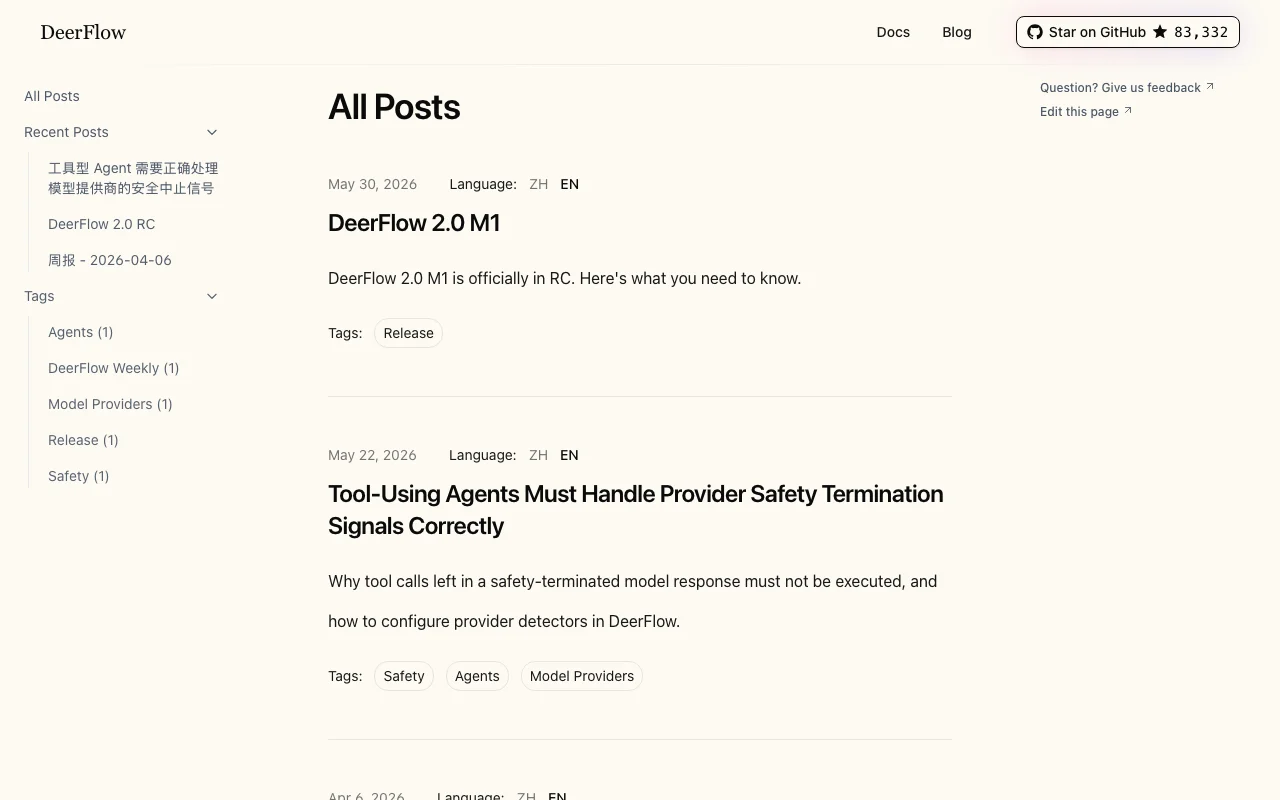
Our take: DeerFlow is for developers comfortable self-hosting an open-source agent harness for research and automation, not for users wanting a hosted service.
Main limitation: DeerFlow must be self-deployed with technical setup, and no hosted offer or hosted pricing was found.
By the AI Tool Atlas editors.
Based on the vendor's official documentation; we have not tested this product hands-on. What “documented overview” means
Is DeerFlow right for you?
DeerFlow is for developers comfortable self-hosting an open-source agent harness for research and automation, not for users wanting a hosted service. Based on the vendor's documentation, not on a hands-on test.
Best for: Agent developers
Also a good fit for
Research teams self-hosting
Consider another tool if must be self-deployed per docs
Or if
Requires technical setup
No hosted pricing seen
DeerFlow pricing and usage limits
Prices checked Oct 2, 2026 on the official US pricing page. Prices and limits change often.
DeerFlow is an open-source framework (code on GitHub under bytedance/deer-flow) for building and running agent systems that research, code and create, handling tasks lasting minutes to hours.
Docs describe two parts: a Harness SDK/runtime and a reference App for deployment and end-user workflows.
What you provide and what you get back
What you give DeerFlow and what comes back, from its documentation
You provide
Research tasks and prompts
Model provider keys
You get back
Research reports
Agent outputs and data visualizations
Where you can use it
Platforms
macos, linux
Account
Required
Platforms
macOS, Linux
Architecture
Sandboxes, memory, skills, subagents
Interface
Local web frontend
Best use cases for DeerFlow
Scenarios are worked out by our editors from the documentation; the actual result depends on your input and plan.
Deep research reports
Who
Researchers
You provide
A topic and sources
Expected result
You get a researched report produced by agents working on your topic and sources.
Plan needed
Free, open source
Limitation
Setup and model keys are needed before the harness can run, and costs for the model are yours. source (opens in a new tab)
Build custom agent systems
Who
Developers
You provide
Skills, tools and subagents
Expected result
You get a custom agent system built from your own skills, tools and subagents.
Plan needed
Free, open source
Limitation
You maintain the deployment yourself, including updates and the environment it runs in. source (opens in a new tab)
Data analysis with visualizations
Who
Analysts
You provide
A dataset
Expected result
You get an analysis of your dataset that includes visualizations and written insights.
Runs agent work inside sandboxes. Developers who want agent code to run apart from their main system benefit from having that work isolated.
Access: Self-hosted (open source)Limit: You manage the sandbox yourself, since the harness is self-hosted.source (opens in a new tab)
Long-term memory
Keeps memory that persists across sessions. Teams running long tasks benefit because the agent can keep context between sessions.
Access: Self-hosted (open source)Limit: Storage for the memory is yours to manage, since the harness is self-hosted.source (opens in a new tab)
Tools and skills
Supports tools and skills the agent can call. Developers can extend what an agent is able to do by adding tools and skills it can call.
Access: Self-hosted (open source)Limit: The skill catalog is not itemized in the sources we read.source (opens in a new tab)
Subagents
Delegates parts of a task to subagents. People running long tasks benefit because parts of a job can be handed to separate subagents.
Access: Self-hosted (open source)Limit: Results depend on the model you choose to use with it.source (opens in a new tab)
DeerFlow: strengths and limits
Where DeerFlow is strong
Open source Because the code is open source, you can inspect how the agent harness works before running it on your own systems.documentedsource (opens in a new tab)
Documentation with tutorials Documentation with tutorials exists, so developers have written guidance to follow when they set the harness up.documentedsource (opens in a new tab)
Model provider reference A model provider reference is available, which helps you work out how to configure the model that the agents will use.documentedsource (opens in a new tab)
Case studies shown Case studies are shown on the site, so you can see the kinds of tasks the harness is meant to handle before you try it.documentedsource (opens in a new tab)
Limitations to check before paying
Must be self-deployed per docs You have to deploy DeerFlow yourself, so you are responsible for running and maintaining the environment it works in.documentedsource (opens in a new tab)
Requires technical setup The setup is technical, so people without development experience may not be able to get it running without help.documentedsource (opens in a new tab)
No hosted pricing seen No hosted pricing was found, so there is no ready-made paid service to use if you do not want to host it.documentedsource (opens in a new tab)
Platform support not itemized Platform support is not itemized in the sources we read, so check that your system works before you plan around it.documentedsource (opens in a new tab)
How to use DeerFlow for running a research agent locally
Set up DeerFlow
Open the Quick Start page.
Install on macOS (brew) or Linux.
Configure a model provider.
Example: running a research agent locally
Start the local web frontend.
Enter a research question.
Review the generated report.
Review and export the result
Check that cited sources exist.
Confirm sandbox runs completed.
Example prompt suggested by our editors (not a recorded output of the product)
Write a report on solid-state battery progress with sources.
Privacy, data use and commercial rights
Summarized from the vendor's current policies; this is not legal advice and a vendor's badge is not an independent audit.
How your inputs and outputs are handled
Runs locally; data goes to the model provider you configure
Not verified: License; Hosted offer; Windows support.
How we documented and maintain this page
Every fact about DeerFlow above comes from the 3 official pages listed here, last compared on Oct 2, 2026; we have not run DeerFlow ourselves, so it has no editorial score. How we check and re-check pages.
Article updated Oct 10, 2026; prices checked Oct 2, 2026. Outbound links to vendors are plain links; we do not earn commissions. How we review · Report an error