Our take: CartAI is meant for developers building shopping agents or embedded checkout who need an API that completes real merchant checkouts, subscriptions and invoice payments on live web surfaces.
Main limitation: No pricing is published (the pricing and docs URLs returned 404 on fetch), so cost and limits cannot be assessed before contacting the vendor or getting an API key.
By the AI Tool Atlas editors.
Based on the vendor's official documentation; we have not tested this product hands-on. What “documented overview” means
Who should use CartAI
CartAI is meant for developers building shopping agents or embedded checkout who need an API that completes real merchant checkouts, subscriptions and invoice payments on live web surfaces. Based on the vendor's documentation, not on a hands-on test.
Best for: Developers building commerce agents
Also a good fit for
Publishers and affiliates
Consider another tool if requires an API key and account
Or if
No pricing page found (/pricing 404)
Docs list known limitations
CartAI pricing and usage limits
Prices checked Oct 1, 2026 on the official US pricing page. Prices and limits change often.
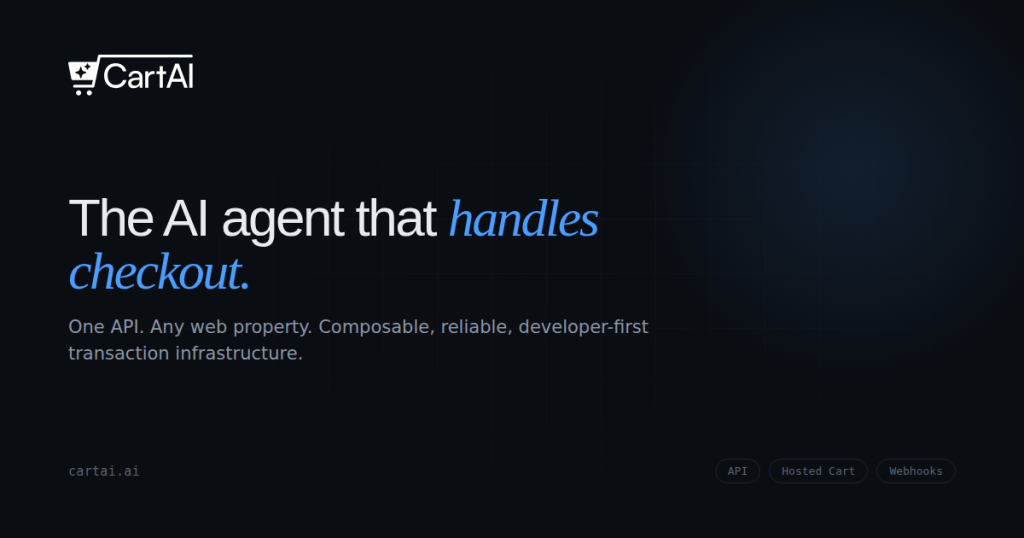
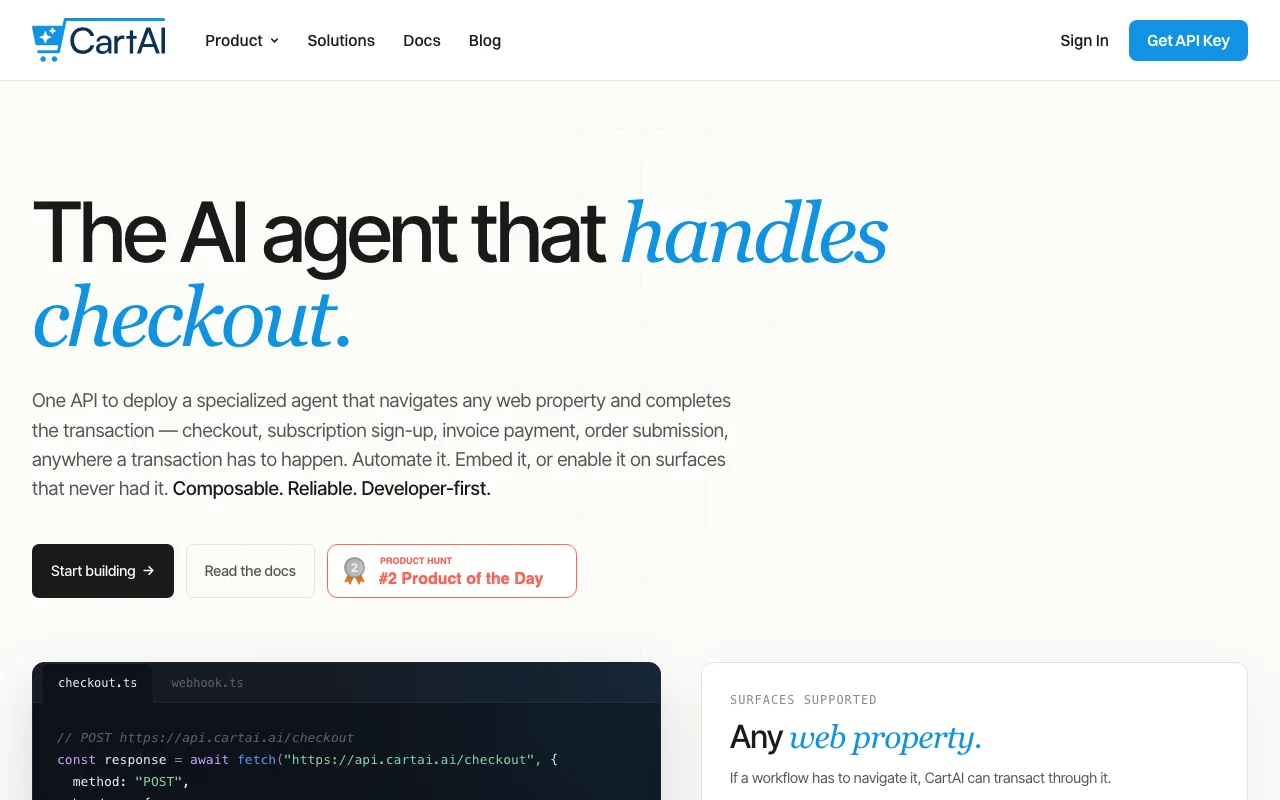
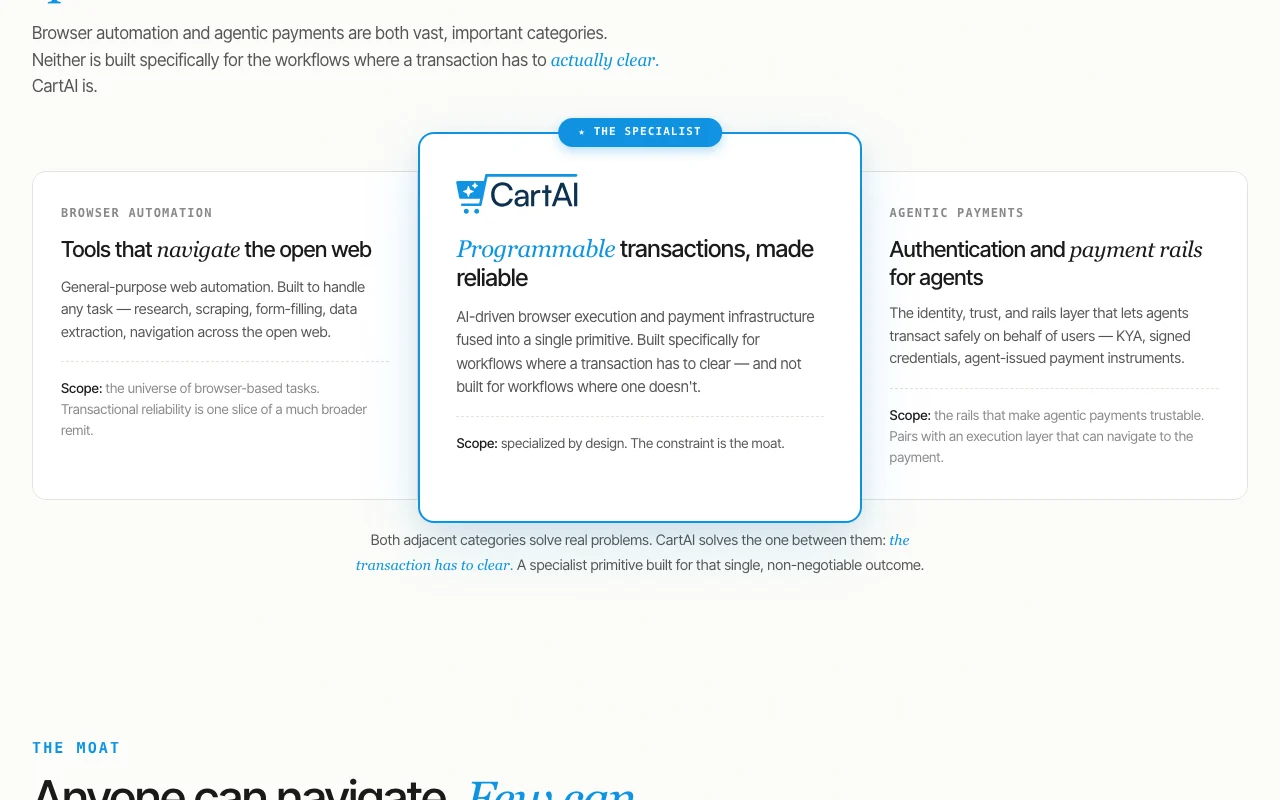
CartAI is a developer-first API: you submit a transaction task and an agent navigates the target site to complete it, reporting state changes through webhooks.
It also offers a hosted drop-in Cart component and SDKs; docs describe sandbox testing.
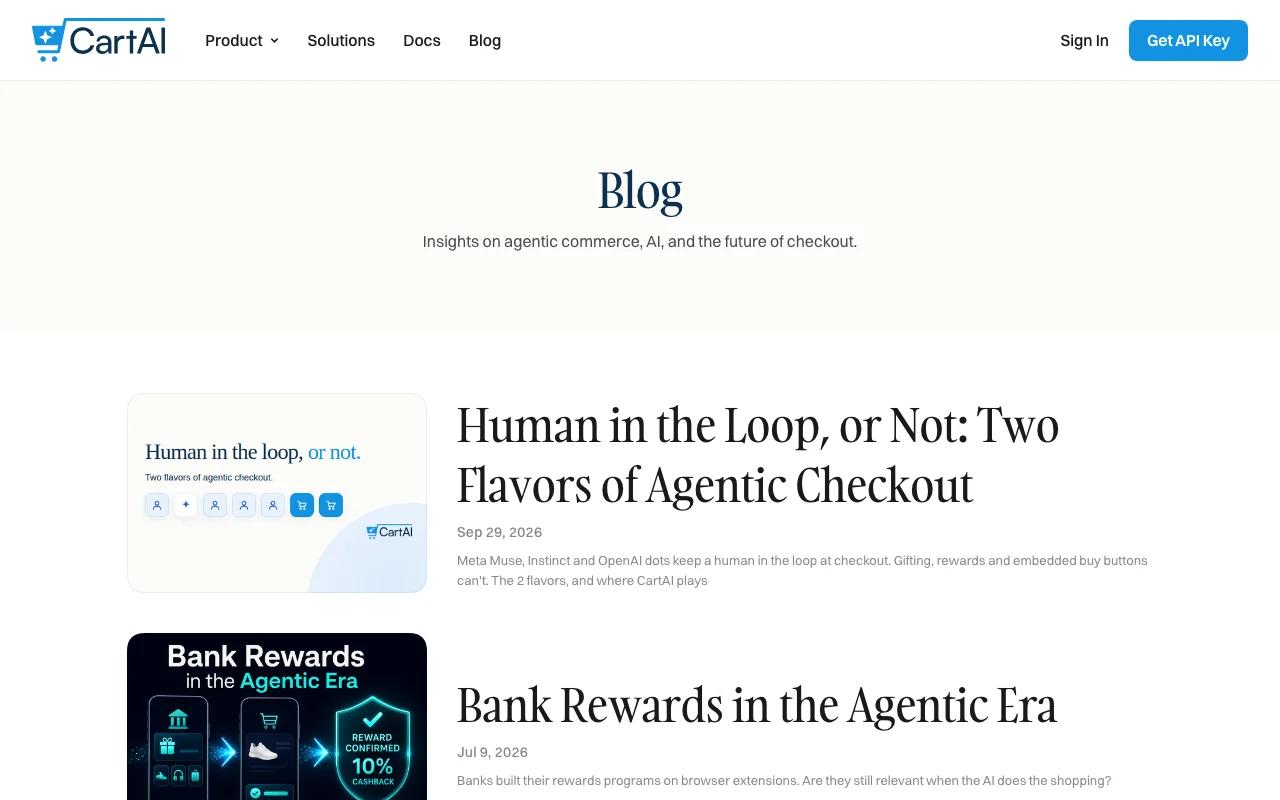
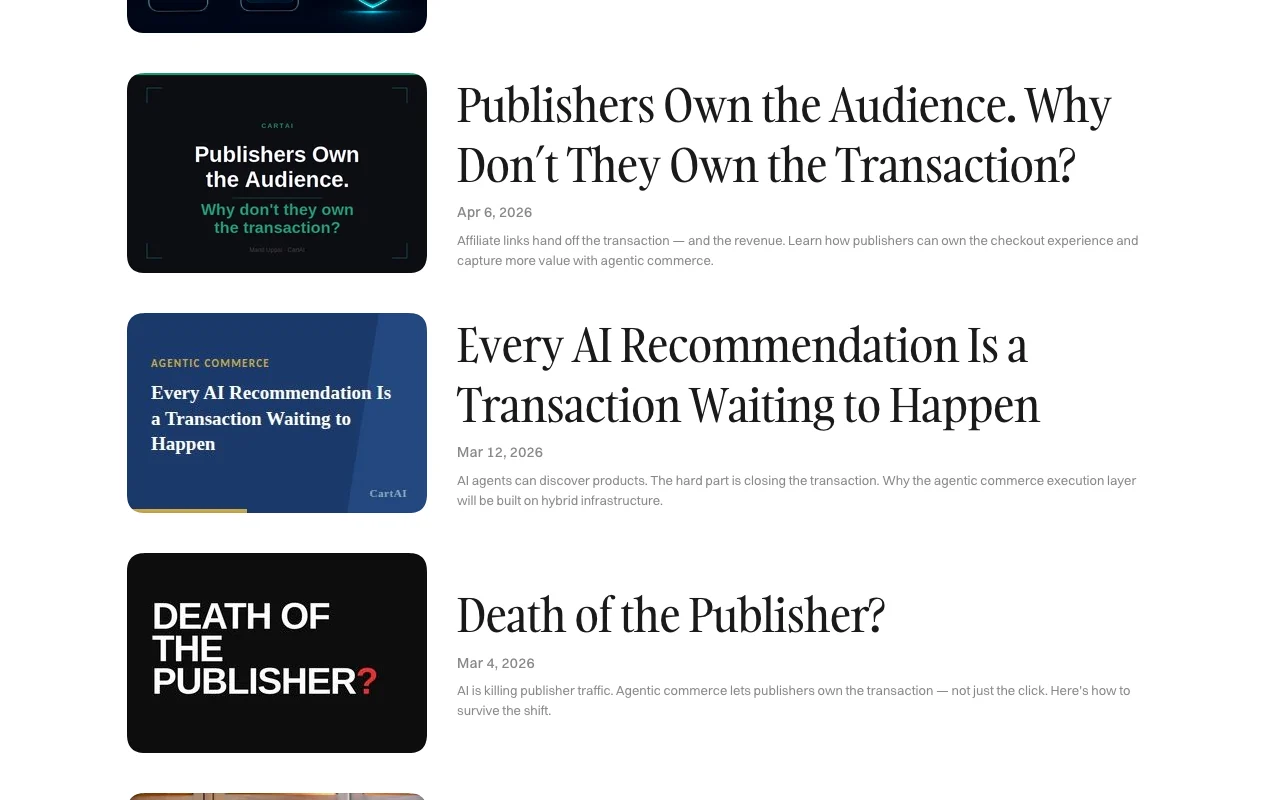
CartAI's official site: how the product presents itself. cartai.ai, captured Oct 1, 2026
What you provide and what you get back
What you give CartAI and what comes back, from its documentation
You provide
Merchant or product URL
Customer details and shipping profile
Payment profile or hosted payment session
You get back
Task ID and status
Webhook events (STARTED, COMPLETED, FAILED)
Normalized orders
Where you can use it
Platforms
API
Account
Required
Interface
REST API, SDKs, MCP server, Hosted Cart
Products
Catalog, Checkouts, Payments, Monetization
Payments
Visa Intelligent Commerce, Mastercard Agent Pay, PCI vaulting
Execution
Asynchronous with webhooks
What people use CartAI for
Scenarios are worked out by our editors from the documentation; the actual result depends on your input and plan.
Automating e-commerce checkout
Who
Developers of shopping agents
You provide
Product URLs and a buyer's shipping and payment profile
Expected result
A completed order on the live merchant site, reported by webhook
Offers a drop-in cart for surfaces that never had checkout. Adds transactions without building UI.
Access: With the APILimit: Customization options are not documented in the fetched text.source (opens in a new tab)
PCI-compliant payment stack
Handles card intake and tokenized vaulting through PCI-compliant partners. Keeps raw card data off your servers.
Access: With the APILimit: Raw card data is handled only by third-party vault partners.source (opens in a new tab)
CartAI pros and cons
Where CartAI is strong
Docs and API reference are public Developers can read how requests and responses work before signing up.documentedsource (opens in a new tab)
Sandbox mode shown in example Checkout can be tried against test mode before real money moves.documentedsource (opens in a new tab)
Open-source repo referenced on site Integration reaches beyond closed-source API contracts.documentedsource (opens in a new tab)
Recorded confirmed orders at BestBuy, Newegg, Jomashop and Ulta The homepage shows real merchants, giving some proof of reliability, though self-published.documentedsource (opens in a new tab)
Cooperates with bot protection Uses Web Bot Auth and Skyfire KYA instead of evading Cloudflare or Human.documentedsource (opens in a new tab)
Limitations to check before paying
Requires an API key and account You cannot try the product without registering.documentedsource (opens in a new tab)
No pricing page found (/pricing 404) Budgeting is impossible before talking to the vendor.documentedsource (opens in a new tab)
Docs list known limitations Some flows may fail, so you need retry handling.documentedsource (opens in a new tab)
Aimed at developers, not end users Non-technical users cannot use it directly.documentedsource (opens in a new tab)
Docs page was unavailable on fetch Documentation could not be verified.documentedsource (opens in a new tab)
How to use CartAI for completing a checkout through an API
Set up CartAI
Click Get API Key on cartai.ai and sign in.
Store the key as an environment variable such as CARTAI_KEY.
Install the npm or pip SDK, or call https://api.cartai.ai/checkout directly.
Deploy a webhook endpoint to receive STARTED, COMPLETED and FAILED events.
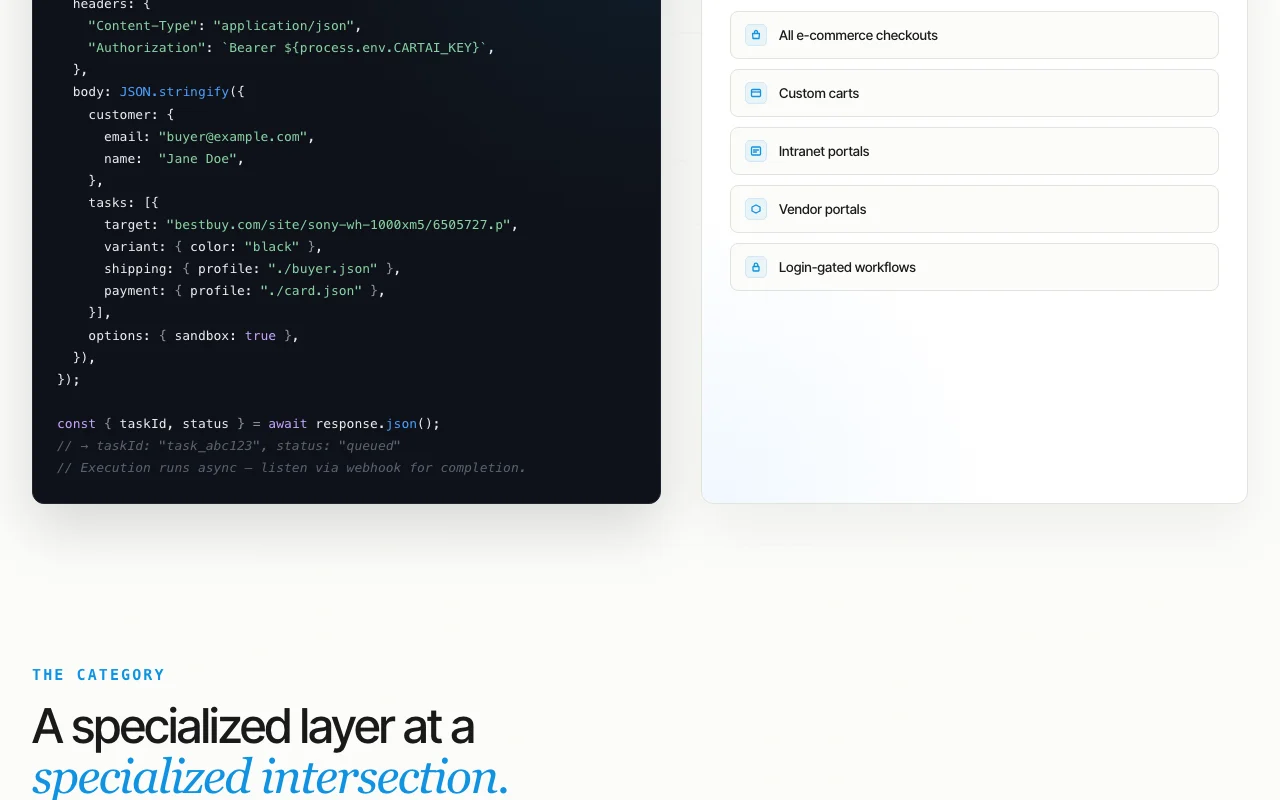
Example: completing a checkout through an API
POST to /checkout with the customer, a target product URL and variant.
Include shipping and payment profiles and set options.sandbox to true.
Receive the taskId and queued status.
Handle the COMPLETED webhook to start your post-purchase flow.
Review and export the result
Confirm the webhook fires with the task ID.
Verify the normalized order matches the product and variant.
Switch off sandbox only after a clean test run.
CartAI integrations and API
Native integrations and export formats
Export: JSON
API access and separate billing
CartAI has no public API in its official documentation. REST API with Bearer key, npm and pip SDKs and an MCP server.
Privacy, data use and commercial rights
Summarized from the vendor's current policies; this is not legal advice and a vendor's badge is not an independent audit.
How your inputs and outputs are handled
Processes checkout data such as name, email and addresses; raw card numbers are handled only by PCI-compliant vault partners.
Checkout data and a vaulted token may be retained to pre-fill future transactions; see section 12 of the policy.
No. Raw card numbers are handled only by PCI-compliant third-party vaulting partners, and CartAI stores vaulted tokens. source (opens in a new tab)
How do I know when a checkout finishes?
Execution is asynchronous; you receive webhook events such as STARTED, COMPLETED and FAILED. source (opens in a new tab)
Which kinds of sites can CartAI transact on?
E-commerce checkouts, custom carts, intranet portals, vendor portals and login-gated workflows. source (opens in a new tab)
Can I test without real purchases?
The example request sets options.sandbox to true, which indicates a sandbox mode. source (opens in a new tab)
How does CartAI deal with bot protection?
It says it cooperates with Cloudflare, Human and Fingerprint through Web Bot Auth, Skyfire KYA and signed agent identity rather than evading them. source (opens in a new tab)
Not verified: Pricing (page 404); Documentation (page 404); Rate limits; Free tier or trial; Training use of data.
How we documented and maintain this page
Every fact about CartAI above comes from the 3 official pages listed here, last compared on Oct 1, 2026; we have not run CartAI ourselves, so it has no editorial score. How we check and re-check pages.
Article updated Oct 10, 2026; prices checked Oct 1, 2026. Outbound links to vendors are plain links; we do not earn commissions. How we review · Report an error

 (open full size in a new tab)
 (open full size in a new tab)
 (open full size in a new tab)
 (open full size in a new tab)
 (open full size in a new tab)