CodingDocumented overviewLast checked Sep 29, 2026

Vendo: Pricing, Features & Best Use Cases

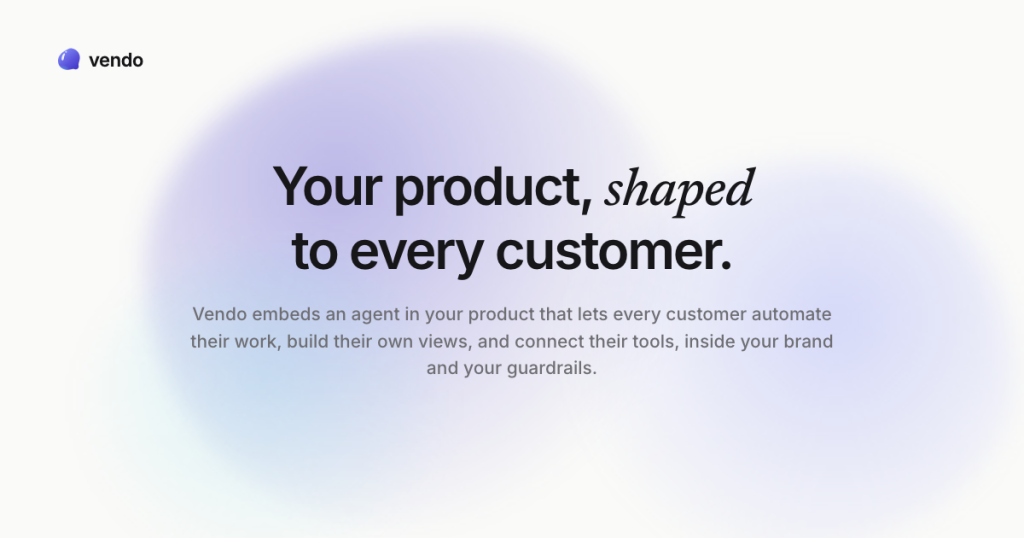
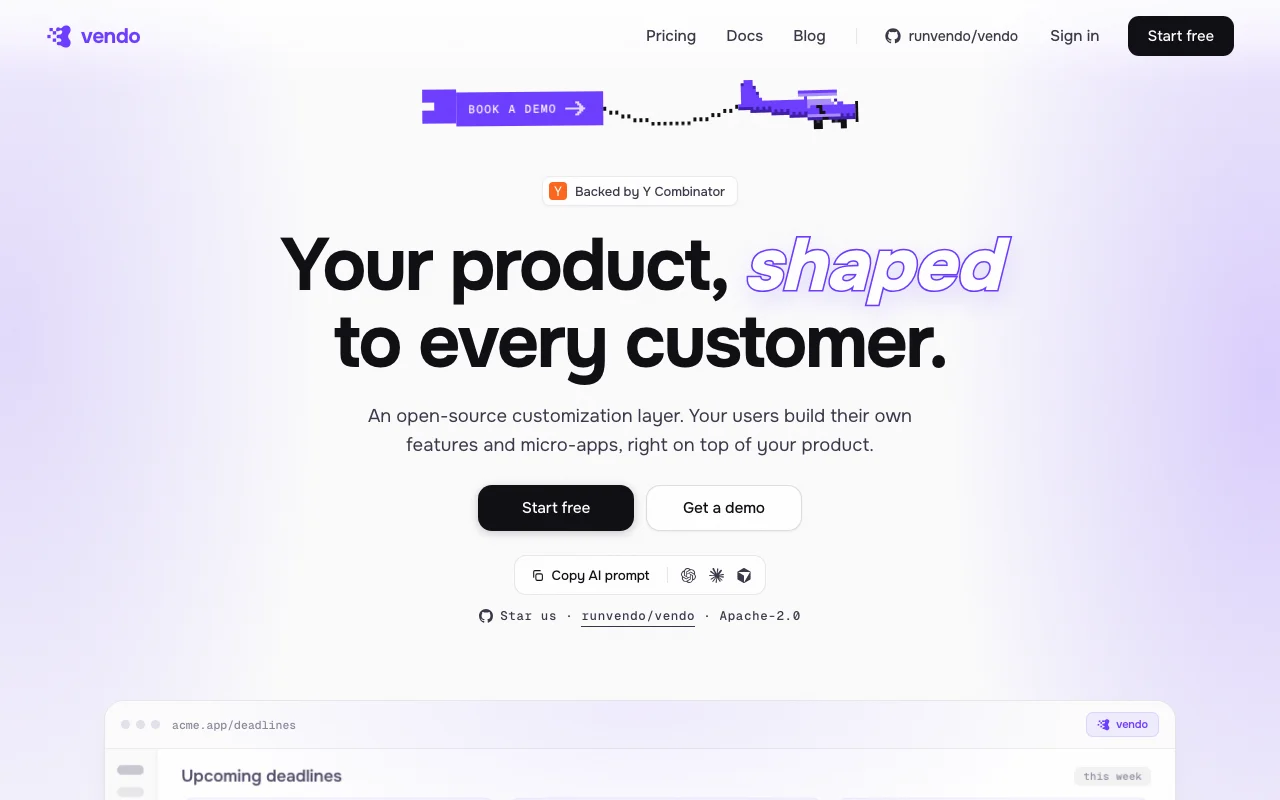
Open-source customization layer that lets your product's users build their own micro-apps, dashboards and automations on top of your app via an embedded agent.

Is Vendo right for you?

Pick Vendo if you run a SaaS product (for example on Next.js) and want your customers to build branded micro-apps and automations through an embedded agent that respects your permissions. Based on the vendor's documentation, not on a hands-on test.

Best for: SaaS developers adding end-user customization

Also a good fit for

  • B2B startups offering per-tenant micro-apps
  • Teams wanting an open-source agent layer with hosted governance

Consider another tool if requires integrating an npm package into your codebase (Node 20 or newer)

Or if

  • Free plan history retention limited to 7 days and no publishing or sharing
  • Tenant features require the $499/month Teams plan

Vendo pricing and usage limits

Prices checked Sep 29, 2026 on the official US pricing page. Official pricing ↗ Prices and limits change often.

Vendor pricing page re-checked automatically 12 days ago: no changes detected.

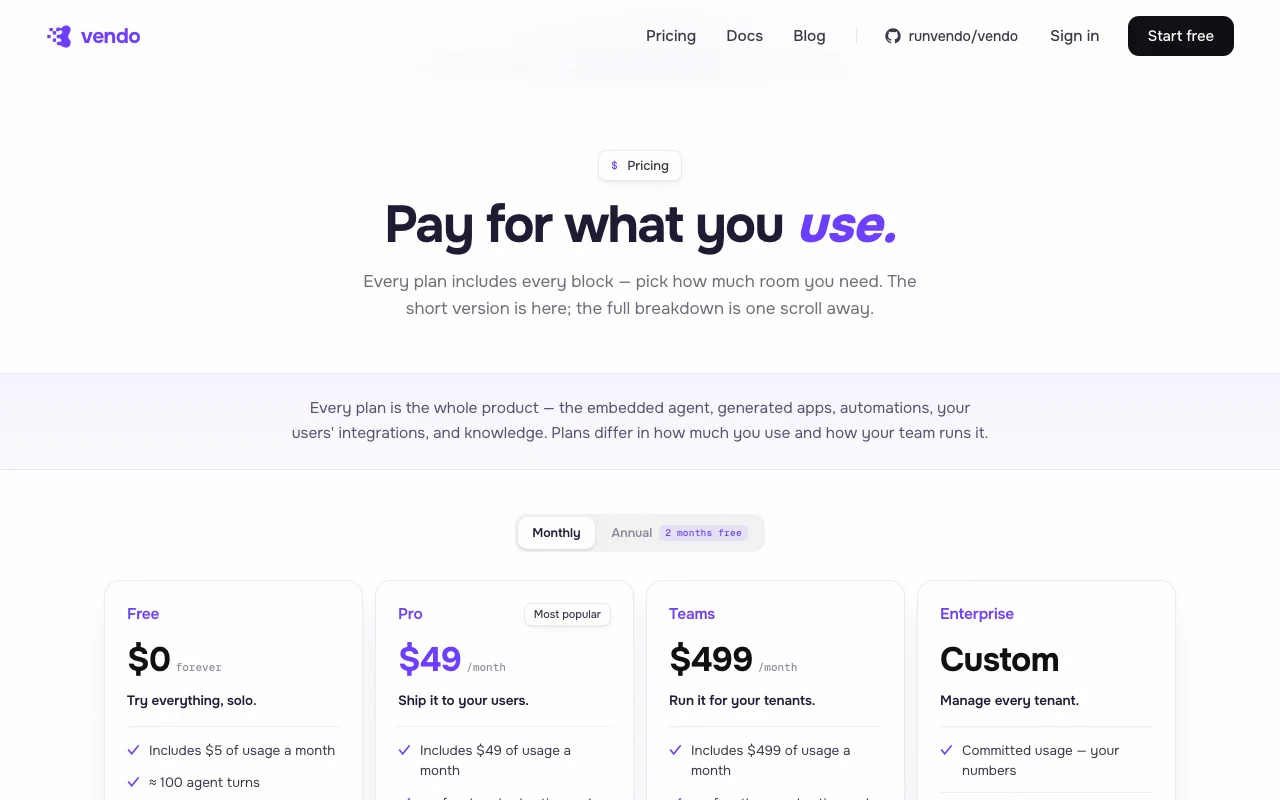
Vendo pricing page with plans and prices — screenshot of the coding AI tool, Oct 1, 2026
The official Vendo pricing page as we saw it. vendo.run, captured Oct 1, 2026

Free access and trial conditions

Free plan, $5 of usage a month with a hard stop and no bill.

None beyond the Free plan.

Paid plans: what changes as you upgrade

Free Web

Free source (opens in a new tab)

Monthly

For: Developers evaluating

Limits

  • $5 usage/month, hard stop
  • 7-day history
1 more
  • No publishing or sharing

Includes

  • Full open-source agent
  • GitHub or Google sign-in

API included

Pro Web

$49 source (opens in a new tab)

Monthly

Annual billing gives 2 months free

For: Indies and startups in production

Limits

  • $49 usage included
  • 90-day history
1 more
  • Overage cap default $100/mo

Includes

  • Publishing
  • Snapshot share links
1 more
  • Basic console

API included

Teams Web

$499 source (opens in a new tab)

Monthly

Annual billing gives 2 months free

For: B2B companies with tenants

Limits

  • $499 usage included
  • Overage cap default $1,000/mo

Includes

  • Tenant orgs
  • Approvals and session replay
1 more
  • Shared workspaces

API included

Enterprise Web

Custom pricing source (opens in a new tab)

Custom

For: Regulated companies

Limits

  • Committed usage

Includes

  • SAML SSO and SCIM
  • DPA/BAA
2 more
  • Deploy on your infrastructure
  • Uptime SLA

Usage caps, credits and extra costs

Models $1.15-$2.30 per M input and $5.75-$11.50 per M output; sandbox $0.01/min; storage $0.25/GB-month; automations $3 per 1,000 runs; bring-your-own keys read $0.

Not stated.

What is Vendo, and how does it work?

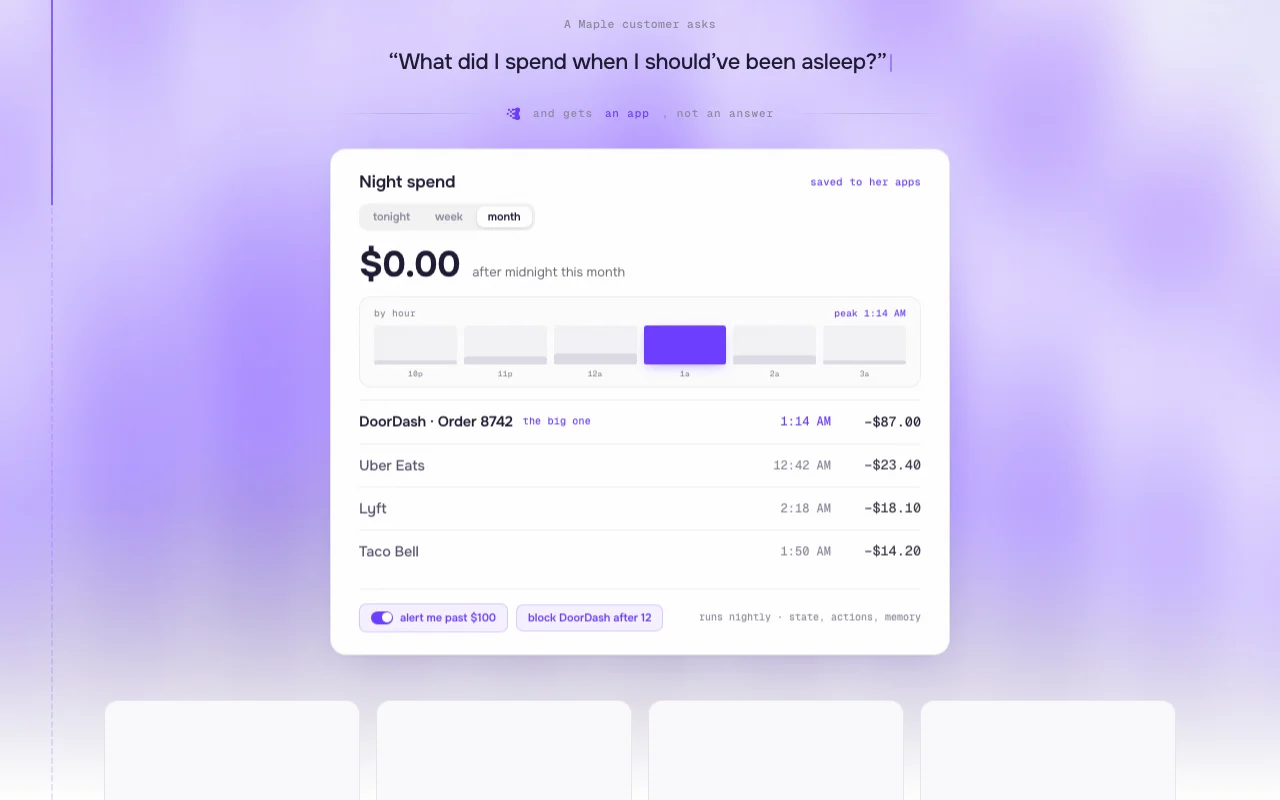
Vendo is an open-source (Apache-2.0) library and hosted service, backed by Y Combinator, that adds an agentic interface to an existing product. End users describe what they need and Vendo assembles a working micro-app with UI, actions, automations and state, using the host product's own components, theme, API tools and permission rules. Generated apps run sandboxed as the signed-in customer. Developers install the @vendoai/vendo npm package (Node 20+) and run `npx vendo init`, which scans the repo to produce theme, tools and policy configuration. Vendo Cloud provides a console with usage, keys, deployments, publishing, tenant organizations, approvals and session replay. Pricing is usage-based with a monthly allowance per plan.

Vendo homepage — screenshot of the coding AI tool, Oct 1, 2026
Vendo's official site: how the product presents itself. vendo.run, captured Oct 1, 2026

What you provide and what you get back

How Vendo works: what you provide, where it runs and what you get backYOU PROVIDEYour inputYour repo, scanned by npx vendo i…End-user natural-language requestsConnected tools such as Gmail, Sl…CODINGVendoWeb, APIfrom $49 (Pro)free tier availableaccount requiredchecked Sep 29, 2026YOU GET BACKThe resultGenerated micro-apps with UI, act…Scheduled and triggered automatio…Config files theme.json, tools.js…input → Vendo → output · from the vendor's own pages, no hands-on test unless stated
What you give Vendo and what comes back, from its documentation

You provide

  • Your repo, scanned by npx vendo init for components, theme, API tools and policy
  • End-user natural-language requests
  • Connected tools such as Gmail, Slack, GitHub

You get back

  • Generated micro-apps with UI, actions and state
  • Scheduled and triggered automations
  • Config files theme.json, tools.json, policy.json

Where you can use it

Platforms
Web, API
Account
Required
Install
npm i @vendoai/vendo, Node 20+
License
Apache-2.0 core
Model inference
Anthropic (processor)
Spend caps
$100 Pro / $1,000 Teams default
Compliance
SOC 2 Type II audit in progress

What people use Vendo for

Scenarios are worked out by our editors from the documentation; the actual result depends on your input and plan.

Letting SaaS customers compose custom dashboards from product data

Who
SaaS product teams
You provide
A customer asking for a custom view of product data
Expected result
A branded dashboard micro-app composed from your components
Plan needed
Free to evaluate; Pro for publishing
Limitation
Free plan has no publishing or sharing source (opens in a new tab)

Turning recurring user requests into scheduled automations

Who
End users of an embedding product
You provide
A request such as every Monday at 7 chase missing documents
Expected result
A standing automation running with the user's own permissions
Plan needed
Pro and up
Limitation
Automation runs billed at $3 per 1,000 source (opens in a new tab)

Generating branded micro-apps inside an existing Next.js product

Who
B2B companies with multiple customer organizations
You provide
Customer companies as tenants
Expected result
Tenant orgs with shared workspaces, roles and usage pools
Plan needed
Teams
Limitation
Per-tenant limits and SCIM are Enterprise only source (opens in a new tab)

What Vendo does, and where it stops

Vendo homepage — screenshot of the coding AI tool, Oct 1, 2026
Feature overview on the official site. vendo.run, captured Oct 1, 2026

Embedded agent that generates real micro-apps with actions and state

Embeds an agent that assembles real micro-apps with actions, automations and state. Customers get features without a roadmap ticket.

Access: All plansLimit: Needs integration into your codebase source (opens in a new tab)

`vendo init` reads the repo for components, theme, API tools and permission policy

Runs npx vendo init to read your repo and write theme, tools and policy configuration. Output matches your brand and permissions.

Access: Open sourceLimit: Node 20+ required source (opens in a new tab)

Sandboxed execution as the signed-in end user

Executes generated apps in a sandbox as the signed-in end user. Users cannot exceed their own permissions.

Access: All plansLimit: Sandbox minutes are metered at $0.01/min source (opens in a new tab)

Standing automations and scheduled runs

Schedules standing automations and connects users' own tools such as Gmail, Slack and GitHub. Work continues without the user present.

Access: All plansLimit: $3 per 1,000 automation runs source (opens in a new tab)

Vendo: strengths and limits

Where Vendo is strong

  • Open-source core under Apache-2.0 with public GitHub repo You can evaluate and self-host the core without paying. documented source (opens in a new tab)
  • Free plan with $5 of monthly usage and a hard stop, no bill You can try it in a prototype safely. documented source (opens in a new tab)
  • Published per-token and infrastructure rates identical on every plan Costs can be forecast before launch. documented source (opens in a new tab)
  • Overage runs under a user-controlled spend cap Spending cannot run away unexpectedly. documented source (opens in a new tab)

Limitations to check before paying

  • Requires integrating an npm package into your codebase (Node 20 or newer) Needs developer time to integrate. documented source (opens in a new tab)
  • Free plan history retention limited to 7 days and no publishing or sharing Free cannot be used to publish to end users. documented source (opens in a new tab)
  • Tenant features require the $499/month Teams plan Multi-tenant products need the higher tier. documented source (opens in a new tab)
  • Per-tenant limits, SSO and SCIM are Enterprise-only; SOC 2 Type II audit still in progress Regulated buyers may need to wait on compliance. documented source (opens in a new tab)

How to use Vendo for adding a customer-facing agent that builds micro-apps in your product

Set up Vendo

  1. Install @vendoai/vendo from npm in a Node 20+ project.
  2. Run npx vendo init so it scans your routes, components and theme.
  3. Review .vendo/theme.json, tools.json and policy.json (reads free, destructive actions ask first).
  4. Run vendo doctor to verify the live setup, then sign in to Vendo Cloud with GitHub or Google.

Example: adding a customer-facing agent that builds micro-apps in your product

  1. Open the embedded overlay or chat sidebar in your product.
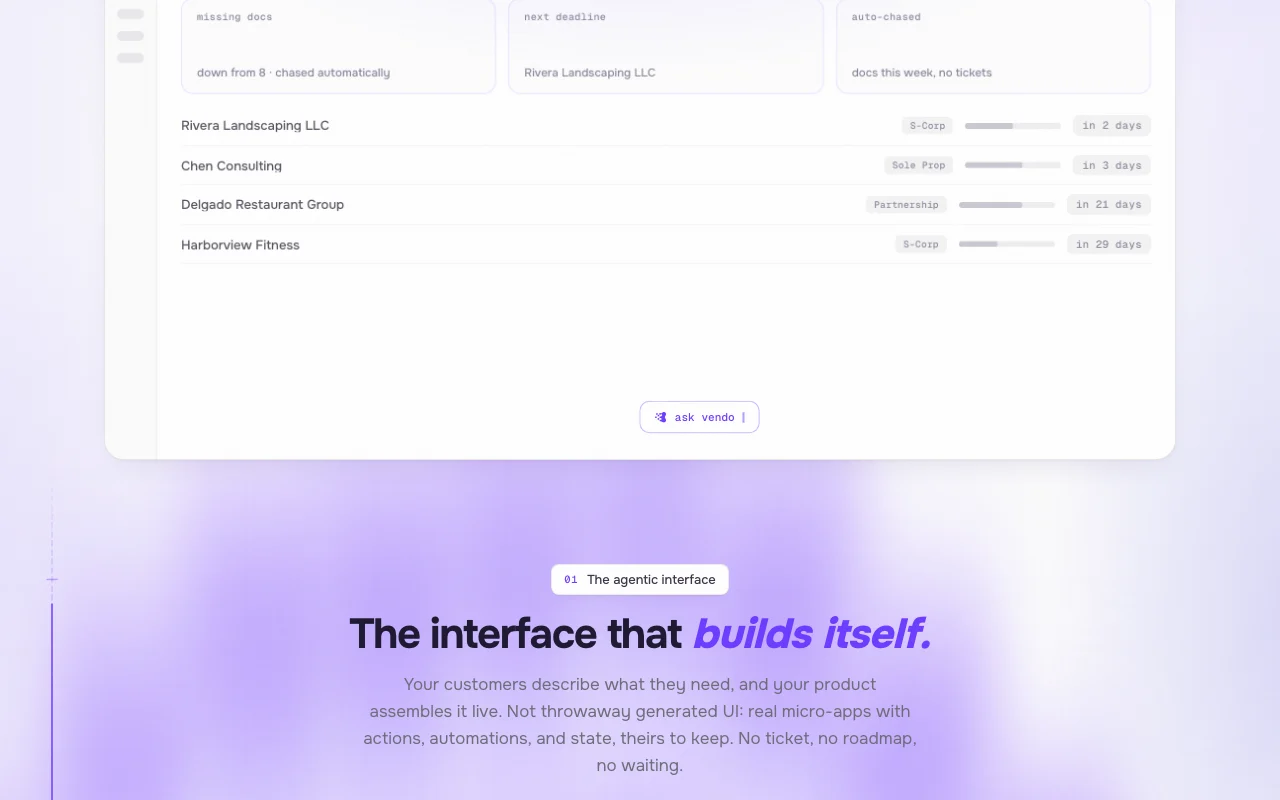
  2. Ask for a view such as upcoming deadlines this week.
  3. Review the generated micro-app and save it.
  4. Ask it to run every Monday at 7 as an automation.

Review and export the result

  1. Confirm the app uses your colors and components.
  2. Check that destructive actions prompt for approval.
  3. Open the console to view usage against the $5 cap.
Example prompt suggested by our editors (not a recorded output of the product)
Show me clients with missing documents this week and remind them every Monday at 7.

Vendo API

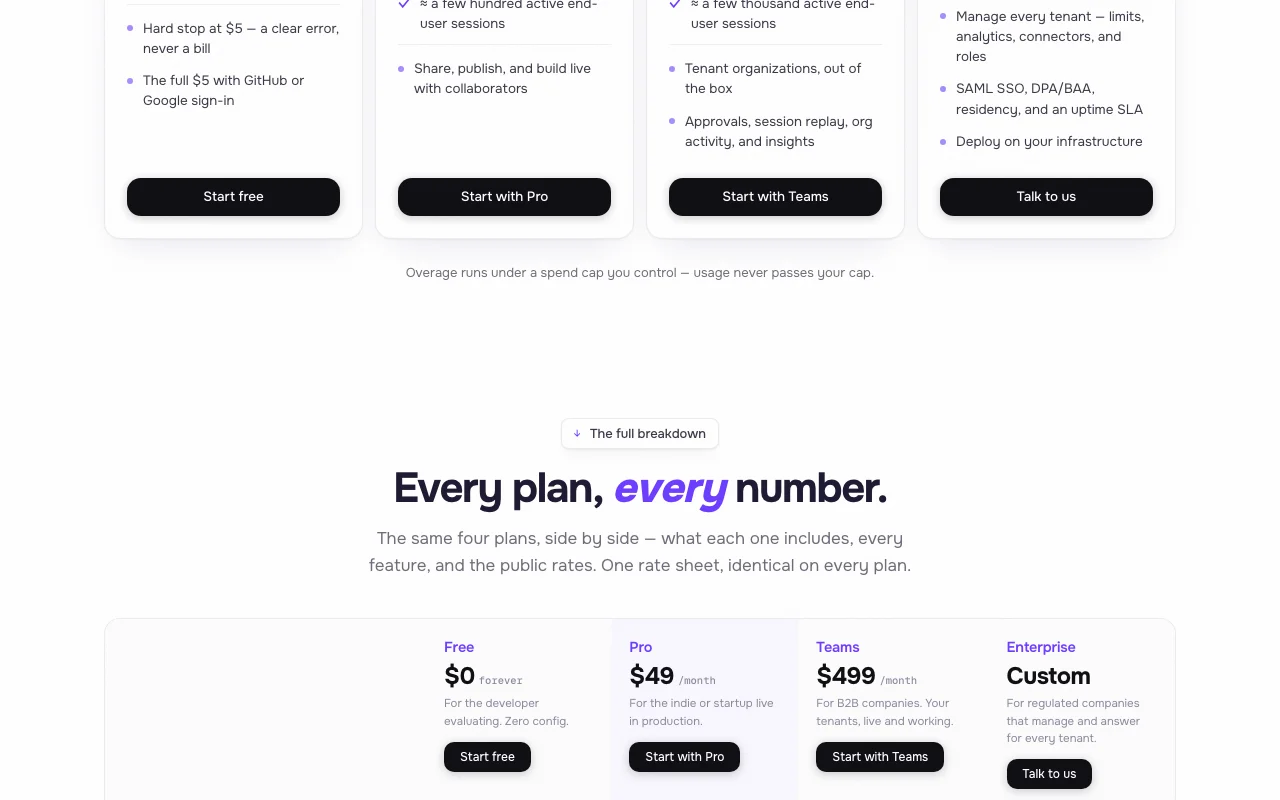
Vendo pricing page with plans and prices — screenshot of the coding AI tool, Oct 1, 2026
Plan comparison on the official pricing page. vendo.run, captured Oct 1, 2026

API access and separate billing

Vendo has no public API in its official documentation. npm package @vendoai/vendo; /docs on the site returned 404. API documentation ↗

Privacy, data use and commercial rights

Summarized from the vendor's current policies; this is not legal advice and a vendor's badge is not an independent audit.

How your inputs and outputs are handled

Account, billing, metering and end-user content processed on your instructions.

Policy: customer content is not used to train models.

Customer content deleted when you delete it or close the account; account/billing data kept while active plus legal needs.

Commercial use and plan restrictions

DPA/BAA, residency and SLA are Enterprise.

Controls for business users

  • Per-organization access scoping
  • Spend caps
  • Approvals (Teams)

Policies: vendo.run/privacy

Best Vendo alternatives for different needs

"Better suited" is based on documented features and pricing, not on a head-to-head test.

Lovable: better suited to

Replit: better suited to

Cursor: better suited to

n8n: better suited to

Alternatives
AlternativeWhen to choose itPricingLimitation
Lovable——Compare
Replit——Compare
Cursor——Compare
n8n——

Explore Vendo further

Related to Vendo

Vendo user reviews

No user reviews yet.

Used Vendo? Be the first to share your experience.

Write a review

Reviews are checked by a moderator before they appear. Your email is never published. Plain text only.

Your rating (required)

Show what you made or what went wrong. Images are published only if the review is approved; location data is removed.

    Vendo FAQ

    What happens when the Free $5 is used?

    Usage pauses with an error naming the reset date and you are never billed. source (opens in a new tab)

    Can I avoid per-token charges?

    Yes, bringing your own model key makes the model rate read $0, and own sandbox or infra avoids those rates too. source (opens in a new tab)

    What is a tenant in Vendo?

    One of the companies inside your product, not your own Vendo account; tenant orgs start on Teams. source (opens in a new tab)

    What does a typical agent turn cost?

    About $0.05, and an app build runs $1-2. source (opens in a new tab)

    Is Vendo open source?

    Yes, the core is Apache-2.0 with a public runvendo/vendo repo. source (opens in a new tab)

    Sources and review methodology

    Official sources and verification dates

    Not verified: Supported frameworks beyond Next.js; Official docs content.

    How we documented and maintain this page

    Every fact about Vendo above comes from the 3 official pages listed here, last compared on Sep 29, 2026; we have not run Vendo ourselves, so it has no editorial score. How we check and re-check pages.

    Article updated Oct 10, 2026; prices checked Sep 29, 2026. Outbound links to vendors are plain links; we do not earn commissions. How we review · Report an error