CodingDocumented overviewLast checked Sep 29, 2026

Octopoda: Pricing, Features & Best Use Cases

Persistent memory layer for AI agents with versioning, sharing and monitoring, installed via pip.
Who should use Octopoda

Octopoda is a good fit for developers and AI-first teams who need persistent, versioned, shareable memory for LangChain, CrewAI, MCP or custom agents, with an MIT open-source core and a free 5-agent tier. Based on the vendor's documentation, not on a hands-on test.

Best for: Developers building agents

Also a good fit for

  • AI-first product teams

Consider another tool if free tier capped at 5 agents and 5,000 memories

Or if

  • Pro capped at 25 agents
  • Requires an account for cloud features

Octopoda pricing and usage limits

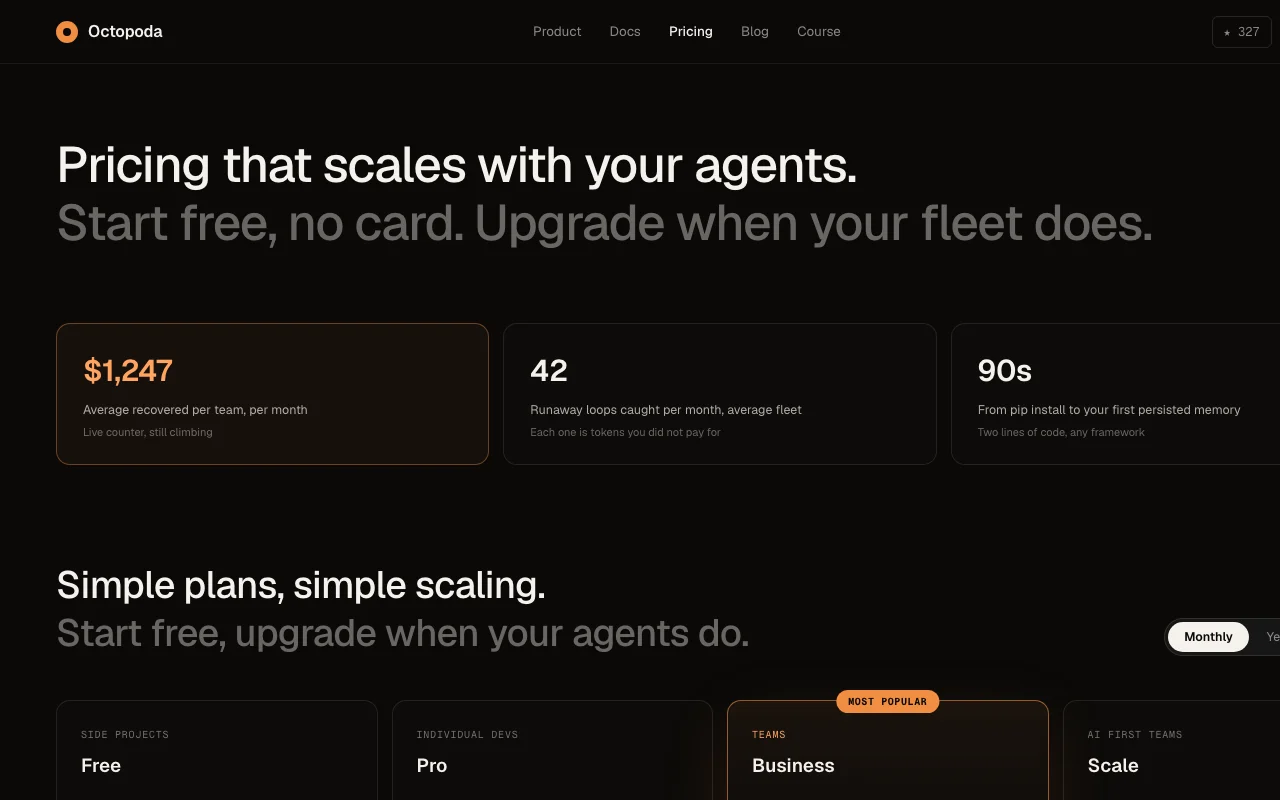
Prices checked Sep 29, 2026 on the official US pricing page. Official pricing ↗ Prices and limits change often.

Octopoda pricing page with plans and prices — screenshot of the coding AI tool, Oct 1, 2026
The official Octopoda pricing page as we saw it. octopodas.com, captured Oct 1, 2026

Free access and trial conditions

Free tier, no card; open-source core

None separate

Paid plans: what changes as you upgrade

Free web

Free source (opens in a new tab)

Month

For: Side projects

Limits

  • 5 agents
  • 5,000 memories
1 more
  • 2,000 AI extractions

Includes

  • Every feature
  • Local SQLite or cloud sync
1 more
  • Community support

Pro web

$19/mo source (opens in a new tab)

Month

Yearly saves 20%

For: Individual developers

Limits

  • 25 agents
  • 250,000 memories
1 more
  • 10,000 AI extractions

Includes

  • Email support within 1 business day
  • Priority bug fix queue

Business web

$49/mo source (opens in a new tab)

Month

Yearly saves 20%

For: Teams

Limits

  • 75 agents
  • 1,000,000 memories
1 more
  • 50,000 AI extractions

Includes

  • Priority support 4h
  • Founder onboarding call
1 more
  • 99.5% uptime SLA

Scale web

$99/mo source (opens in a new tab)

Month

Yearly saves 20%

For: AI-first teams

Limits

  • Unlimited agents
  • 5,000,000 memories
1 more
  • Unlimited AI extractions

Includes

  • Dedicated shared Slack channel
  • 99.9% SLA
1 more
  • Quarterly strategy review

Enterprise web

Custom pricing source (opens in a new tab)

Month

For: Large organizations

Includes

  • VPC or on-prem
  • Custom SLA
2 more
  • SOC 2
  • Dedicated engineer

Usage caps, credits and extra costs

None listed; hitting limits does not break writes

Not stated

What is Octopoda, and how does it work?

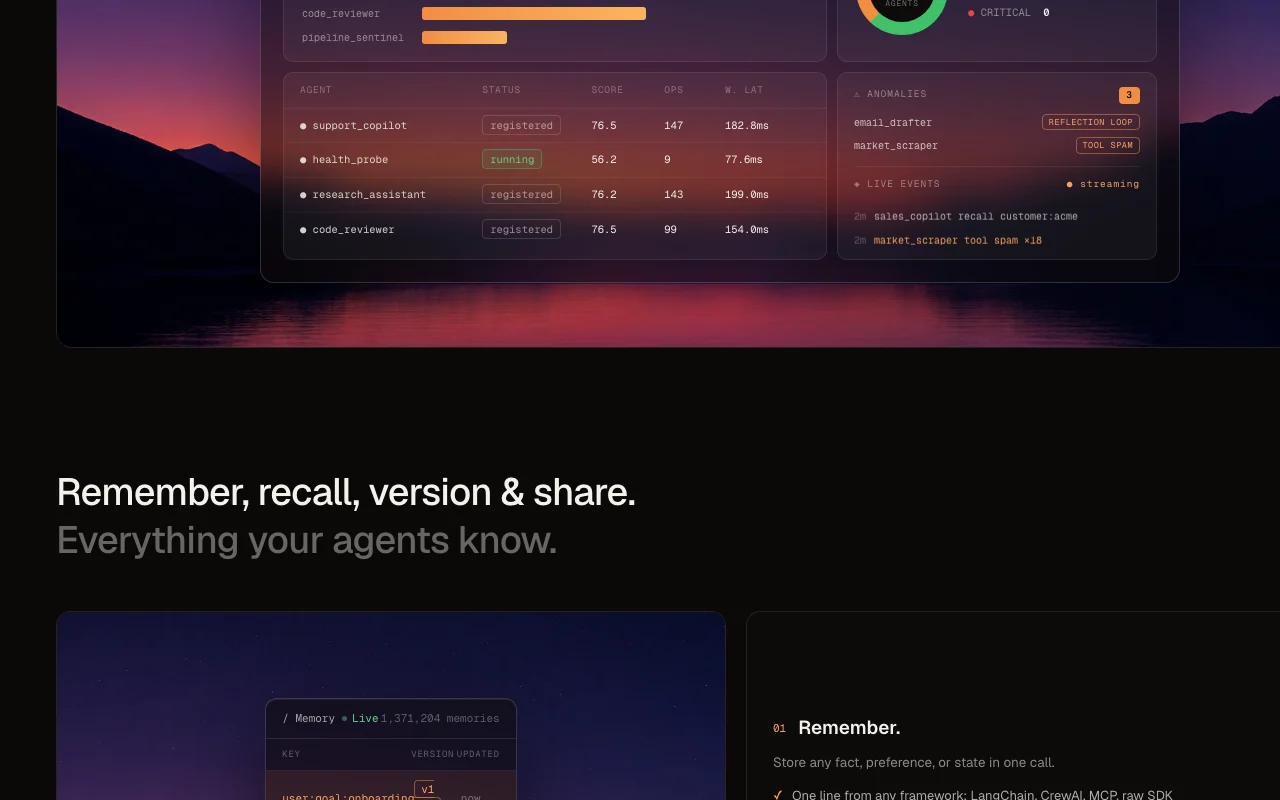
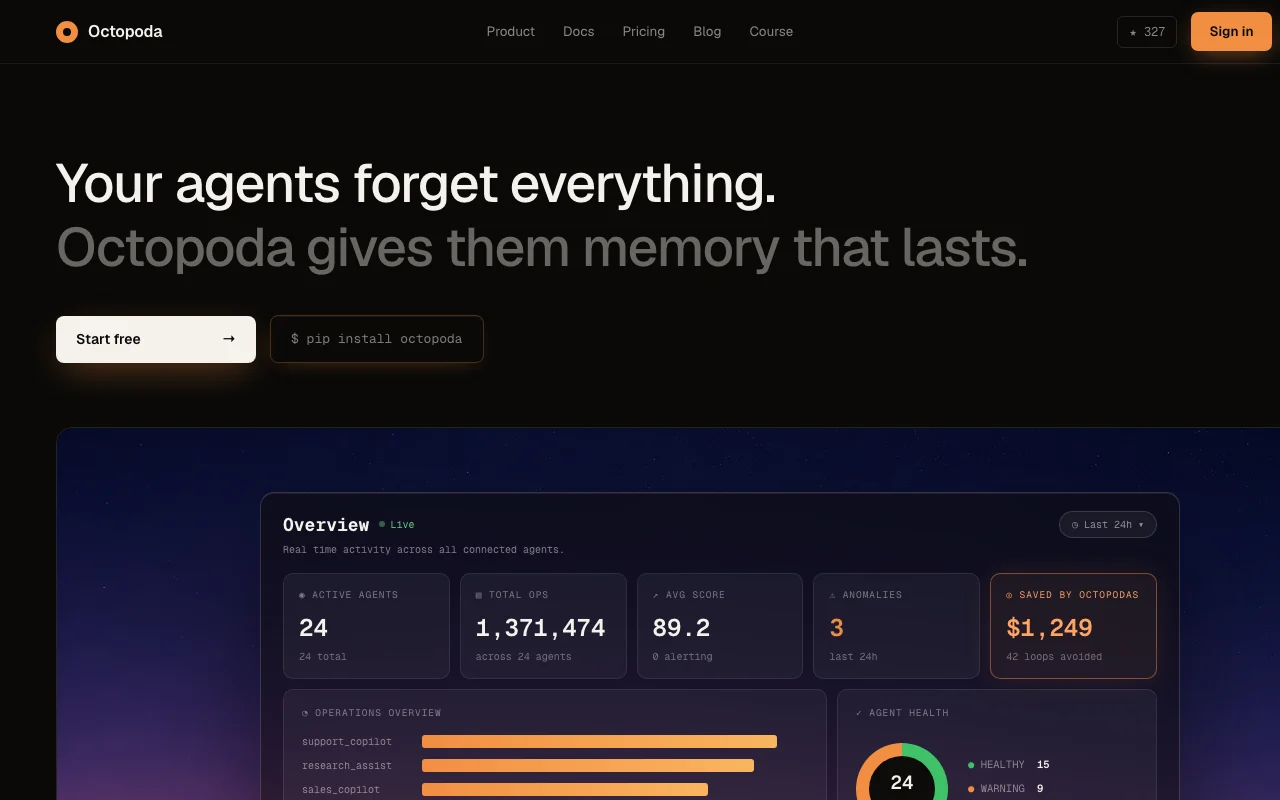
Octopoda gives AI agents memory that survives restarts. Agents can store, recall, version and share facts, with works-with notes for LangChain, CrewAI, MCP and other SDKs. A web dashboard shows agent health, operations and anomalies such as loops. Plans are priced by agent count, memory count and AI extractions.

Octopoda homepage — screenshot of the coding AI tool, Oct 1, 2026
Octopoda's official site: how the product presents itself. octopodas.com, captured Oct 1, 2026

What you provide and what you get back

How Octopoda works: what you provide, where it runs and what you get backYOU PROVIDEYour inputAgent facts written through the S…Framework integrations such as La…MCP tool callsCODINGOctopodaWebfrom $19/mo (Pro)free tier availableaccount requiredchecked Sep 29, 2026YOU GET BACKThe resultRecalled memories by key or meani…Version history, snapshots and ro…Dashboard health, anomalies and l…input → Octopoda → output · from the vendor's own pages, no hands-on test unless stated
What you give Octopoda and what comes back, from its documentation

You provide

  • Agent facts written through the SDK or REST API
  • Framework integrations such as LangChain or CrewAI
  • MCP tool calls

You get back

  • Recalled memories by key or meaning
  • Version history, snapshots and rollbacks
  • Dashboard health, anomalies and loop alerts

Where you can use it

Platforms
Web
Account
Required
Agents
5 / 25 / 75 / unlimited
Memories
5k / 250k / 1M / 5M
License
MIT core
Interfaces
Python SDK, REST, MCP (28 tools)

What people use Octopoda for

Scenarios are worked out by our editors from the documentation; the actual result depends on your input and plan.

Give support agents long-term user memory

Who
Developers building support copilots
You provide
Facts stored per user
Expected result
Agents recall context across sessions
Plan needed
Free (5 agents)
Limitation
Free capped at 5,000 memories source (opens in a new tab)

Share context between agents

Who
Teams running several agents
You provide
Shared memory space
Expected result
Agents read common context
Plan needed
All plans
Limitation
Agent limits by plan source (opens in a new tab)

Roll back agent state after errors

Who
Teams in production
You provide
Snapshots of memory
Expected result
Restored earlier state
Plan needed
All plans
Limitation
Memory capacity by plan source (opens in a new tab)

Octopoda features and their limits

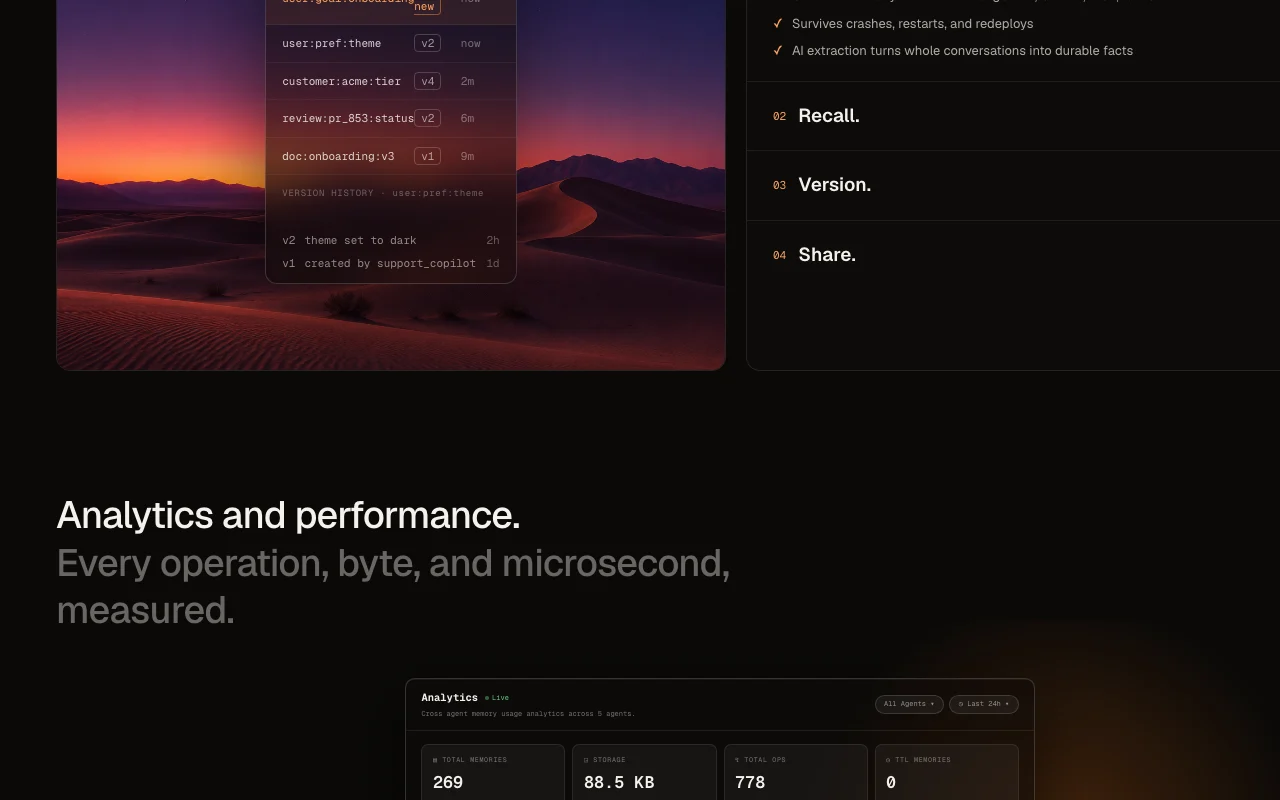
Octopoda homepage — screenshot of the coding AI tool, Oct 1, 2026
Feature overview on the official site. octopodas.com, captured Oct 1, 2026

Remember and recall by key or meaning

Stores facts and fetches them by exact key or semantic search Gives agents persistent context

Access: All plansLimit: AI extractions capped (2,000 Free) source (opens in a new tab)

Version history per key

Keeps earlier values of each memory Lets you audit changes

Access: All plansLimit: Counted in memory totals source (opens in a new tab)

Snapshots and rollback

Captures agent memory state and restores it Recovers from bad runs

Access: All plansLimit: Plan memory limits apply source (opens in a new tab)

Shared memory spaces

Lets multiple agents read and write a common store Coordinates multi-agent work

Access: All plansLimit: Agents counted per plan source (opens in a new tab)

Loop detection and circuit breakers

Spots runaway agent loops and stops them Saves token spend

Access: All plansLimit: Cloud dashboard required for alerts source (opens in a new tab)

Octopoda pros and cons

Reasons to choose Octopoda

Check before paying for Octopoda

How to use Octopoda for adding persistent memory to an AI agent

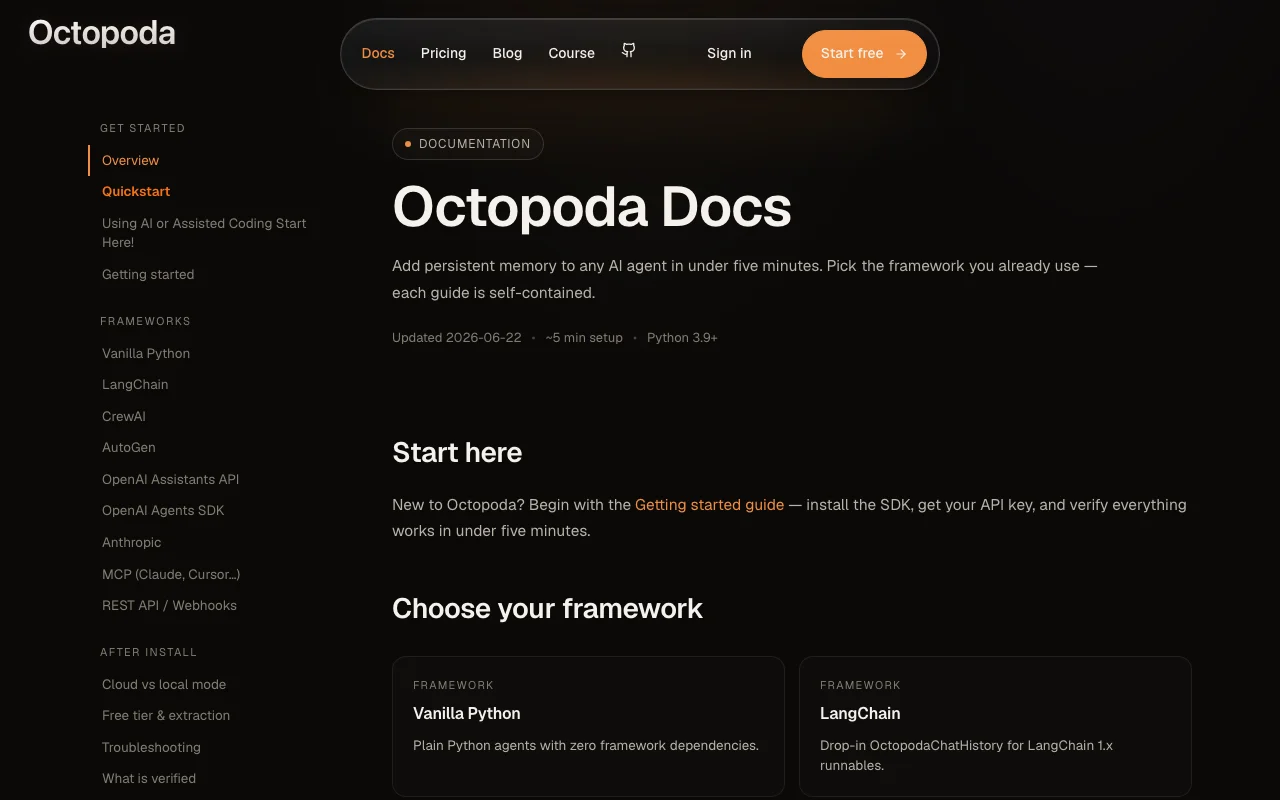
Octopoda documentation — screenshot of the coding AI tool, Oct 1, 2026
Octopoda documentation: where the steps below come from. octopodas.com, captured Oct 1, 2026

Set up Octopoda

  1. Run pip install octopoda
  2. Sign up at octopodas.com for an API key (optional for local mode)
  3. Initialize Octopoda in your agent with two lines of code
  4. Choose your framework guide such as LangChain or CrewAI

Example: adding persistent memory to an AI agent

  1. Register an agent with its own identity
  2. Write a user preference as a memory
  3. Restart the agent and recall the memory
  4. Take a snapshot and roll back after a bad run

Review and export the result

  1. Confirm the memory survives a restart
  2. Check the dashboard for agent health and loop alerts

Octopoda integrations and API

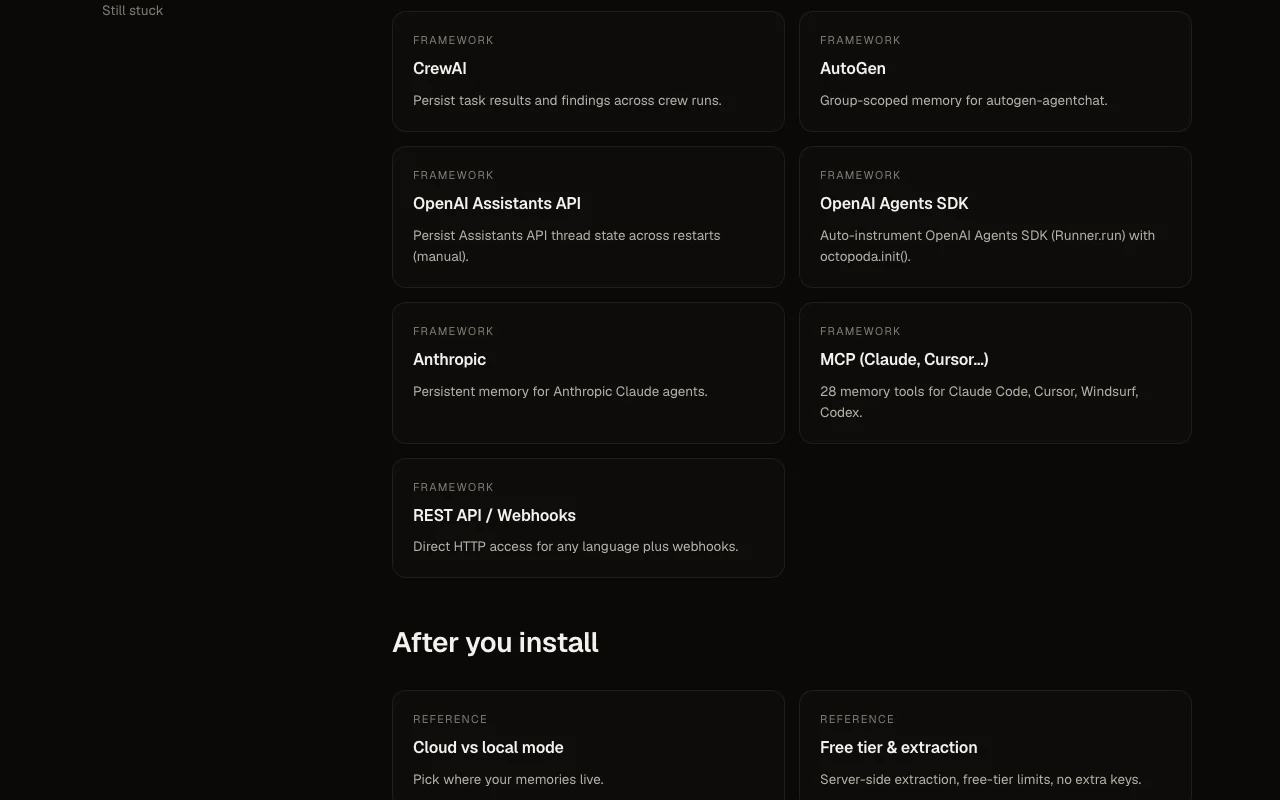
Octopoda documentation — screenshot of the coding AI tool, Oct 1, 2026
Octopoda documentation (continued). octopodas.com, captured Oct 1, 2026

Native integrations and export formats

Export: JSON via /v1/auth/export

API access and separate billing

Octopoda has no public API in its official documentation. REST API and webhooks documented API documentation ↗

Privacy, data use and commercial rights

Summarized from the vendor's current policies; this is not legal advice and a vendor's badge is not an independent audit.

How your inputs and outputs are handled

Agent memory stored locally in SQLite by default; cloud tier uses PostgreSQL with row-level security

Export or delete all data anytime via API

Controls for business users

  • Hash-chained audit trail
  • GDPR compliance stated
  • SOC 2 in progress

Policies: octopodas.com/privacy

Other tools to consider instead of Octopoda

"Better suited" is based on documented features and pricing, not on a head-to-head test.

n8n: better suited to

GitHub Copilot: better suited to

Cursor: better suited to

Alternatives
AlternativeWhen to choose itPricingLimitation
n8n——
GitHub Copilot——Compare
Cursor——Compare

Explore Octopoda further

Tools and guides near Octopoda

Octopoda user reviews

No user reviews yet.

Used Octopoda? Be the first to share your experience.

Write a review

Reviews are checked by a moderator before they appear. Your email is never published. Plain text only.

Your rating (required)

Show what you made or what went wrong. Images are published only if the review is approved; location data is removed.

    Octopoda FAQ

    How much does Octopoda cost?

    Free is $0, Pro $19, Business $49 and Scale $99 per month; yearly billing saves 20%. source (opens in a new tab)

    What counts as an agent?

    Any distinct process calling Octopoda with its own identity; only concurrent registered agents count. source (opens in a new tab)

    What happens if I hit my memory limit?

    Writes keep working, you are notified, and you can prune, set TTLs or upgrade. source (opens in a new tab)

    Can I self-host?

    Yes, the MIT-licensed core runs local-first on SQLite; paid plans add cloud sync, dashboard and support. source (opens in a new tab)

    Which frameworks are supported?

    LangChain, CrewAI, AutoGen, OpenAI Assistants and Agents SDK, Anthropic, MCP and REST. source (opens in a new tab)

    Sources and review methodology

    Official sources and verification dates

    Not verified: Enterprise pricing; Whether memory content is used for training.

    How we documented and maintain this page

    Every fact about Octopoda above comes from the 4 official pages listed here, last compared on Sep 29, 2026; we have not run Octopoda ourselves, so it has no editorial score. How we check and re-check pages.

    Article updated Oct 10, 2026; prices checked Sep 29, 2026. Outbound links to vendors are plain links; we do not earn commissions. How we review · Report an error