Our take: Use epho if you want to start Claude Code, Codex or OpenCode agents in cloud sandboxes with a single HTTP request and pay only for sandbox seconds, with model tokens billed to your own key.
Main limitation: You must supply your own provider key for non-free models, teams start at five concurrent turns, and runs are refused once credit reaches zero.
By the AI Tool Atlas editors.
Based on the vendor's official documentation; we have not tested this product hands-on. What “documented overview” means
Who epho fits
Use epho if you want to start Claude Code, Codex or OpenCode agents in cloud sandboxes with a single HTTP request and pay only for sandbox seconds, with model tokens billed to your own key. Based on the vendor's documentation, not on a hands-on test.
Best for: Developers automating coding-agent workflows over HTTP
Also a good fit for
Teams that want cloud-hosted Claude Code/Codex runs without managing sandboxes
CI and bot builders
Consider another tool if requires your own OpenAI/Anthropic/OpenCode Zen key for non-free models; tokens billed separately
Or if
Teams start capped at five concurrent active turns; excess requests queue
Only one live turn per chat at a time
epho pricing and usage limits
Prices checked Oct 1, 2026 on the official US pricing page. Official pricing ↗ Prices and limits change often.
Free access and trial conditions
OpenCode Zen models ending in -free run without a provider key; sandbox time is still billed
$10 starting credit on signup (about 60 hours of the default instance)
Default 2 vCPU / 2 GiB / 10 GiB instance is about $0.0000438 per second, roughly $0.0026 per one-minute run
For: Developers running coding agents from scripts and CI
Limits
Five concurrent active turns to start; extra requests queue
One live turn per chat
1 more
HTTP 402 when credit balance is zero
Includes
Claude Code, Codex or OpenCode harness
Repos, input files, MCP servers and env vars attached
2 more
Streaming SSE or async with webhook
cost_usd reported on every run
API included
Usage caps, credits and extra costs
Model tokens are billed by your own OpenAI, Anthropic or OpenCode Zen account
Not stated
What is epho, and how does it work?
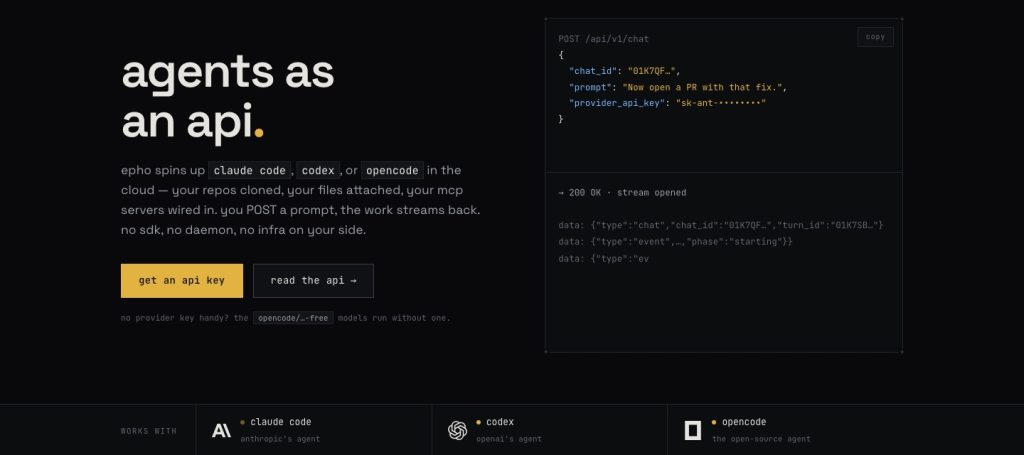
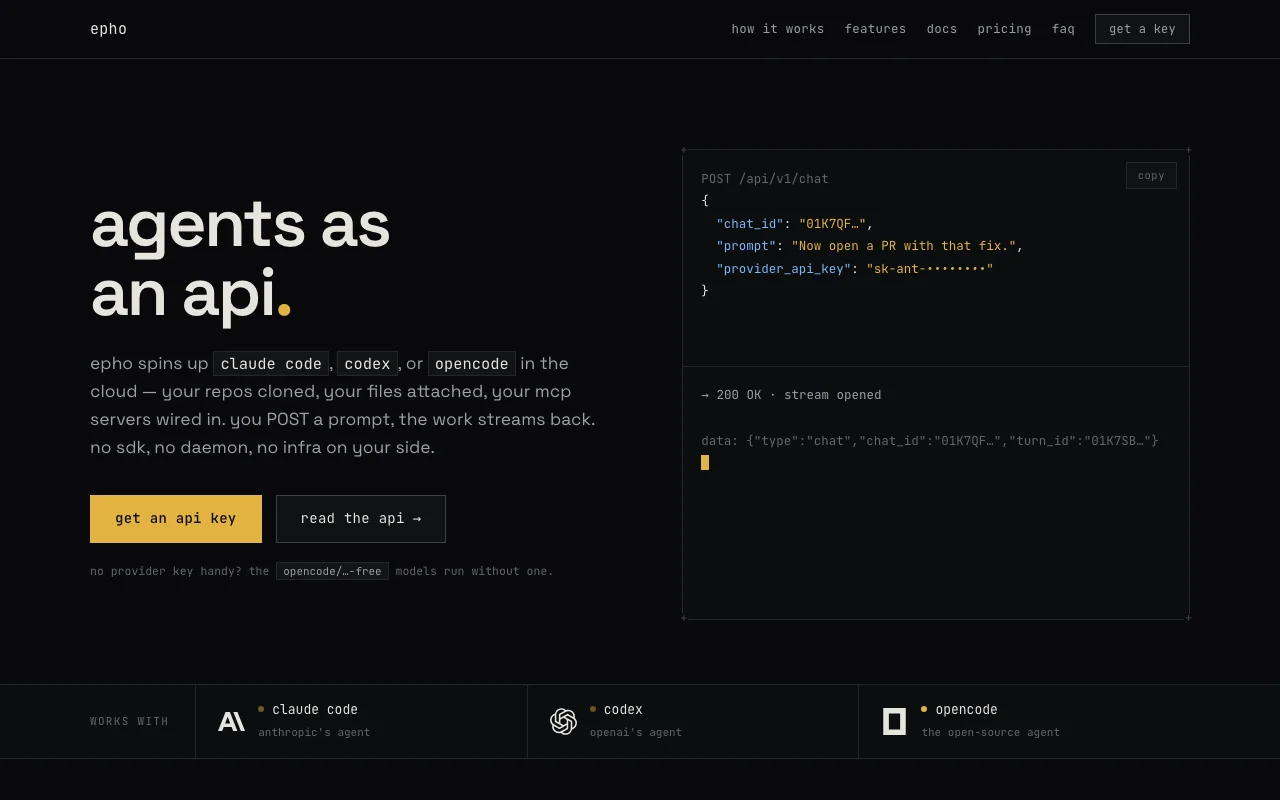
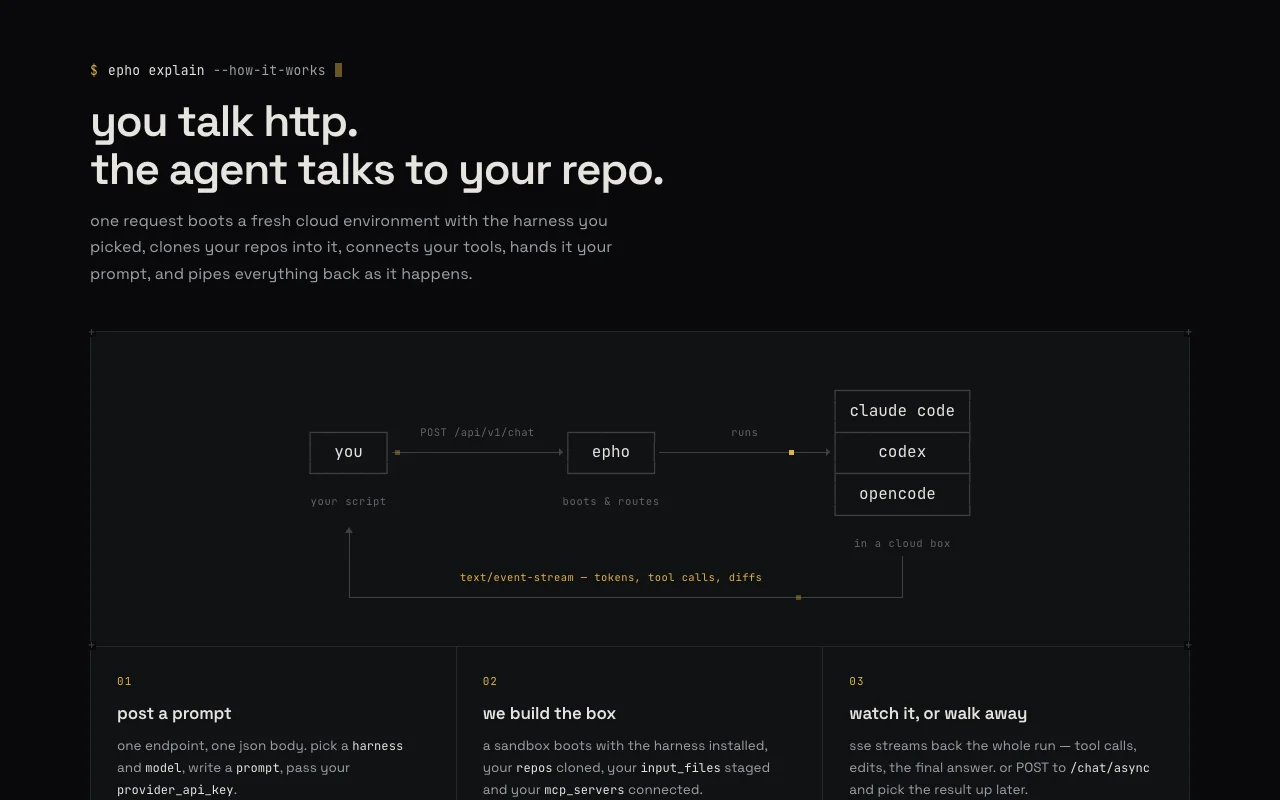
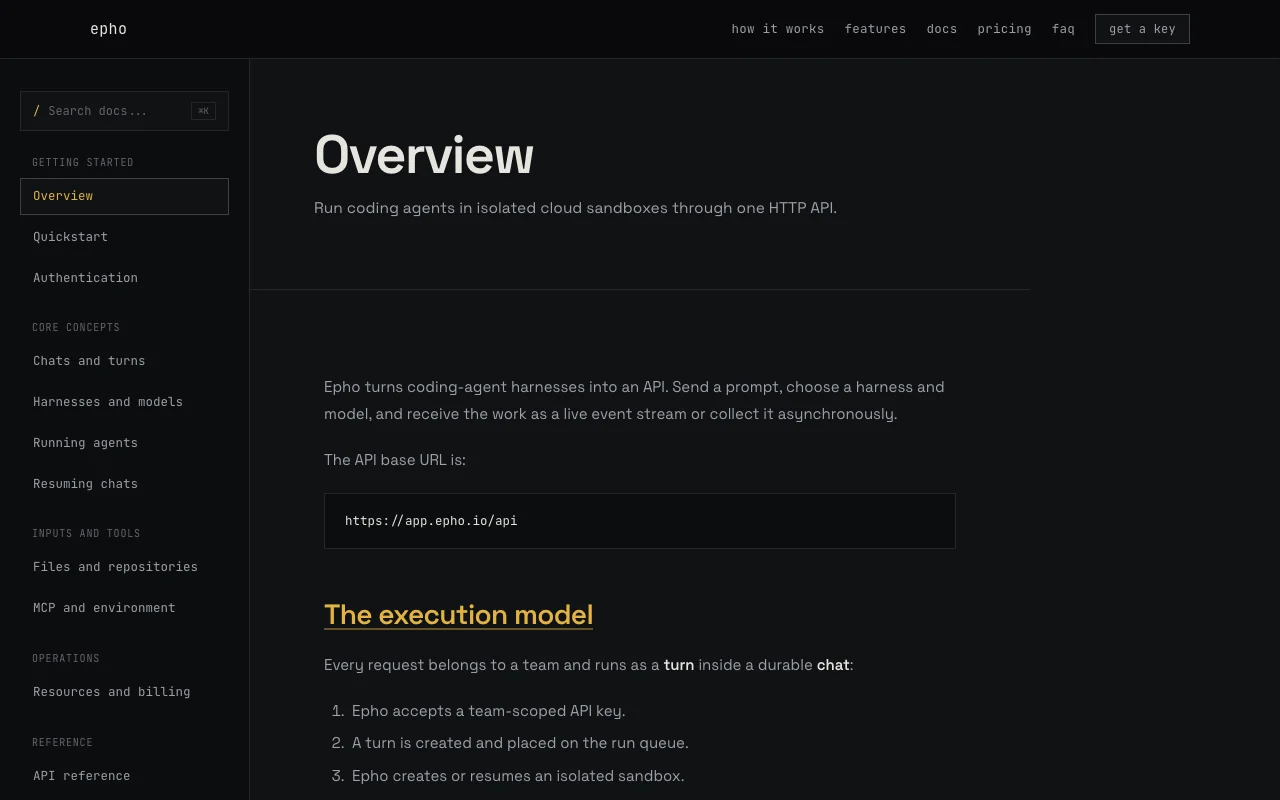
epho exposes coding-agent harnesses (Claude Code, Codex, OpenCode) as a single HTTP endpoint. You POST a prompt with a harness, model, your provider API key and optional repos, input files, MCP servers and environment variables; epho boots an isolated cloud sandbox, runs the agent and streams tool calls, edits and the final answer back over SSE, or accepts the job asynchronously with webhook delivery.
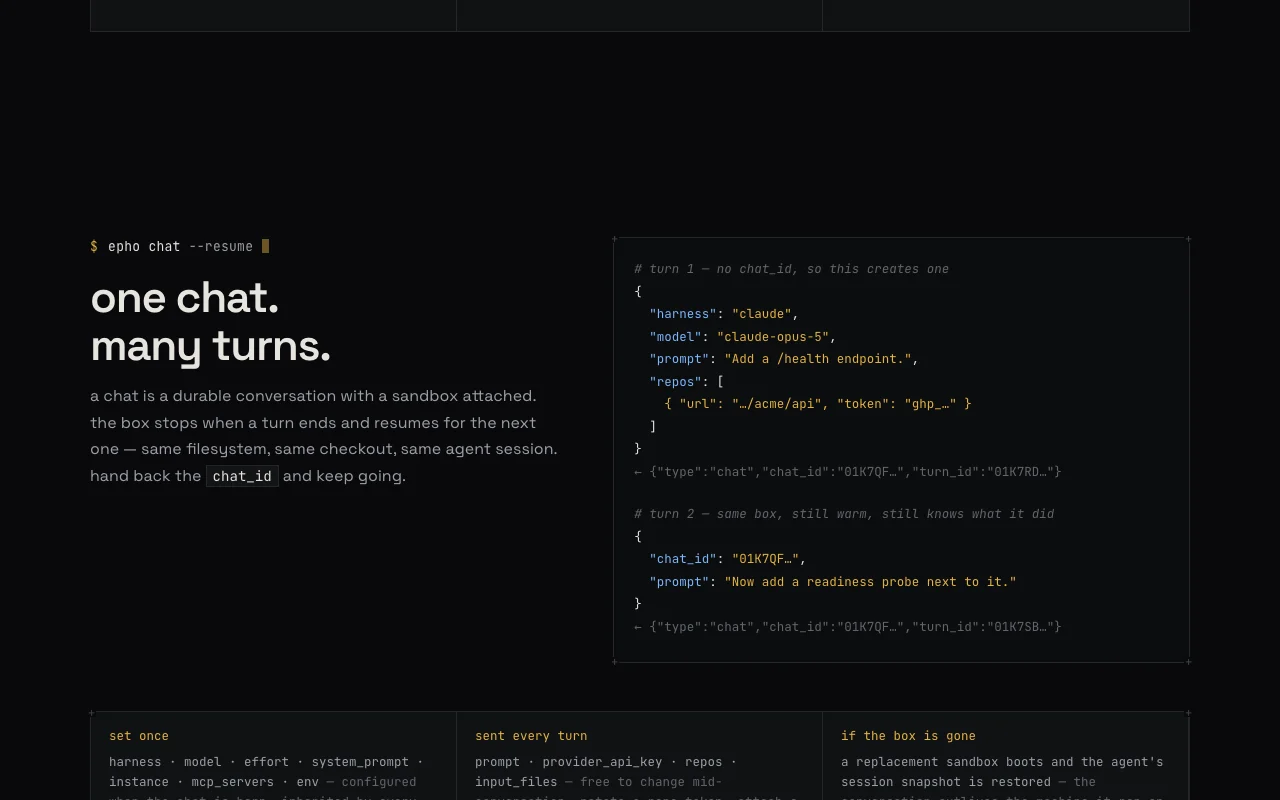
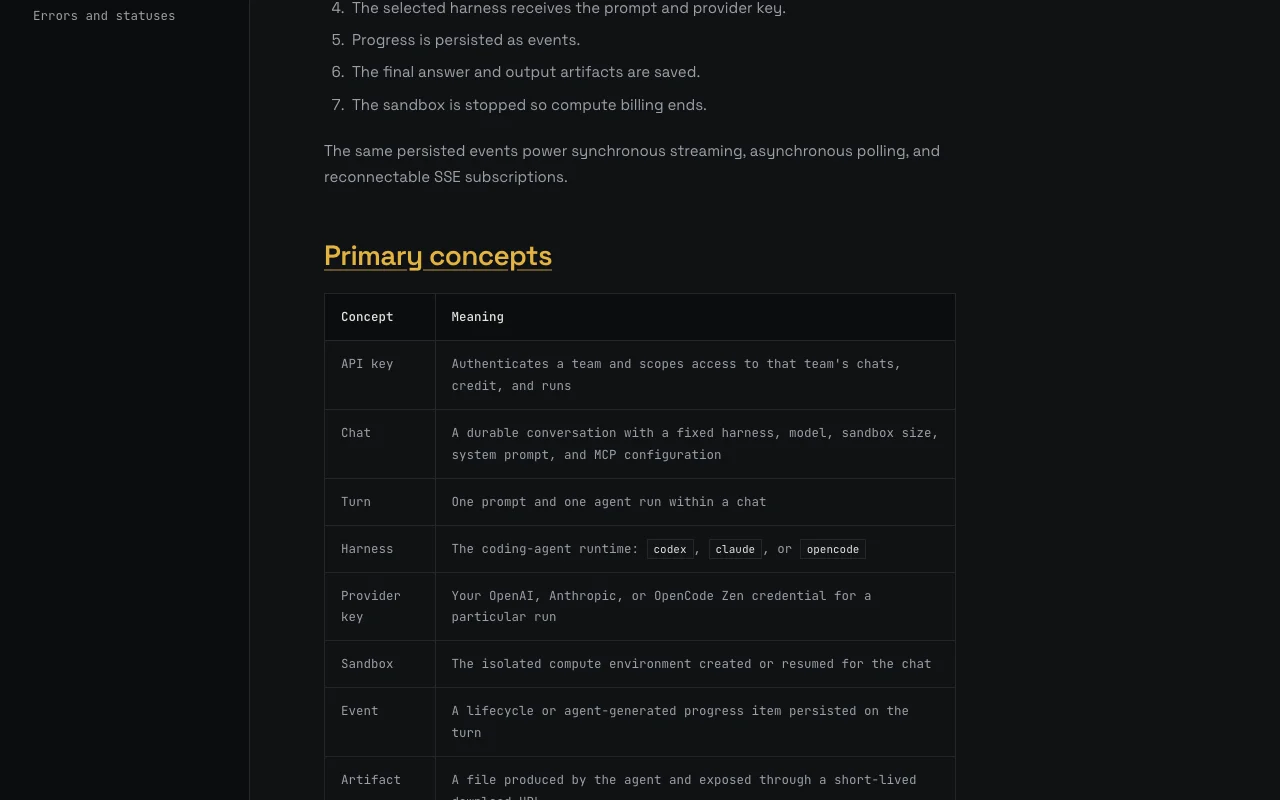
Runs are grouped into durable chats that resume the same sandbox and agent session across turns. Billing is usage-based per second of sandbox CPU, memory and disk; model tokens are billed by your own provider, not by epho. The service is operated by Bruin Data Limited.
epho's official site: how the product presents itself. epho.io, captured Oct 1, 2026
What you provide and what you get back
What you give epho and what comes back, from its documentation
You provide
Prompt with harness and model choice
Your provider API key
Git repos (up to 32) with tokens
Input files, MCP servers, environment variables
You get back
SSE stream of tool calls, edits and final answer
Done event with presigned artifacts
Async job IDs plus webhook delivery
Where you can use it
Platforms
Web, API
Account
Required
Best use cases for epho
Scenarios are worked out by our editors from the documentation; the actual result depends on your input and plan.
Automating pull-request reviews or issue-to-PR pipelines from CI, cron or GitHub Actions
Who
DevOps and platform engineers
You provide
Repo URL and review prompt triggered from CI, cron or GitHub Actions
Durable multi-turn chats that resume the same sandbox filesystem and session
Keeps durable chats that resume the same sandbox filesystem and agent session Supports follow-up tasks without losing context
Access: All usageLimit: Replacement sandbox restores a session snapshot if the box is gonesource (opens in a new tab)
epho: strengths and limits
Where epho is strong
Per-second usage billing with a reported cost_usd on every run You can see the cost of every rundocumentedsource (opens in a new tab)
$10 starting credit on signup (about 60 hours of the default 2 vCPU / 2 GiB instance) You can test the service before adding fundsdocumentedsource (opens in a new tab)
No SDK or local daemon required; plain HTTP/curl works You can integrate from any languagedocumentedsource (opens in a new tab)
Public docs with quickstart and API reference You can find endpoint details before committingdocumentedsource (opens in a new tab)
Limitations to check before paying
Requires your own OpenAI/Anthropic/OpenCode Zen key for non-free models; tokens billed separately You manage two bills: sandbox time and model tokensdocumentedsource (opens in a new tab)
Teams start capped at five concurrent active turns; excess requests queue Large fleets must request higher concurrencydocumentedsource (opens in a new tab)
Only one live turn per chat at a time Follow-ups on the same chat cannot overlapdocumentedsource (opens in a new tab)
Requests are refused (HTTP 402) once credit balance reaches zero Unattended jobs can stop when credit runs outdocumentedsource (opens in a new tab)
How to use epho for running a coding agent in a cloud sandbox over HTTP
epho documentation: where the steps below come from. epho.io, captured Oct 1, 2026
Set up epho
Sign up at app.epho.io and copy your epho API key
Pick a harness (claude, codex or opencode) and a model
Prepare a repo URL with an access token if the repo is private
Example: running a coding agent in a cloud sandbox over HTTP
POST to /api/v1/chat with harness, model, prompt, provider_api_key and repos
Read the SSE stream for tool calls and the done event
Reuse the returned chat_id for a follow-up turn
For long jobs, call /chat/async with a webhook_url
Review and export the result
Check the cost_usd field in the done event against your credit
Open the returned artifacts or diff before merging anything
Example prompt suggested by our editors (not a recorded output of the product)
Add a /health endpoint to the API that returns 200 with the current git commit, and write a test for it.
epho integrations and API
epho documentation (continued). epho.io, captured Oct 1, 2026
Native integrations and export formats
Export: SSE event stream, Presigned artifacts
API access and separate billing
epho has no public API in its official documentation. Single POST /api/v1/chat endpoint plus /chat/async API documentation ↗
Privacy, data use and commercial rights
Summarized from the vendor's current policies; this is not legal advice and a vendor's badge is not an independent audit.
How your inputs and outputs are handled
Prompts, repos and files are sent into an isolated sandbox
unknown
unknown
Commercial use and plan restrictions
unknown
unknown
Controls for business users
Provider key sent per request and torn down with the run
Isolated cloud sandbox per chat
Other tools to consider instead of epho
"Better suited" is based on documented features and pricing, not on a head-to-head test.
Cursor: better suited to
GitHub Copilot: better suited to
Replit: better suited to
Devin Desktop (formerly Windsurf): better suited to
It is billed per second for sandbox CPU ($0.0000164 per vCPU-second), memory ($0.0000053 per GiB-second) and disk, about $0.0026 per one-minute run on the default instance. source (opens in a new tab)
Do I need my own model key?
Yes for non-free models: your OpenAI, Anthropic or OpenCode Zen key rides along with each request; OpenCode Zen models ending in -free need no key. source (opens in a new tab)
How much free credit is there?
New accounts get a $10 starting credit, about 60 hours of the default 2 vCPU / 2 GiB instance. source (opens in a new tab)
Yes, pass the chat_id to resume the same sandbox filesystem and agent session, though only one live turn per chat is allowed. source (opens in a new tab)
Not verified: Data retention and training terms (privacy page 404); Tax handling; Higher concurrency tiers.
How we documented and maintain this page
Every fact about epho above comes from the 3 official pages listed here, last compared on Oct 1, 2026; we have not run epho ourselves, so it has no editorial score. How we check and re-check pages.
Article updated Oct 10, 2026; prices checked Oct 1, 2026. Outbound links to vendors are plain links; we do not earn commissions. How we review · Report an error