Our take: Evaluate ZGI if your team wants to self-host an open-source agent platform that routes across OpenAI, Anthropic, DeepSeek and Qwen and queries company databases in natural language.
Main limitation: Hosted pricing is unpublished, documentation is marked under construction, and digital workers plus chat-channel integrations are in development, not in the current release.
By the AI Tool Atlas editors.
Based on the vendor's official documentation; we have not tested this product hands-on. What “documented overview” means
Who should use ZGI
Evaluate ZGI if your team wants to self-host an open-source agent platform that routes across OpenAI, Anthropic, DeepSeek and Qwen and queries company databases in natural language. Based on the vendor's documentation, not on a hands-on test.
Best for: Enterprises standardizing on one agent runtime
Also a good fit for
Teams needing multi-provider LLM routing
Developers self-hosting an agent platform
Consider another tool if no public pricing page found for the hosted cloud offering
Or if
Digital workers and channel integrations are marked as not yet available
Governance features (IAM, budgets, audit) are listed as current work in progress on the roadmap
ZGI pricing and usage limits
Prices checked Oct 1, 2026 on the official US pricing page. Prices and limits change often.
Vendor pricing page re-checked automatically 11 days ago: no changes detected.
Free access and trial conditions
Self-hosting from the public GitHub repository; license terms are in the ZGI Community License.
Code published on GitHub under the ZGI Community License
Usage caps, credits and extra costs
Provider API costs for connected models are not covered on the site.
Not stated.
What is ZGI, and how does it work?
ZGI is an open-source agent runtime for businesses from Hangzhou Zhineng Qiyuan Technology. It bundles an Agent Studio for building agents with Skills, knowledge, tools and models; a Workflows module for orchestrating multi-step jobs; a Database module for querying live business data in natural language; and a Model Gateway that connects providers such as OpenAI, Anthropic, Google, DeepSeek and Qwen with routing by quality, cost or region.
The code is published on GitHub under the ZGI Community License and can be self-hosted, while a hosted workspace is offered at cloud.zgi.ai. A 'digital workers' concept with email and chat-channel integrations is shown as in development and not part of the current release.
What you provide and what you get back
What you give ZGI and what comes back, from its documentation
You provide
Company files and knowledge
Business database connections
Model provider credentials
Skills and tool definitions
You get back
Business agents answering with company knowledge
Workflow executions with inspectable runs
Natural-language database answers
Where you can use it
Platforms
Web
Account
Required
Modules
Agent Studio, Workflows, Database, Model Management, Knowledge Assets
Model providers
OpenAI, Anthropic, Google, DeepSeek, Qwen and more
Source code is public on GitHub and self-hostable You can audit and self-host the code instead of relying on a vendor black boxdocumentedsource (opens in a new tab)
Supports both global and Chinese model providers in one gateway You can mix Western and Chinese providers without separate integrationsdocumentedsource (opens in a new tab)
Roadmap and blog are published openly You can see what is planned and what is not available yet before adoptingdocumentedsource (opens in a new tab)
Hosted cloud workspace available without local deployment You can try the product without installing it yourselfdocumentedsource (opens in a new tab)
Check before paying for ZGI
No public pricing page found for the hosted cloud offering Budgeting is impossible without contacting the vendordocumentedsource (opens in a new tab)
Digital workers and channel integrations are marked as not yet available Teams wanting an always-on agent in email or Slack must wait for future releasesdocumentedsource (opens in a new tab)
Governance features (IAM, budgets, audit) are listed as current work in progress on the roadmap Enterprise security teams may find controls incomplete todaydocumentedsource (opens in a new tab)
Usage governed by a custom ZGI Community License rather than a standard OSI license The license needs legal review before commercial redistributiondocumentedsource (opens in a new tab)
How to use ZGI for building a business Q&A agent on company data
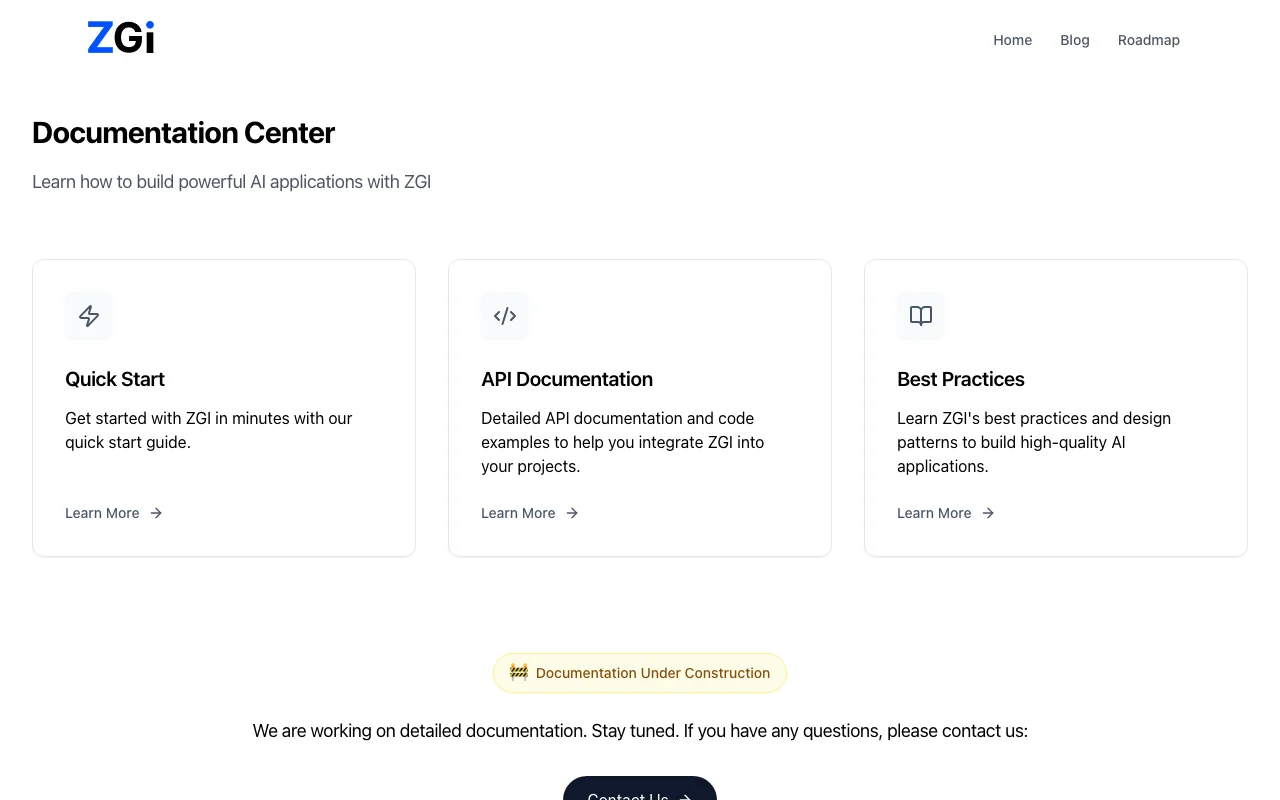
ZGI documentation: where the steps below come from. zgi.ai, captured Oct 2, 2026
Set up ZGI
Open cloud.zgi.ai or clone the ZGI repository from GitHub to self-host
Connect one or more model providers in Model Management
Upload company files into Knowledge Assets
Open Agent Studio and create a new agent
Example: building a business Q&A agent on company data
Attach a Skill, such as Renewal Risk, and the knowledge assets to the agent
Connect a business database for natural-language queries
Ask the agent which renewals need attention this week
Open the process view to see which Skills, searches and queries ran
Review and export the result
Verify answers against the source documents or database rows
Review the execution trace to confirm the right Skill and data source were used
Example prompt suggested by our editors (not a recorded output of the product)
Which customer renewals need attention this week, and what is the risk for each?
ZGI API
API access and separate billing
ZGI has no public API in its official documentation. API documentation listed but marked under construction API documentation ↗
Privacy, data use and commercial rights
Summarized from the vendor's current policies; this is not legal advice and a vendor's badge is not an independent audit.
How your inputs and outputs are handled
Company files, database queries and prompts pass through the platform and to connected model providers.
Not stated (privacy page unavailable).
Commercial use and plan restrictions
Governed by the ZGI Community License (terms not loaded).
Not stated.
Controls for business users
Self-hosting
Routing, quota and fallback policies at the gateway
Other tools to consider instead of ZGI
"Better suited" is based on documented features and pricing, not on a head-to-head test.
n8n: better suited to
Make: better suited to
Zapier: better suited to
Gemini Notebook (formerly NotebookLM): better suited to
It connects OpenAI, Anthropic, Google, DeepSeek, Qwen and more, then selects models per agent by quality, availability, cost or region and controls quotas and fallback centrally. source (opens in a new tab)
Can I self-host ZGI?
Yes. The code is public on GitHub under the ZGI Community License and can be deployed on your own infrastructure; a hosted workspace is at cloud.zgi.ai. source (opens in a new tab)
Are ZGI digital workers available?
No. Digital workers with email and chat channels like Slack, Teams and Lark are shown as coming soon and not in the current release. source (opens in a new tab)
Not yet. The docs page lists Quick Start, API Documentation and Best Practices but says documentation is under construction. source (opens in a new tab)
Not verified: Hosted pricing and plans; Privacy, retention and training terms (pages 404); License terms text; Quickstart and API documentation contents.
How we documented and maintain this page
Every fact about ZGI above comes from the 4 official pages listed here, last compared on Oct 1, 2026; we have not run ZGI ourselves, so it has no editorial score. How we check and re-check pages.
Article updated Oct 2, 2026; prices checked Oct 1, 2026. Outbound links to vendors are plain links; we do not earn commissions. How we review · Report an error