CodingDocumented overviewLast checked Sep 29, 2026

Tinker (Thinking Machines Lab): Pricing, Features & Best Use Cases

Training API from Thinking Machines Lab for fine-tuning open models with LoRA while it manages the infrastructure.

Is Tinker (Thinking Machines Lab) right for you?

Tinker is for ML researchers and teams that want to write their own training data and algorithm code for LoRA fine-tuning of open models while Thinking Machines runs the GPU infrastructure. Based on the vendor's documentation, not on a hands-on test.

Best for: ML researchers

Also a good fit for

  • Teams fine-tuning open models

Consider another tool if requires sign-up and account

Or if

  • Aimed at researchers writing training code
  • Checkpoint storage billed at $0.10/GB-month

Tinker (Thinking Machines Lab) pricing and usage limits

Prices checked Sep 29, 2026 on the official US pricing page. Official pricing ↗ Prices and limits change often.

Free access and trial conditions

Not stated

Not stated

Paid plans: what changes as you upgrade

Usage-based web

Usage-based source (opens in a new tab)

Unknown

For: Researchers and developers fine-tuning open models

Limits

  • Checkpoint storage $0.10 per GB-month
  • Per-model token rates are in the docs, not captured

Includes

  • forward_backward, optim_step, sample, save_state API
  • LoRA fine-tuning of open models
1 more
  • Downloadable checkpoints

API included

Usage caps, credits and extra costs

Checkpoint storage billed at $0.10/GB-month

Not stated

What is Tinker (Thinking Machines Lab), and how does it work?

Tinker is a training API for researchers and developers. You write the data and algorithm code and Tinker handles scheduling, resource management and GPU infrastructure. It exposes functions such as forward_backward, optim_step, sample and save_state, and supports a range of open-weight models using LoRA.

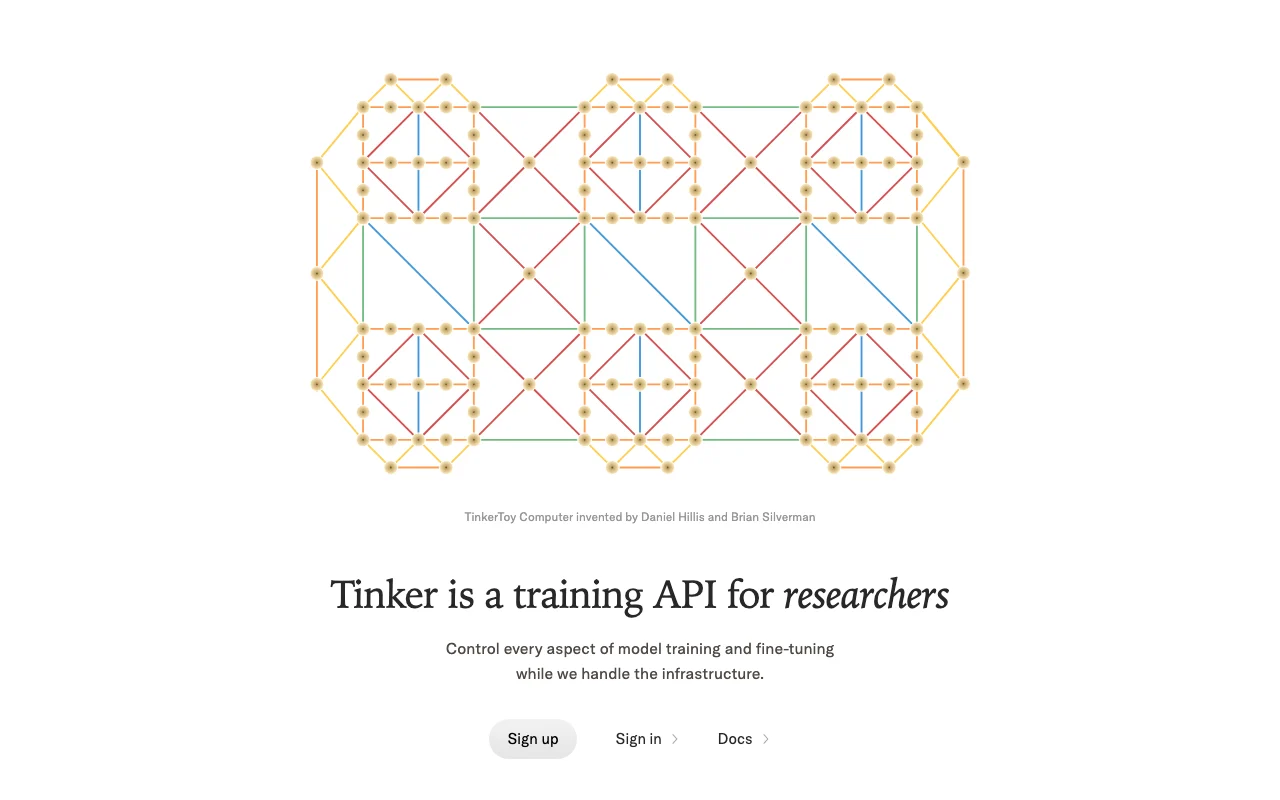
Tinker (Thinking Machines Lab) homepage — screenshot of the coding AI tool, Oct 2, 2026
Tinker (Thinking Machines Lab)'s official site: how the product presents itself. thinkingmachines.ai, captured Oct 2, 2026

What you provide and what you get back

How Tinker (Thinking Machines Lab) works: what you provide, where it runs and what you get backYOU PROVIDEYour inputSupervised learning datasets or R…Training algorithm codeA chosen open-weight base modelCODINGTinker (Thinking Machines La…APIprice not publishedno free tieraccount requiredchecked Sep 29, 2026YOU GET BACKThe resultLoRA adapters and saved checkpoin…Sampled tokens for evaluation or…Downloadable model weightsinput → Tinker (Thinking Machines Lab) → output · from the vendor's own pages, no hands-on test unless stated
What you give Tinker (Thinking Machines Lab) and what comes back, from its documentation

You provide

  • Supervised learning datasets or RL environments
  • Training algorithm code
  • A chosen open-weight base model

You get back

  • LoRA adapters and saved checkpoints
  • Sampled tokens for evaluation or RL
  • Downloadable model weights

Where you can use it

Platforms
API
Account
Required
Method
LoRA
Core functions
forward_backward, optim_step, sample, save_state
Models
Qwen, Kimi, DeepSeek, GPT-OSS, Nemotron, GLM
Storage price
$0.10 per GB-month
Export
Checkpoint download

Best use cases for Tinker (Thinking Machines Lab)

Scenarios are worked out by our editors from the documentation; the actual result depends on your input and plan.

Fine-tuning open models on production traces

Who
ML engineers
You provide
Anonymized traces such as preferred and rejected tool calls
Expected result
A smaller specialized model (e.g. a search subagent)
Plan needed
Usage-based
Limitation
Needs your own training code source (opens in a new tab)

Reinforcement learning experiments

Who
Researchers
You provide
RL environments and reward code
Expected result
Policies trained with sample and optim_step loops
Plan needed
Usage-based
Limitation
Infrastructure handled, algorithm is yours source (opens in a new tab)

Distillation research

Who
Labs and startups
You provide
Teacher outputs and a student base model
Expected result
A distilled model checkpoint
Plan needed
Usage-based
Limitation
Model catalog changes as models retire source (opens in a new tab)

Exporting trained weights

Who
Teams that want to self-host
You provide
A saved checkpoint
Expected result
Downloaded weights via an API endpoint
Plan needed
Usage-based
Limitation
Storage billed per GB-month source (opens in a new tab)

Tinker (Thinking Machines Lab) features and their limits

forward_backward, optim_step, sample, save_state API

Exposes four primitives for gradients, updates, sampling and saving progress You control the training loop

Access: AccountLimit: You must write the loop source (opens in a new tab)

LoRA fine-tuning

Trains a small adapter instead of all weights Cuts compute while matching full fine-tuning in the vendor's research

Access: AccountLimit: Adapters, not full-weight tuning source (opens in a new tab)

Open-model catalog

Offers models such as Kimi-K2.6, GPT-OSS, Qwen, DeepSeek and Nemotron Pick the base that fits

Access: AccountLimit: Some models retire (for example Qwen3.6-27B) source (opens in a new tab)

Cookbook recipes

Provides realistic examples and abstractions for fine-tuning Faster start

Access: PublicLimit: Examples need adaptation source (opens in a new tab)

Checkpoint download

Lets you download any saved checkpoint No lock-in on trained weights

Access: AccountLimit: Storage costs $0.10/GB-month source (opens in a new tab)

Pros, cons and deal-breakers

Reasons to choose Tinker (Thinking Machines Lab)

Check before paying for Tinker (Thinking Machines Lab)

How to use Tinker (Thinking Machines Lab) for fine-tuning an open model with LoRA through an API

Set up Tinker (Thinking Machines Lab)

  1. Sign up for Tinker from thinkingmachines.ai/tinker
  2. Create an API key in the console
  3. Install the Tinker client and open the cookbook for a starter recipe

Example: fine-tuning an open model with LoRA through an API

  1. Pick a base model such as Qwen3.5-9B
  2. Prepare supervised examples or an RL environment
  3. Loop forward_backward and optim_step over batches
  4. Call sample to evaluate and save_state to checkpoint

Review and export the result

  1. Sample outputs and compare against your baseline model
  2. Download the checkpoint and confirm it loads

Tinker (Thinking Machines Lab) integrations and API

Native integrations and export formats

Export: Model checkpoints

API access and separate billing

An API is available, billing not documented. Training API with Python-style functions; docs page not loaded API documentation ↗

Privacy, data use and commercial rights

Summarized from the vendor's current policies; this is not legal advice and a vendor's badge is not an independent audit.

How your inputs and outputs are handled

Training data and checkpoints you submit

Your data is used solely to fine-tune your models; not used to train Thinking Machines' own models

Not stated

Commercial use and plan restrictions

Not stated

Not stated

Best Tinker (Thinking Machines Lab) alternatives for different needs

"Better suited" is based on documented features and pricing, not on a head-to-head test.

Claude: better suited to

Google Gemini: better suited to

Alternatives
AlternativeWhen to choose itPricingLimitation
Claude——
Google Gemini——

Explore Tinker (Thinking Machines Lab) further

Related to Tinker (Thinking Machines Lab)

Tinker (Thinking Machines Lab) user reviews

No user reviews yet.

Used Tinker (Thinking Machines Lab)? Be the first to share your experience.

Write a review

Reviews are checked by a moderator before they appear. Your email is never published. Plain text only.

Your rating (required)

Show what you made or what went wrong. Images are published only if the review is approved; location data is removed.

    Tinker (Thinking Machines Lab) FAQ

    What is Tinker?

    A training API from Thinking Machines Lab for fine-tuning open models with LoRA while it handles scheduling and GPU infrastructure. source (opens in a new tab)

    How is Tinker priced?

    Usage-based in USD per million tokens, with checkpoint storage at $0.10 per GB-month. source (opens in a new tab)

    Is my data used to train Thinking Machines models?

    No, the FAQ says your data is used solely to fine-tune your models. source (opens in a new tab)

    Can I download my trained weights?

    Yes, an API endpoint lets you download any saved checkpoint. source (opens in a new tab)

    Which models can I train?

    A range of open models such as Qwen, Kimi-K2.6, DeepSeek-V3.1, GPT-OSS and Nemotron, with some marked as retiring. source (opens in a new tab)

    Sources and review methodology

    Official sources and verification dates

    Not verified: Per-million-token rates; Free credits; Privacy retention; US availability.

    How we documented and maintain this page

    Every fact about Tinker (Thinking Machines Lab) above comes from the 2 official pages listed here, last compared on Sep 29, 2026; we have not run Tinker (Thinking Machines Lab) ourselves, so it has no editorial score. How we check and re-check pages.

    Article updated Oct 10, 2026; prices checked Sep 29, 2026. Outbound links to vendors are plain links; we do not earn commissions. How we review · Report an error