Our take: LTVX.ai fits merchants with meaningful card-decline losses who can book a demo; there is no public pricing and the dashboard is labeled Beta.
Main limitation: There is no public pricing, so you must contact the vendor or book a demo to learn what it costs.
By the AI Tool Atlas editors.
Based on the vendor's official documentation; we have not tested this product hands-on. What “documented overview” means
Who should use LTVX.ai
LTVX.ai fits merchants with meaningful card-decline losses who can book a demo; there is no public pricing and the dashboard is labeled Beta. Based on the vendor's documentation, not on a hands-on test.
Best for: E-commerce and subscription merchants with declined payments
Also a good fit for
Payment and fintech teams
Consider another tool if no public pricing; contact or demo required
Or if
Aimed at merchants, not individuals
Dashboard shown is labeled Beta
LTVX.ai pricing and usage limits
Prices checked Oct 2, 2026 on the official US pricing page. Prices and limits change often.
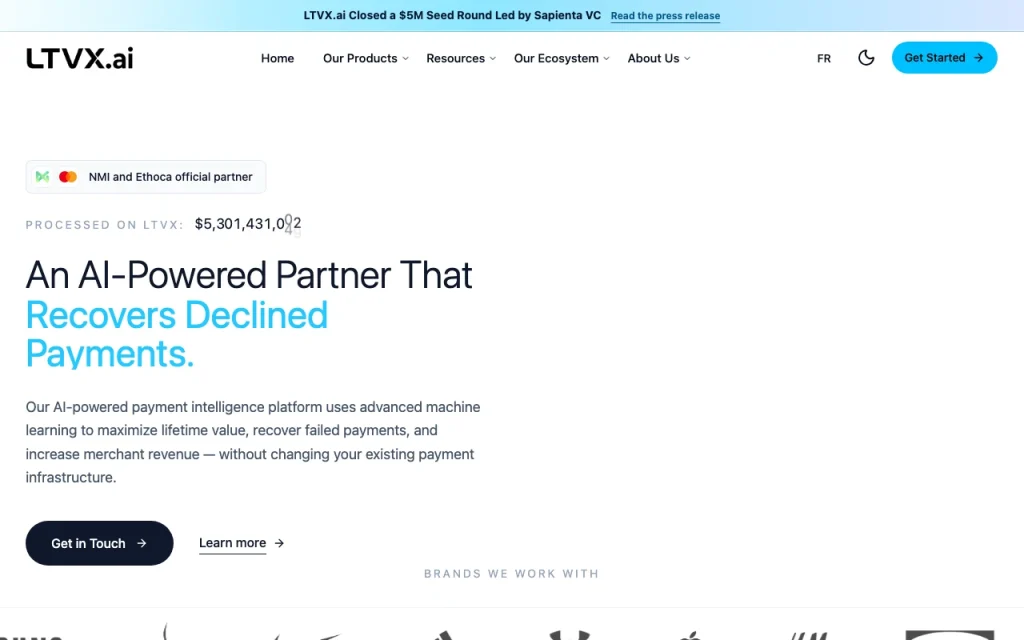
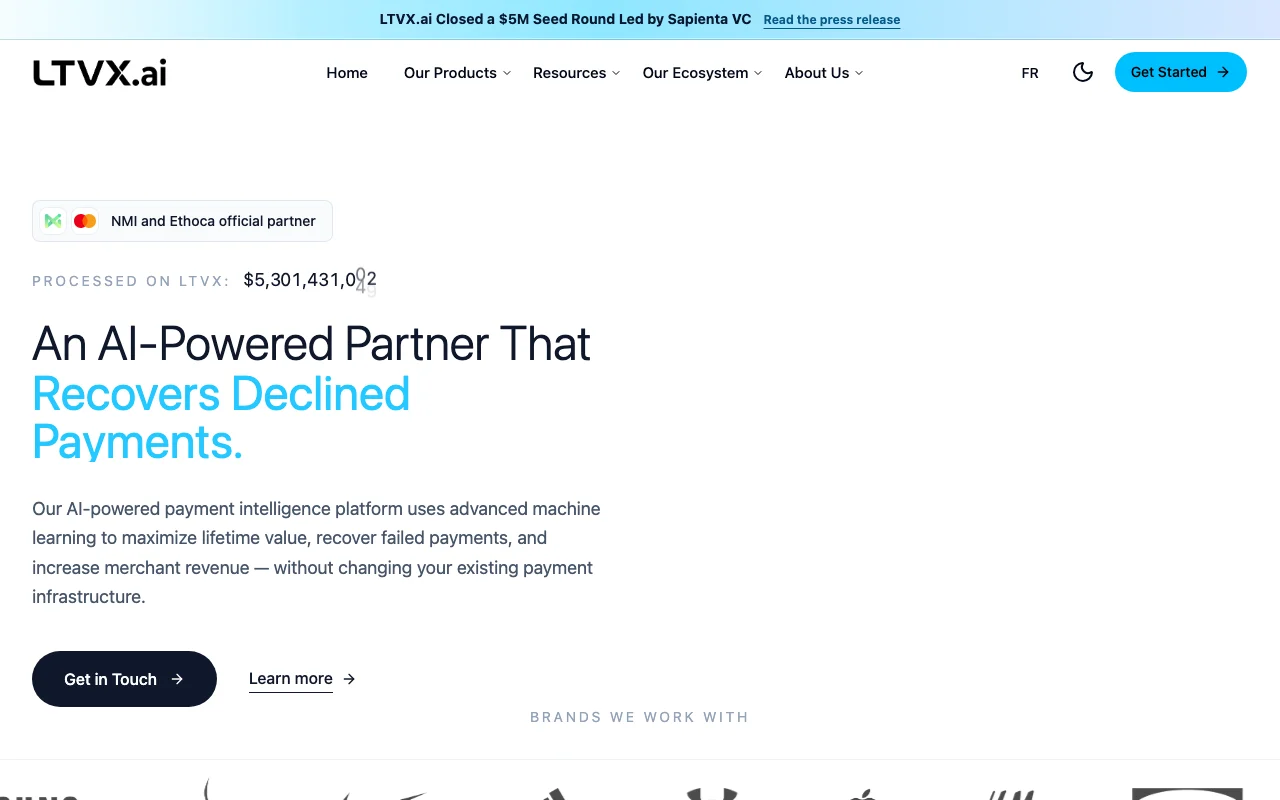
LTVX.ai is an AI-powered payment intelligence platform for merchants. It says its machine learning models maximize customer lifetime value, recover failed payments and increase revenue without changing the existing payment infrastructure.
The site describes predictive LTV scoring, churn prevention, decline recovery through real-time retry routing, and internal acquiring, with a dashboard for revenue and recovery metrics. LTVX.ai is operated by Payment Ventures FZE LLC (Abu Dhabi) and lists an office in New Jersey, USA. It is aimed at merchants and payment businesses rather than individual users.
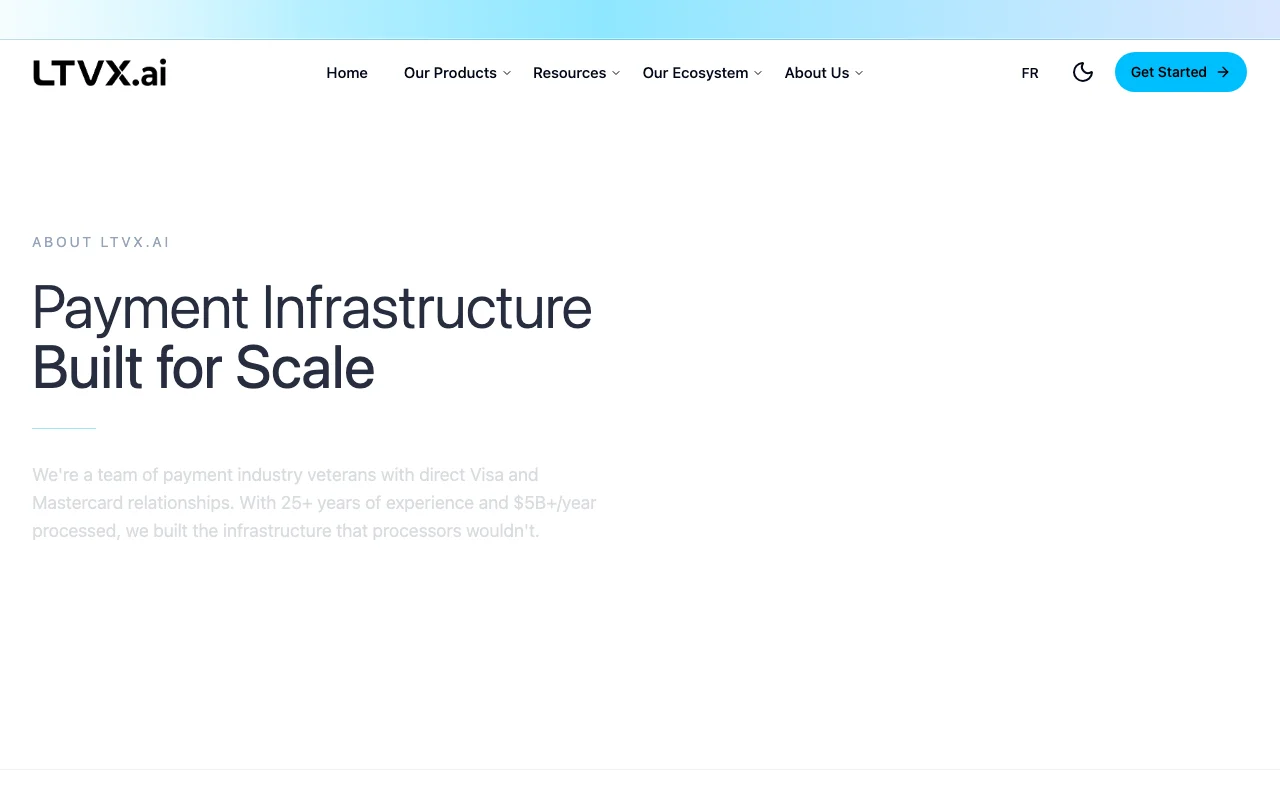
LTVX.ai's official site: how the product presents itself. ltvx.ai, captured Oct 2, 2026
What you provide and what you get back
What you give LTVX.ai and what comes back, from its documentation
You provide
Payment transaction data
Customer history
You get back
Recovered declined transactions
Lifetime value predictions
Where you can use it
Platforms
web
Account
Required
Focus
Decline recovery and LTV
Compliance
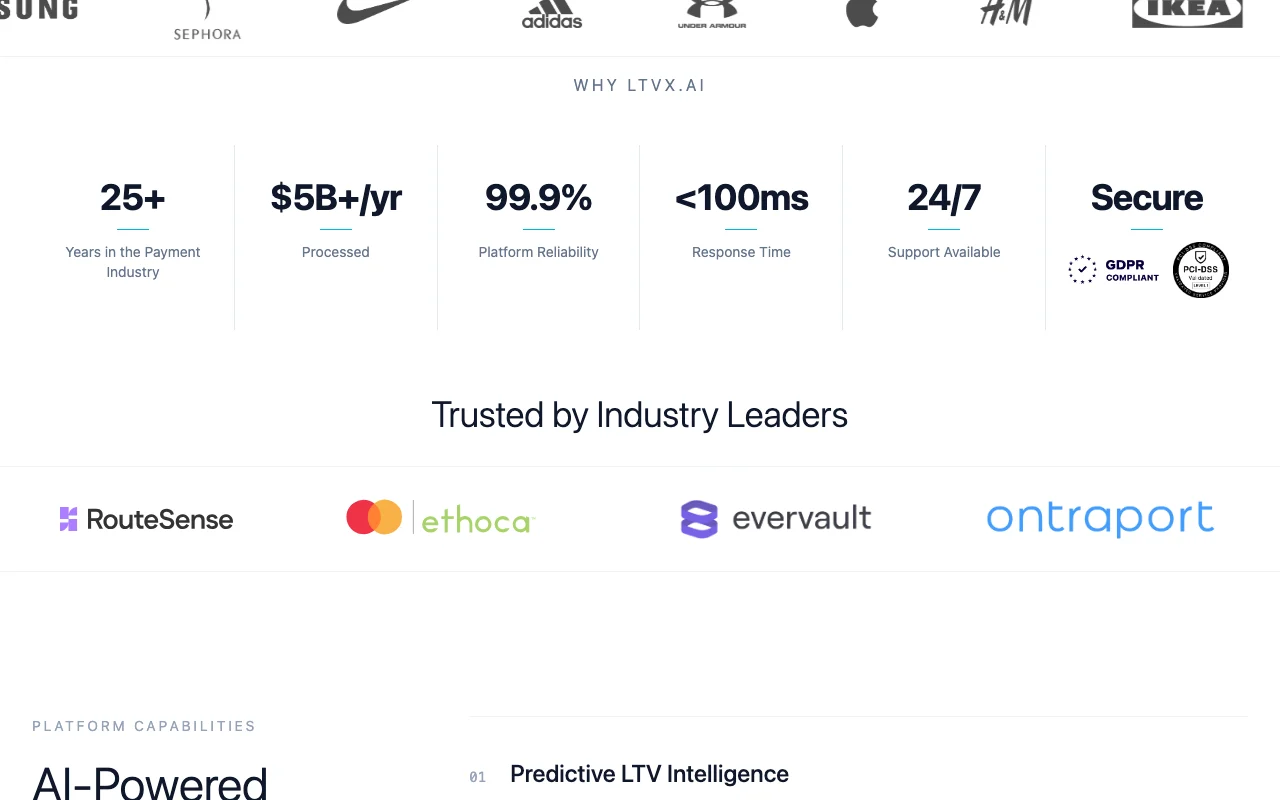
PCI DSS Level 1, GDPR (stated)
Status
Dashboard in Beta
Where LTVX.ai is most useful
Scenarios are worked out by our editors from the documentation; the actual result depends on your input and plan.
Recovering falsely declined card transactions
Who
Online merchants
You provide
Declined card payments
Expected result
Falsely declined card payments are retried through other routes so that more sales are completed.
You get a predicted lifetime value for customers based on their purchase data.
Plan needed
Contact vendor
Limitation
The dashboard shown is labeled Beta, so the way it presents predictions may change. source (opens in a new tab)
Churn prevention for subscription merchants
Who
Subscription businesses
You provide
Subscriber behavior
Expected result
You get signals that point to subscribers who may cancel, so you can act before they leave.
Plan needed
Contact vendor
Limitation
The product is aimed at merchants, and the sources do not state how churn is measured for subscribers. source (opens in a new tab)
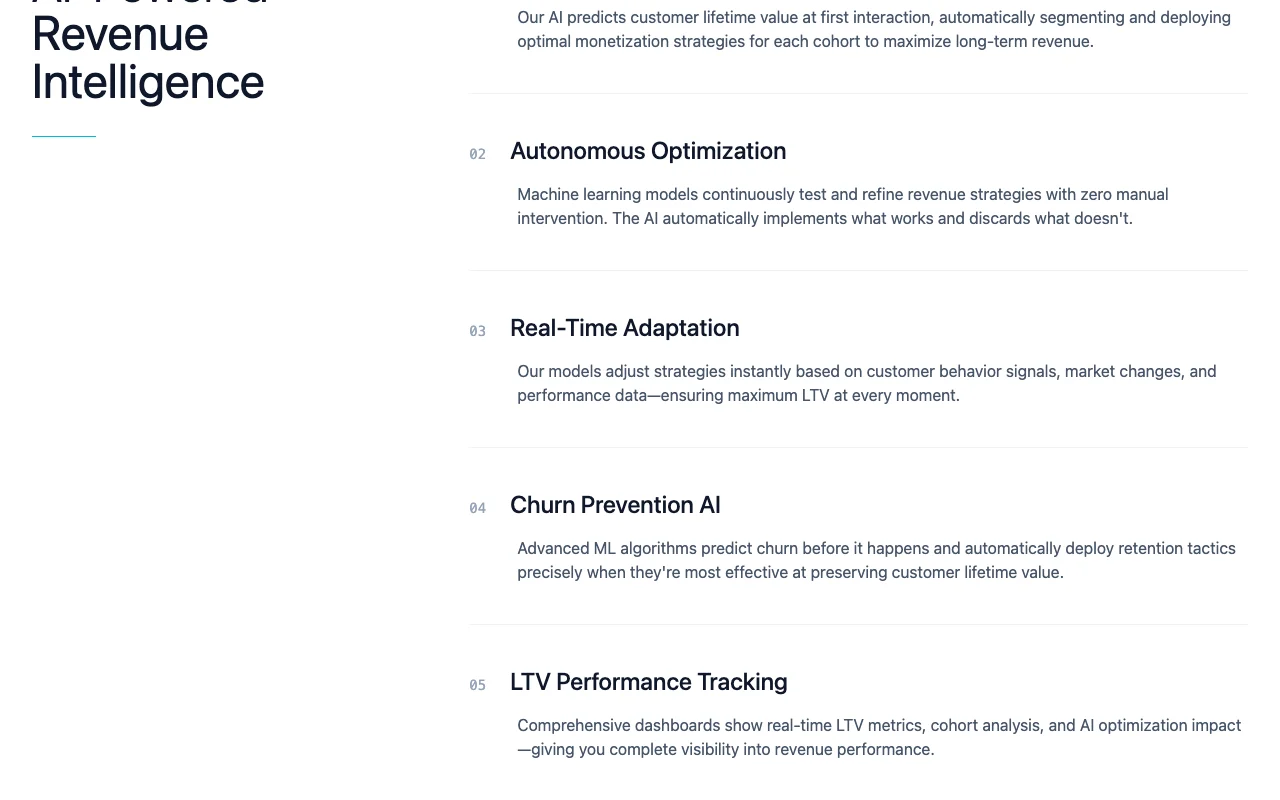
What LTVX.ai does, and where it stops
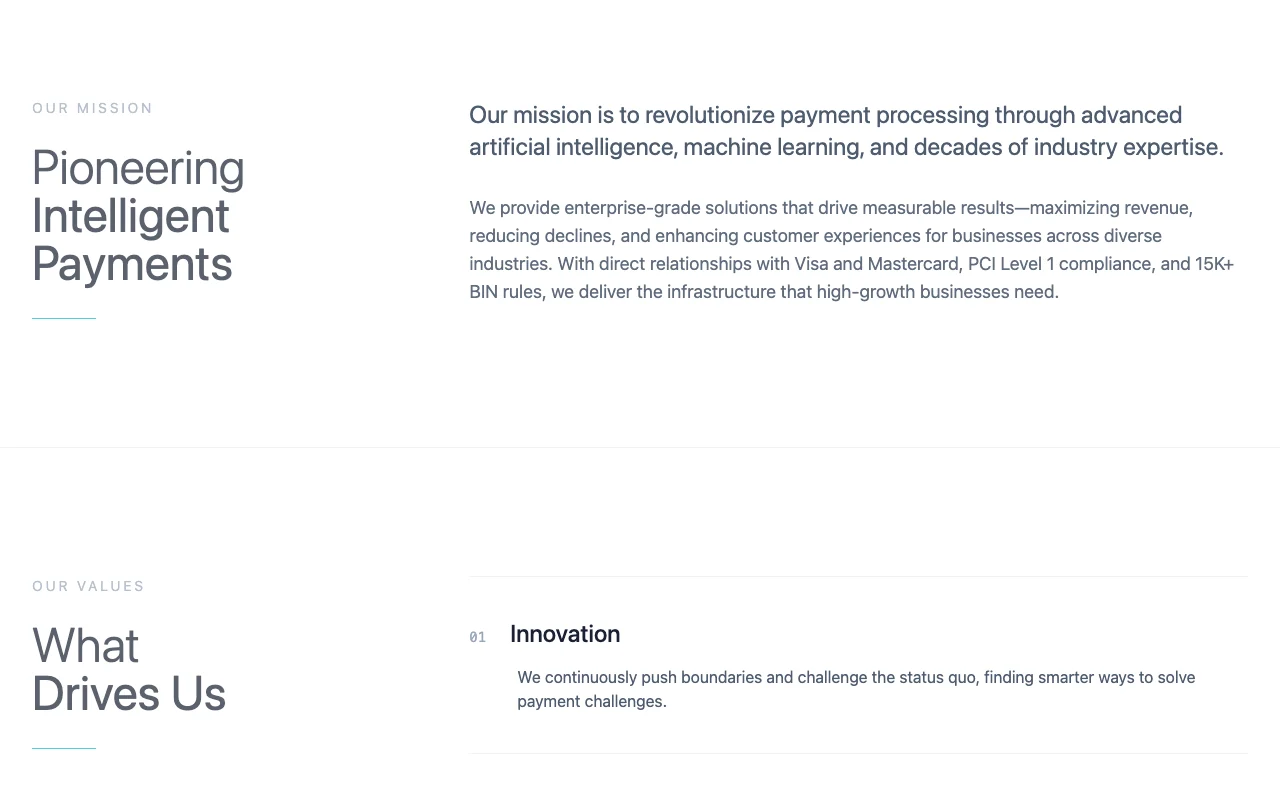
Feature overview on the official site. ltvx.ai, captured Oct 2, 2026
Predictive LTV intelligence
Predicts customer lifetime value. Growth and finance teams get a prediction of how much each customer is likely to be worth over time.
Access: Not statedLimit: The accuracy of the predictions is stated by the vendor and was not independently checked.source (opens in a new tab)
Decline recovery with AI retry routing
Retries falsely declined transactions with AI routing. Merchants may win back sales from card payments that were declined by mistake, by retrying them through other routes.
Access: Not statedLimit: Recovery results vary by merchant and are vendor claims.source (opens in a new tab)
Autonomous optimization
Tunes itself without manual rules. Teams spend less time writing manual rules because the system adjusts itself.
Adapts in real time to payment signals. Merchants get a system that changes its behavior as payment signals change instead of waiting for a rule update.
Works without changing existing payment infrastructure, per the site The site says it works without changing your existing payment infrastructure, so you may not need to rebuild how you take payments.documentedsource (opens in a new tab)
States PCI DSS Level 1 and GDPR compliance The site states PCI DSS Level 1 and GDPR compliance, which a merchant can raise with the vendor when doing a security review.documentedsource (opens in a new tab)
Lists a US office and a US phone number A US office and a US phone number are listed, so US merchants have a local contact point if they need to reach the vendor.documentedsource (opens in a new tab)
Limitations to check before paying
No public pricing; contact or demo required Without public pricing you must contact the vendor or ask for a demo before you can compare its cost with other options.documentedsource (opens in a new tab)
Aimed at merchants, not individuals The product is built for merchants and payment businesses, so individual users will not find a use for it.documentedsource (opens in a new tab)
Dashboard shown is labeled Beta The dashboard shown on the site is labeled Beta, so its features and layout may still change as the product develops.documentedsource (opens in a new tab)
Performance figures are vendor-stated The performance figures are stated by the vendor, so you should ask for evidence before relying on them in a business case.documentedsource (opens in a new tab)
How to use LTVX.ai for recovering falsely declined payments
Set up LTVX.ai
Open ltvx.ai and read the decline page.
Book a demo with the vendor.
Share a sample of payment data.
Example: recovering falsely declined payments
Review the vendor integration plan.
Run a pilot on a share of traffic.
Compare recovery against baseline.
Review and export the result
Check recovered revenue against processor reports.
Confirm no extra fraud exposure.
Privacy, data use and commercial rights
Summarized from the vendor's current policies; this is not legal advice and a vendor's badge is not an independent audit.
Not verified: Pricing; Integrations; Data retention.
How we documented and maintain this page
Every fact about LTVX.ai above comes from the 3 official pages listed here, last compared on Oct 2, 2026; we have not run LTVX.ai ourselves, so it has no editorial score. How we check and re-check pages.
Article updated Oct 10, 2026; prices checked Oct 2, 2026. Outbound links to vendors are plain links; we do not earn commissions. How we review · Report an error

 (open full size in a new tab)
 (open full size in a new tab)
 (open full size in a new tab)
 (open full size in a new tab)
 (open full size in a new tab)
 (open full size in a new tab)