Our take: Choose Lettertrace if you are comfortable supplying your own Anthropic, OpenAI and Google keys and want an open-source MIT tool that tracks brand mentions, position and sentiment across AI assistants.
Main limitation: You pay the model providers directly through your own API keys, and the site has no pricing or docs page.
By the AI Tool Atlas editors.
Based on the vendor's official documentation; we have not tested this product hands-on. What “documented overview” means
Who should use Lettertrace
Choose Lettertrace if you are comfortable supplying your own Anthropic, OpenAI and Google keys and want an open-source MIT tool that tracks brand mentions, position and sentiment across AI assistants. Based on the vendor's documentation, not on a hands-on test.
Best for: Developer-minded marketing teams doing AEO/GEO
Also a good fit for
Startups wanting free AI brand monitoring
Agencies that prefer self-hosted tooling
Consider another tool if requires your own Anthropic, OpenAI and Google API keys, whose usage you pay for
Or if
Self-hosting requires setting up Node and Supabase
No formal pricing or docs page on the site (/pricing and /docs return 404)
Lettertrace pricing and usage limits
Prices checked Oct 1, 2026 on the official US pricing page. Prices and limits change often.
Free access and trial conditions
Homepage says it is free end-to-end; /pricing returns 404.
Trial runs on shared provider keys exist, with a free-run limit not quantified.
For: Developers and marketers who accept self-managed API costs
Limits
Model API usage billed by your providers
Trial runs on shared keys are limited (limit not stated)
Includes
Multi-model monitoring
Prompt variation generation
2 more
Share-of-voice tracking
Daily or weekly scheduling
Usage caps, credits and extra costs
Your own Anthropic, OpenAI and Google API usage; Supabase if self-hosting.
What is Lettertrace, and how does it work?
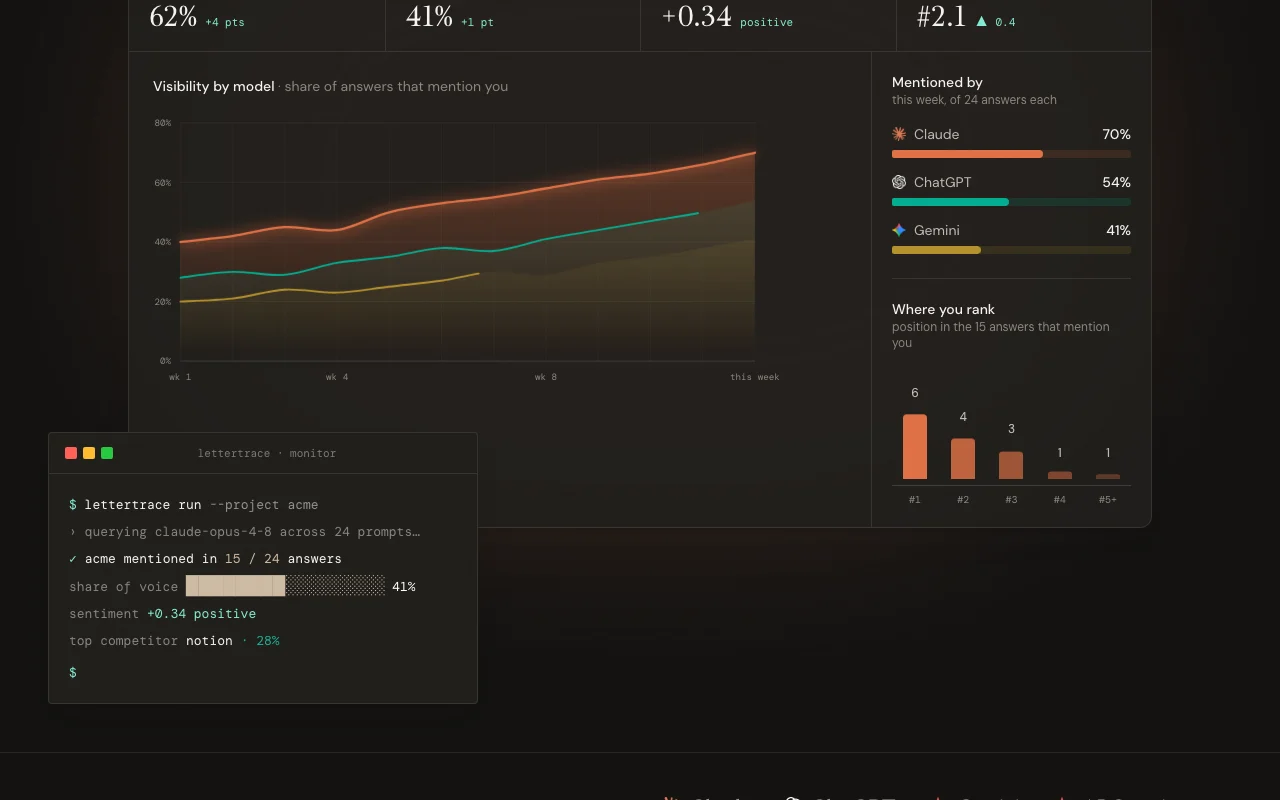
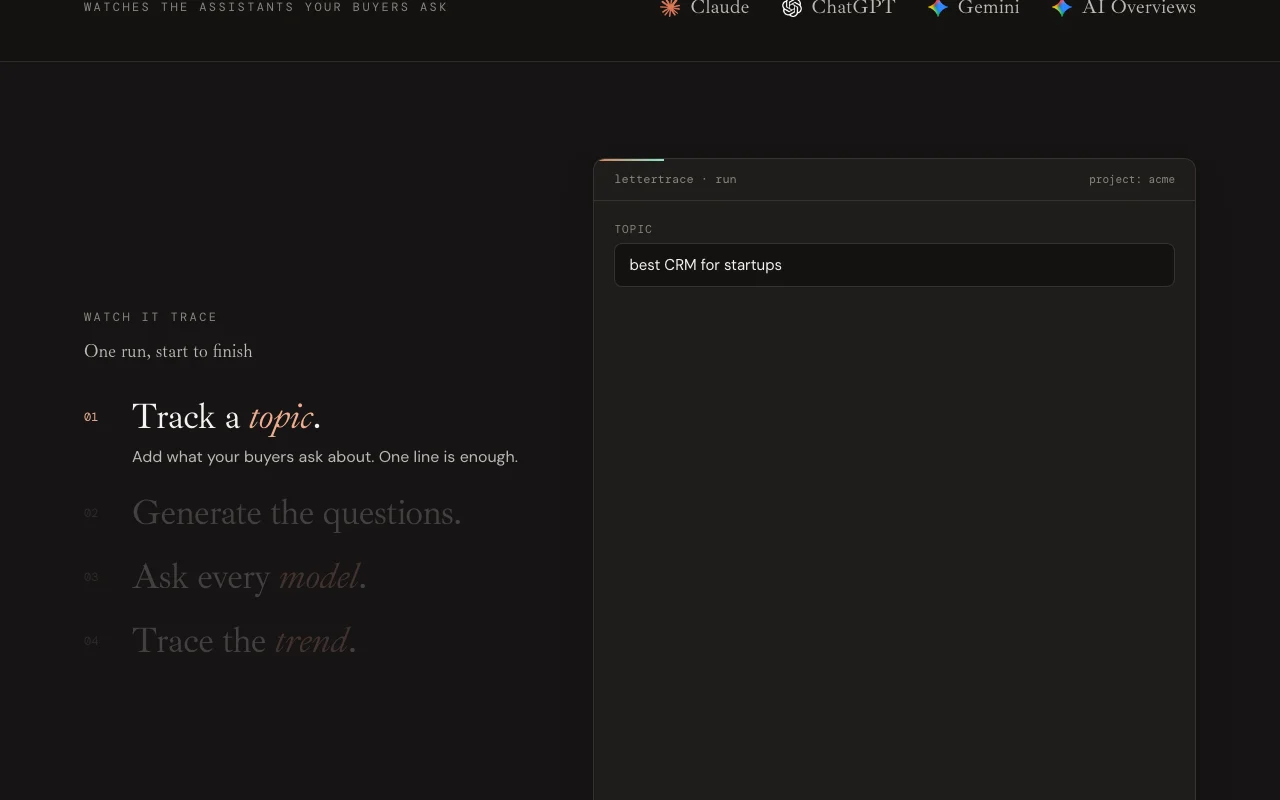
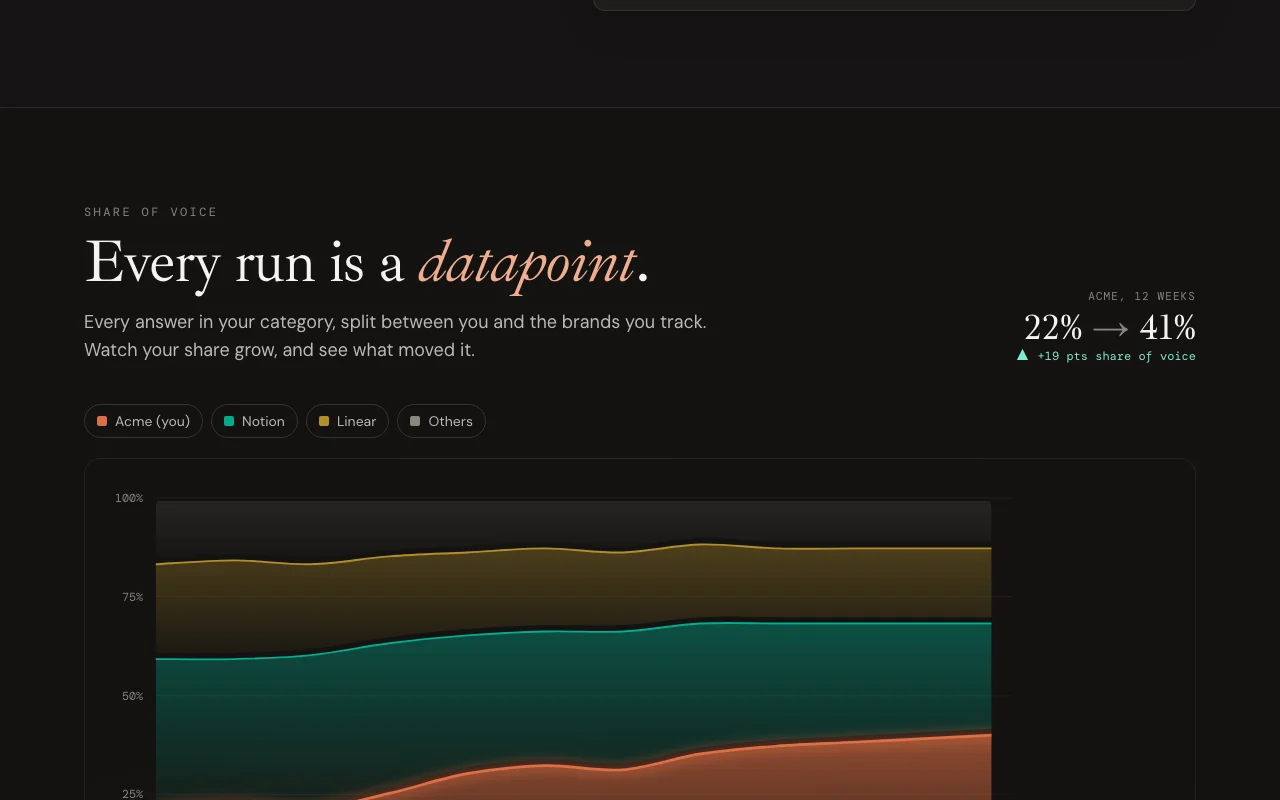
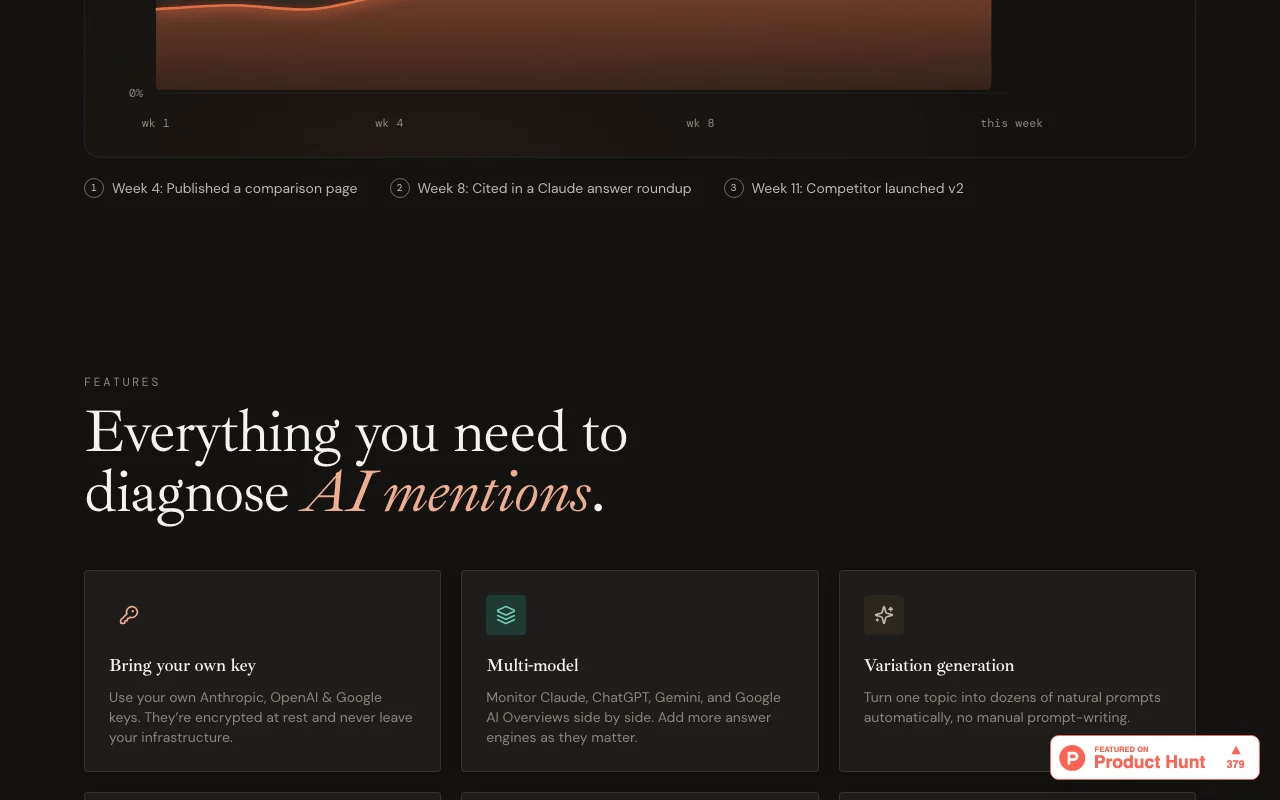
Lettertrace is an AI visibility (AEO/GEO) monitor. You add a topic your buyers ask about, it generates dozens of natural prompts, sends them to Claude, ChatGPT, Gemini and Google AI Overviews, and reads each answer for brand mentions, position, sentiment and recommendations. Runs can be scheduled daily or weekly to build share-of-voice trend lines against tracked competitors.
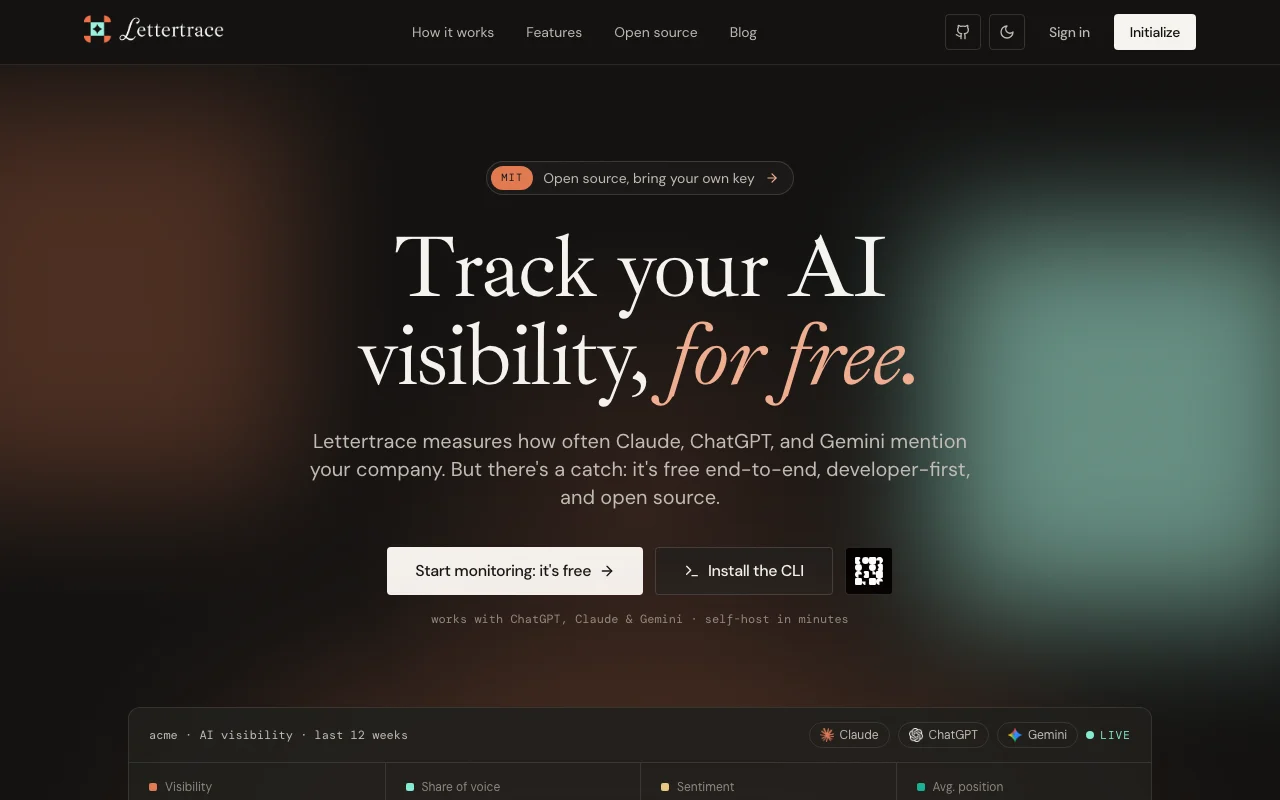
The project is MIT-licensed and designed to be self-hosted with your own Anthropic, OpenAI and Google API keys and your own Supabase database; the site also offers a hosted sign-in and dashboard and a CLI. The vendor describes it as free end-to-end with no usage markup.
Lettertrace's official site: how the product presents itself. lettertrace.com, captured Oct 1, 2026
What you provide and what you get back
What you give Lettertrace and what comes back, from its documentation
You provide
Topic or brand to track
Competitor names
Your Anthropic, OpenAI and Google API keys
You get back
Visibility percentage per model
Share of voice vs competitors
Sentiment and average position
Where you can use it
Platforms
Web
Account
Required
Models monitored
Claude, ChatGPT, Gemini, Google AI Overviews
License
MIT
Metrics
Visibility, share of voice, sentiment, average position
Schedule
Daily or weekly
Where Lettertrace is most useful
Scenarios are worked out by our editors from the documentation; the actual result depends on your input and plan.
Measuring brand visibility across AI assistants
Who
Marketers and founders doing AEO/GEO
You provide
One topic your buyers ask about
Expected result
Dozens of generated prompts run on Claude, ChatGPT and Gemini with a visibility percentage per model
Open source under MIT license with self-host instructions Your costs are the raw provider charges, so no vendor markup is added.documentedsource (opens in a new tab)
Bring your own API keys with no vendor markup Your results stay in your own Supabase database with no lock-in.documentedsource (opens in a new tab)
Data stored in your own Supabase instance when self-hosted You can inspect and change the code before running it.documentedsource (opens in a new tab)
Tracks how often Claude, ChatGPT and Gemini mention a brand, with visibility, share of voice, sentiment and average position Marketers can watch AI-answer share against named competitors over weeks.documentedsource (opens in a new tab)
Provider API keys are encrypted at rest with AES-256-GCM and data is isolated per account by Postgres row-level security Stored keys are not kept in plaintext and accounts cannot read each other's runs.documentedsource (opens in a new tab)
Limitations to check before paying
Requires your own Anthropic, OpenAI and Google API keys, whose usage you pay for Costs scale with the number of prompts and models you run.documentedsource (opens in a new tab)
Self-hosting requires setting up Node and Supabase Setup takes developer time and a database.documentedsource (opens in a new tab)
No formal pricing or docs page on the site (/pricing and /docs return 404) You must contact the founder or read the repo for limits.documentedsource (opens in a new tab)
Young project: public repo shows a small number of stars and forks Fewer community answers and examples to rely on.documentedsource (opens in a new tab)
Uses RB2B business-visitor identification on its public marketing pages Visitors to the marketing site may be identified, though the authenticated product does not run it.documentedsource (opens in a new tab)
How to use Lettertrace for tracking brand mentions in AI answers
Set up Lettertrace
Sign in on lettertrace.com with Google or GitHub, or clone the repo to self-host.
Add your Anthropic, OpenAI and Google API keys (stored encrypted).
Create a project with your brand, domain and aliases.
Add competitors to track.
Example: tracking brand mentions in AI answers
Add a topic such as best CRM for a startup.
Generate prompt variations from the topic.
Run the monitor across the connected models.
Open the results for visibility, position and sentiment.
Schedule a weekly run to build a trend.
Review and export the result
Open individual answers and confirm the mention detection is correct.
Compare the first and second runs before trusting a trend.
Example prompt suggested by our editors (not a recorded output of the product)
What CRM should a 10-person startup use?
Lettertrace API
API access and separate billing
Lettertrace has no public API in its official documentation. A CLI is offered; API docs page not found.
Privacy, data use and commercial rights
Summarized from the vendor's current policies; this is not legal advice and a vendor's badge is not an independent audit.
How your inputs and outputs are handled
Stores brands, topics, prompts, full AI answers, cited sources and mentions.
Under bring-your-own-key, handling and training are governed by your agreement with Anthropic or OpenAI.
Kept while the account is active; deleting a project or account deletes its data.
The platform is advertised as free and MIT-licensed, but you pay your model providers for API usage; no pricing page exists. source (opens in a new tab)
Self-hosted runs use your own Supabase instance; the hosted service stores configuration, full answers and keys encrypted, per its privacy policy. source (opens in a new tab)
How do I self-host it?
Clone the repository, run npm install, copy .env.example to .env.local, add Supabase URL and keys, then npm run dev on localhost:3000. source (opens in a new tab)
Not verified: trial run limit size; hosted plan limits; API documentation; training use on shared keys.
How we documented and maintain this page
Every fact about Lettertrace above comes from the 3 official pages listed here, last compared on Oct 1, 2026; we have not run Lettertrace ourselves, so it has no editorial score. How we check and re-check pages.
Article updated Oct 10, 2026; prices checked Oct 1, 2026. Outbound links to vendors are plain links; we do not earn commissions. How we review · Report an error