Our take: Choose Tangle if your team wants to assemble containerized ML pipelines in a drag-and-drop editor, reuse Kubeflow or Vertex AI components, and avoid re-running unchanged steps through global caching.
Main limitation: No pricing page or commercial plan is documented, and the hosted app is described as experimental; self-hosting needs container infrastructure.
By the AI Tool Atlas editors.
Based on the vendor's official documentation; we have not tested this product hands-on. What “documented overview” means
Is Tangle right for you?
Choose Tangle if your team wants to assemble containerized ML pipelines in a drag-and-drop editor, reuse Kubeflow or Vertex AI components, and avoid re-running unchanged steps through global caching. Based on the vendor's documentation, not on a hands-on test.
Best for: ML engineers building pipelines
Also a good fit for
Data teams wanting a visual workflow editor
Teams already using Kubeflow or Vertex AI
Consider another tool if no official pricing page or commercial plan documented
Or if
Self-hosting requires container infrastructure
Hosted version is labeled experimental
Tangle pricing and usage limits
Prices checked Oct 1, 2026 on the official US pricing page. Prices and limits change often.
Vendor pricing page re-checked automatically 13 days ago: no changes detected.
Free access and trial conditions
Docs state no registration is required to experiment; code is public on GitHub. Cost of the hosted service is not stated.
None.
Paid plans: what changes as you upgrade
Open source and hosted playground Web app / self-hosted
For: ML teams that can self-host or just want to prototype
Limits
Hosted new version is labeled experimental
Includes
Visual pipeline editor
Backend and frontend code on GitHub
1 more
No registration needed to experiment
Usage caps, credits and extra costs
Compute and container infrastructure when self-hosting; not priced by the vendor.
Not applicable.
What is Tangle, and how does it work?
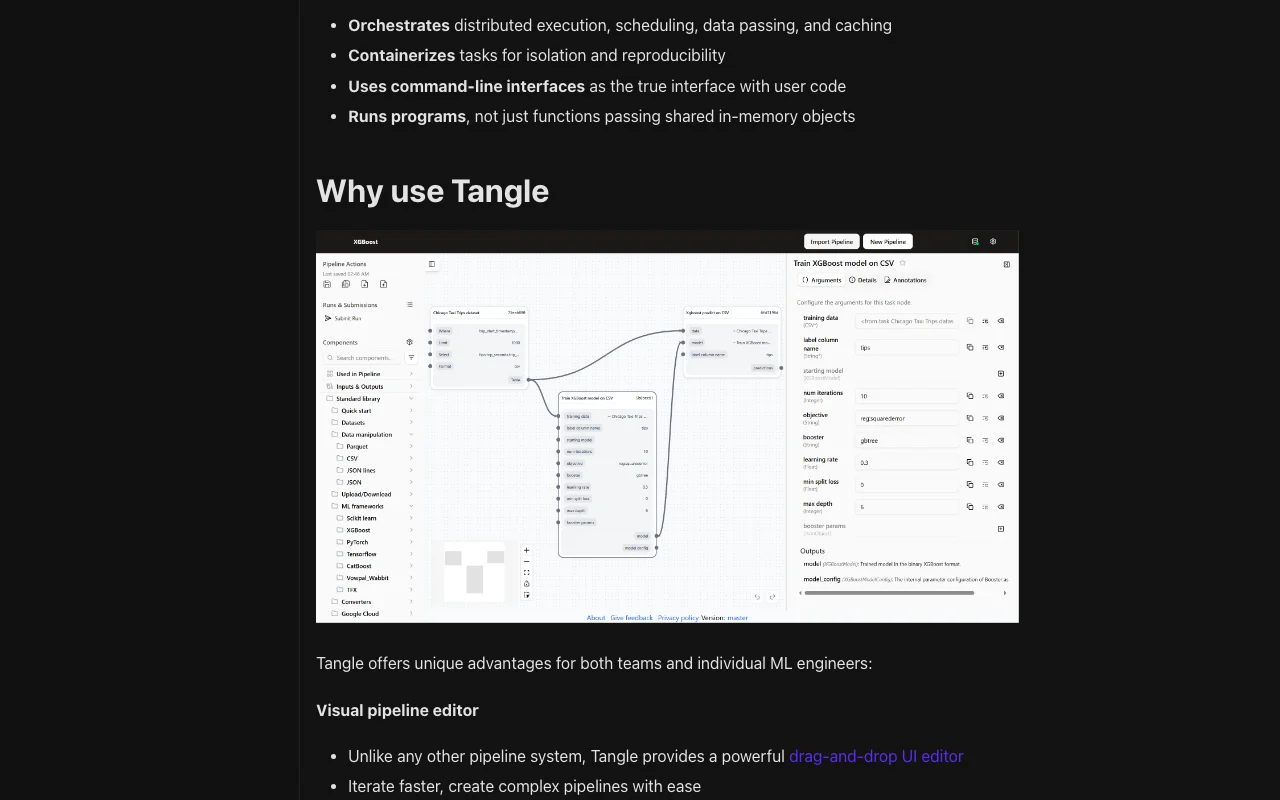
Tangle is an open-source, platform-agnostic tool for building machine learning and data pipelines in a visual drag-and-drop editor. Users connect components, configure arguments and run workflows without setting up a local development environment; each task runs in an isolated container with defined interfaces.
Components are language-agnostic (Python, Java, Shell, Ruby, C++, JS/TS) and compatible with existing Kubeflow and Vertex AI pipeline components. A content-based cache shared across all pipelines avoids re-running identical steps. The project is built by Shopify ML engineers and offers a hosted experimental playground on Hugging Face Spaces plus GitHub repositories for self-hosting.
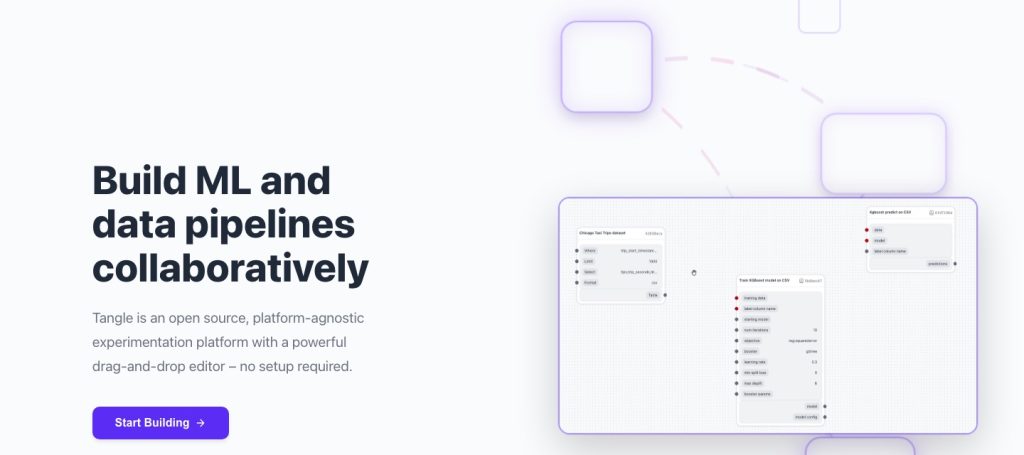
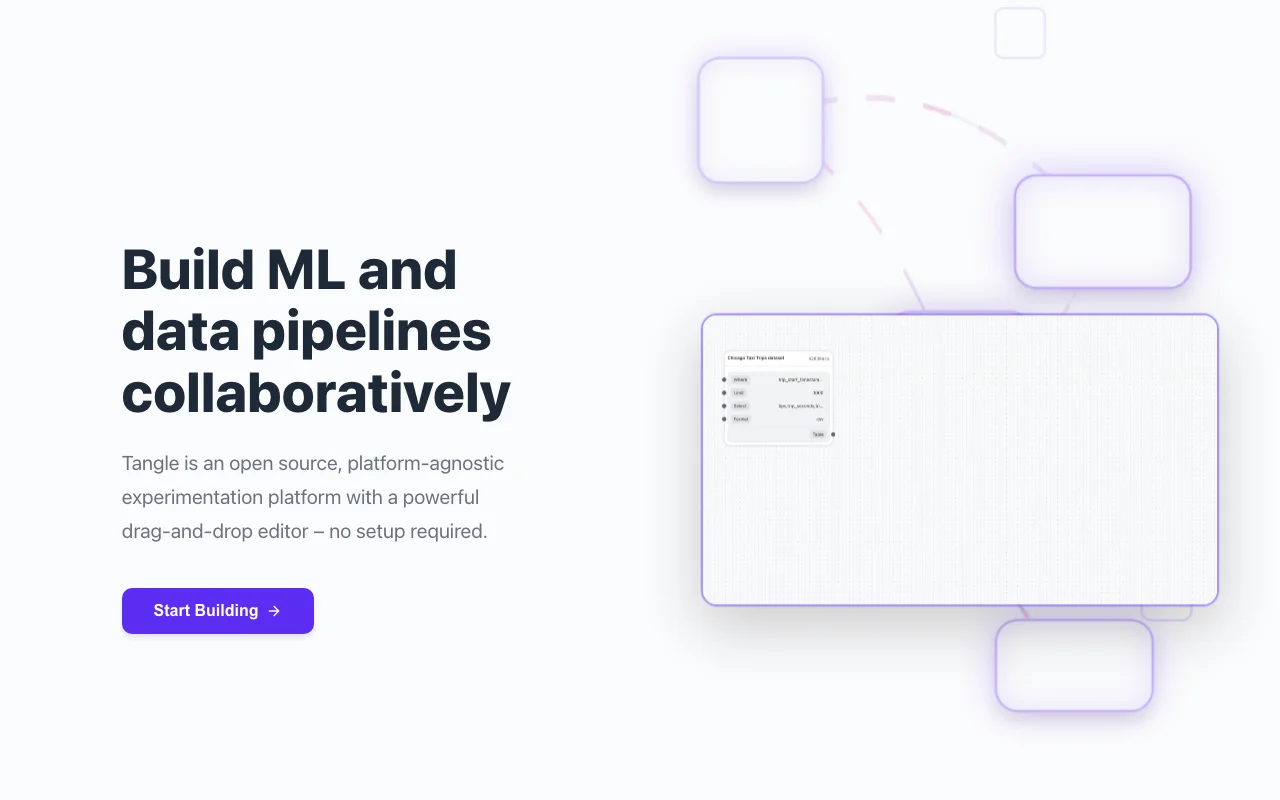
Tangle's official site: how the product presents itself. tangleml.com, captured Oct 1, 2026
What you provide and what you get back
What you give Tangle and what comes back, from its documentation
You provide
Pipeline components (containerized programs with ComponentSpec)
Arguments and data inputs for tasks
Existing Kubeflow or Vertex AI components
You get back
Executed pipeline runs with graphs, logs and artifact metadata
Cached intermediate artifacts
Cloneable runs
Where you can use it
Platforms
Web
Account
Required
Languages for components
Python, Java, Shell, Ruby, C++, JS/TS
Execution
Isolated containers per task
Caching
Content-based, global across pipelines
Origin
Developed by Shopify ML engineers; based on Cloud Pipelines Pipeline Editor
Repos
tangleml/tangle, tangleml/tangle-ui
Where Tangle is most useful
Scenarios are worked out by our editors from the documentation; the actual result depends on your input and plan.
Prototyping ML training pipelines visually
Who
ML engineers and non-engineers prototyping training flows
You provide
Components dragged onto the canvas and connected, plus argument values
Expected result
A runnable training pipeline without writing orchestration code
Each task runs in an isolated container whose command-line interface is the contract with your code, so programs rather than in-memory functions are orchestrated. Avoids dependency conflicts between steps.
Results are keyed by content and shared globally across all pipelines, and even running executions can be reused. Saves compute and time compared to lineage-based caching in Kubeflow or Vertex.
Access: Open sourceLimit: Cache behavior for external side effects is not documentedsource (opens in a new tab)
Language-agnostic components
Components use the KFP v1 ComponentSpec format and can wrap Python, Java, Shell, Ruby, C++ or JS/TS code in a container via the in-app editor. Existing Kubeflow and Vertex AI components are reusable.
Open source with no vendor lock-in You can host it on your laptop, on-premises or any cloud and keep your data.documentedsource (opens in a new tab)
Runs on any cloud or locally Pipelines are not tied to Google Cloud or a Kubernetes-only stack.documentedsource (opens in a new tab)
Hosted playground requires no registration Evaluation takes minutes since you can build a first pipeline without an account.documentedsource (opens in a new tab)
Compatible with existing Kubeflow/Vertex AI components Existing component investments carry over instead of being rewritten.documentedsource (opens in a new tab)
Check before paying for Tangle
No official pricing page or commercial plan documented Budgeting for a team rollout is not possible from the website alone.documentedsource (opens in a new tab)
Self-hosting requires container infrastructure You must run and maintain containers and storage yourself.documentedsource (opens in a new tab)
Hosted version is labeled experimental Production use of the new hosted version carries stability risk.documentedsource (opens in a new tab)
No desktop, mobile or public API documented Automation outside the UI is unclear, so integrations may need the GitHub repos.documentedsource (opens in a new tab)
How to use Tangle for building a visual ML pipeline
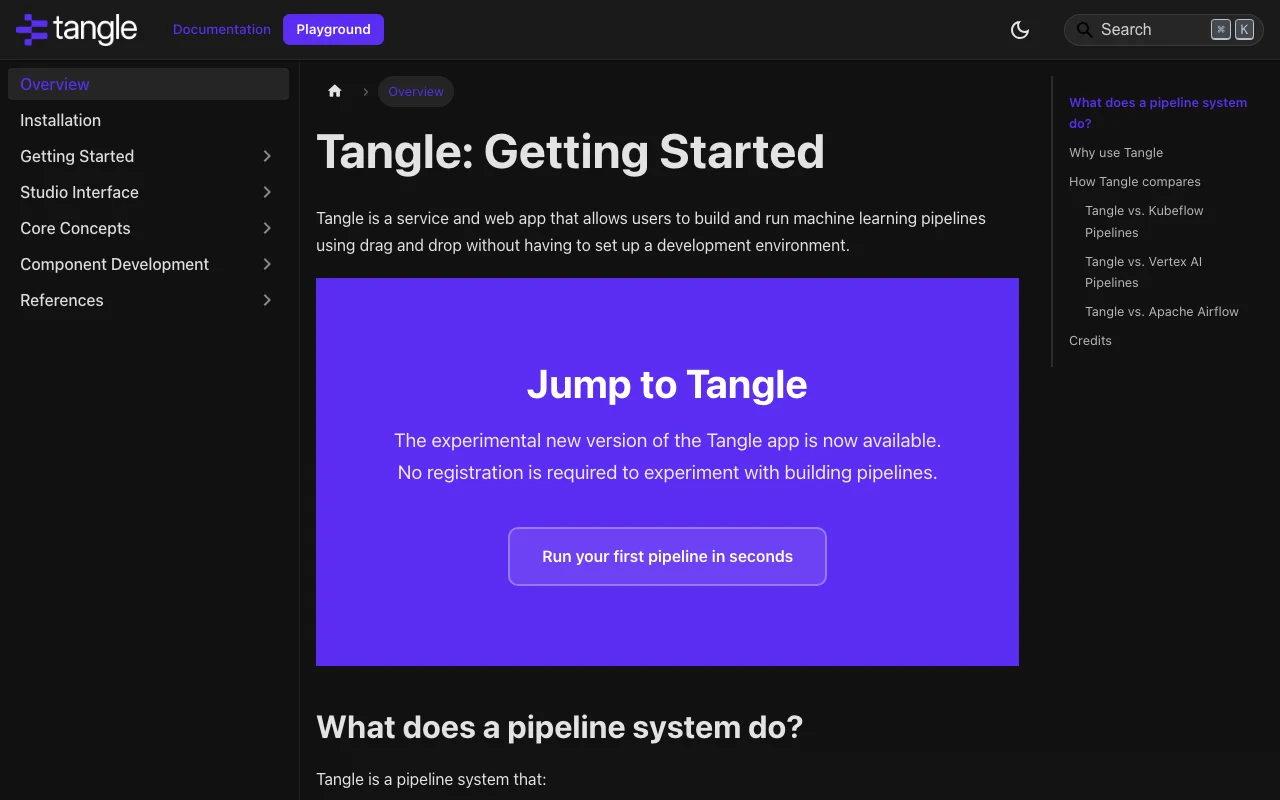
Tangle documentation: where the steps below come from. tangleml.com, captured Oct 1, 2026
Set up Tangle
Open tangleml.com and click 'Start Building' (no registration needed to experiment).
Choose 'Try Example Pipelines' to load a sample into the editor.
Open the component library to pick reusable modules, or wrap your own code in a container with the in-app editor.
For self-hosting, clone github.com/tangleml/tangle (backend) and github.com/tangleml/tangle-ui (frontend).
Example: building a visual ML pipeline
Drag components onto the canvas and connect outputs to inputs.
Configure each task's arguments in the side panel.
Run the pipeline and open the run graph to follow tasks.
Edit one component and run again to see unchanged tasks served from cache.
Review and export the result
Open the run's logs and artifact metadata for each task.
Confirm unchanged tasks are marked as cached after the second run.
Clone the run and compare results to confirm reproducibility.
Tangle API
Tangle documentation (continued). tangleml.com, captured Oct 1, 2026
API access and separate billing
Tangle has no public API in its official documentation. No public API documented in the fetched pages API documentation ↗
Privacy, data use and commercial rights
Summarized from the vendor's current policies; this is not legal advice and a vendor's badge is not an independent audit.
How your inputs and outputs are handled
Pipeline definitions, logs and artifacts are stored by the system you run; self-hosting keeps data on your infrastructure.
Intermediate data is immutable and never overwritten.
Other tools to consider instead of Tangle
"Better suited" is based on documented features and pricing, not on a head-to-head test.
No. The docs say no registration is required to experiment with building pipelines in the hosted app. source (opens in a new tab)
How does Tangle's caching differ from Kubeflow Pipelines?
Tangle caches by content globally across all pipelines and can reuse running executions, whereas Kubeflow caches only successful runs within each pipeline. source (opens in a new tab)
Does Tangle require Kubernetes?
No. The comparison page says Kubeflow needs Kubernetes while Tangle can run locally or on any cloud provider. source (opens in a new tab)
Can I reuse my Kubeflow or Vertex AI components in Tangle?
Yes. Tangle uses the same ComponentSpec format as KFP v1 and is described as compatible with Kubeflow and Vertex AI components. source (opens in a new tab)
Is Tangle free to use?
The code is open source on GitHub, but the website has no pricing page (404) so the cost of any hosted service is not stated. source (opens in a new tab)
Not verified: Hosted service pricing; Privacy policy (/privacy 404); Public API; Data location on hosted playground.
How we documented and maintain this page
Every fact about Tangle above comes from the 2 official pages listed here, last compared on Oct 1, 2026; we have not run Tangle ourselves, so it has no editorial score. How we check and re-check pages.
Article updated Oct 10, 2026; prices checked Oct 1, 2026. Outbound links to vendors are plain links; we do not earn commissions. How we review · Report an error