Our take: Lizard is worth a look for developers whose coding agents deploy apps, since it offers a JSON-output CLI, managed Postgres and Redis and pay-as-you-go billing by the second with $10 in trial credit.
Main limitation: Trial credits expire after 31 days, idle apps and stored data keep accruing charges, and the standard tier caps apps at 20 vCPU, 40 GB RAM and 5 replicas.
By the AI Tool Atlas editors.
Based on the vendor's official documentation; we have not tested this product hands-on. What “documented overview” means
Who Lizard fits
Lizard is worth a look for developers whose coding agents deploy apps, since it offers a JSON-output CLI, managed Postgres and Redis and pay-as-you-go billing by the second with $10 in trial credit. Based on the vendor's documentation, not on a hands-on test.
Best for: Developers using AI coding agents
Also a good fit for
Indie hackers and side projects
Teams wanting usage-based hosting
Consider another tool if trial credits expire after 31 days
Or if
Idle apps and stored data continue to accrue charges
Per-account limits (up to 20 vCPU, 40 GB RAM, 5 replicas per app) on the standard tier
Lizard in the news
Headlines from US outlets, selected automatically — not endorsements. Updated Oct 2, 2026
For: Teams needing compliance and dedicated infrastructure
Includes
SOC 2 and HIPAA compliance
SSO/SAML, RBAC and audit log
1 more
Dedicated nodes and SLAs
API included
Usage caps, credits and extra costs
Sandboxes billed per second from $0.009/hour (Small), $0.018 (Medium), $0.036 (Large); purchased credits never expire; payment fee shown at top-up
unknown
What is Lizard, and how does it work?
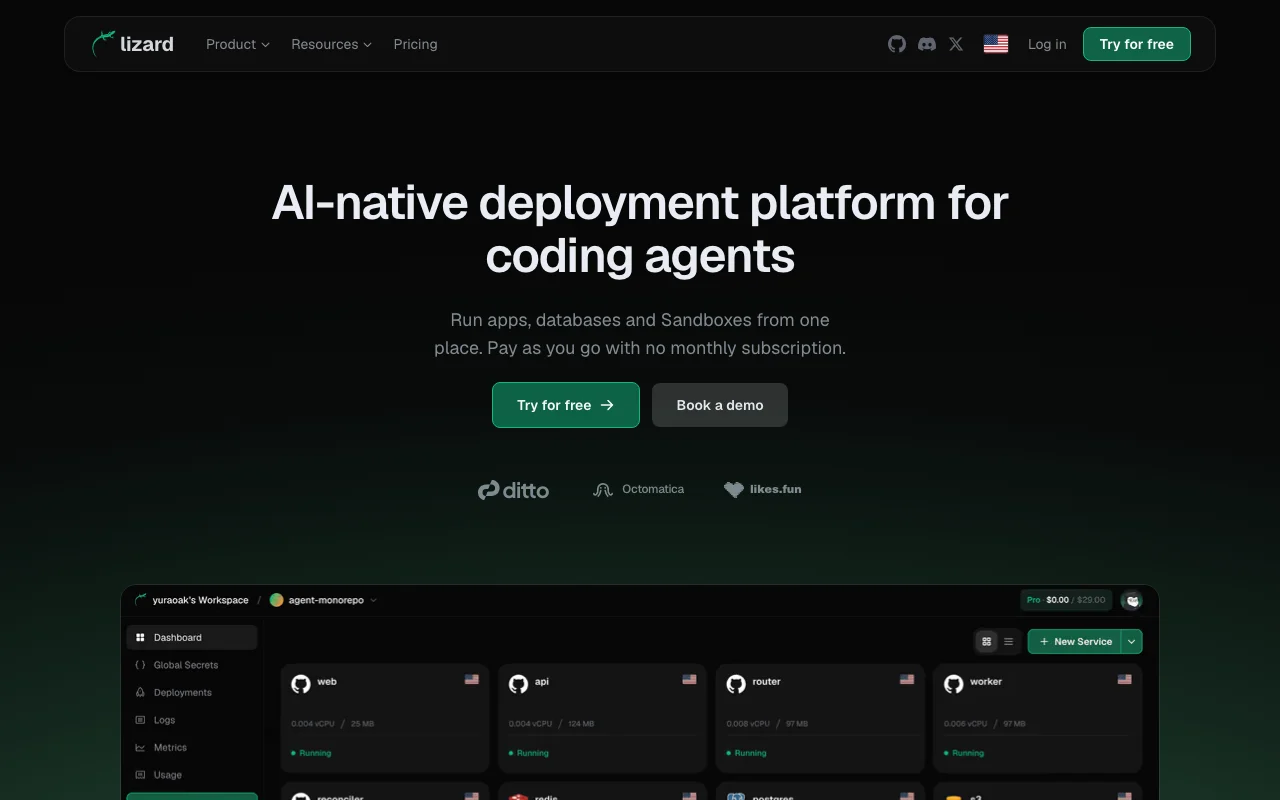
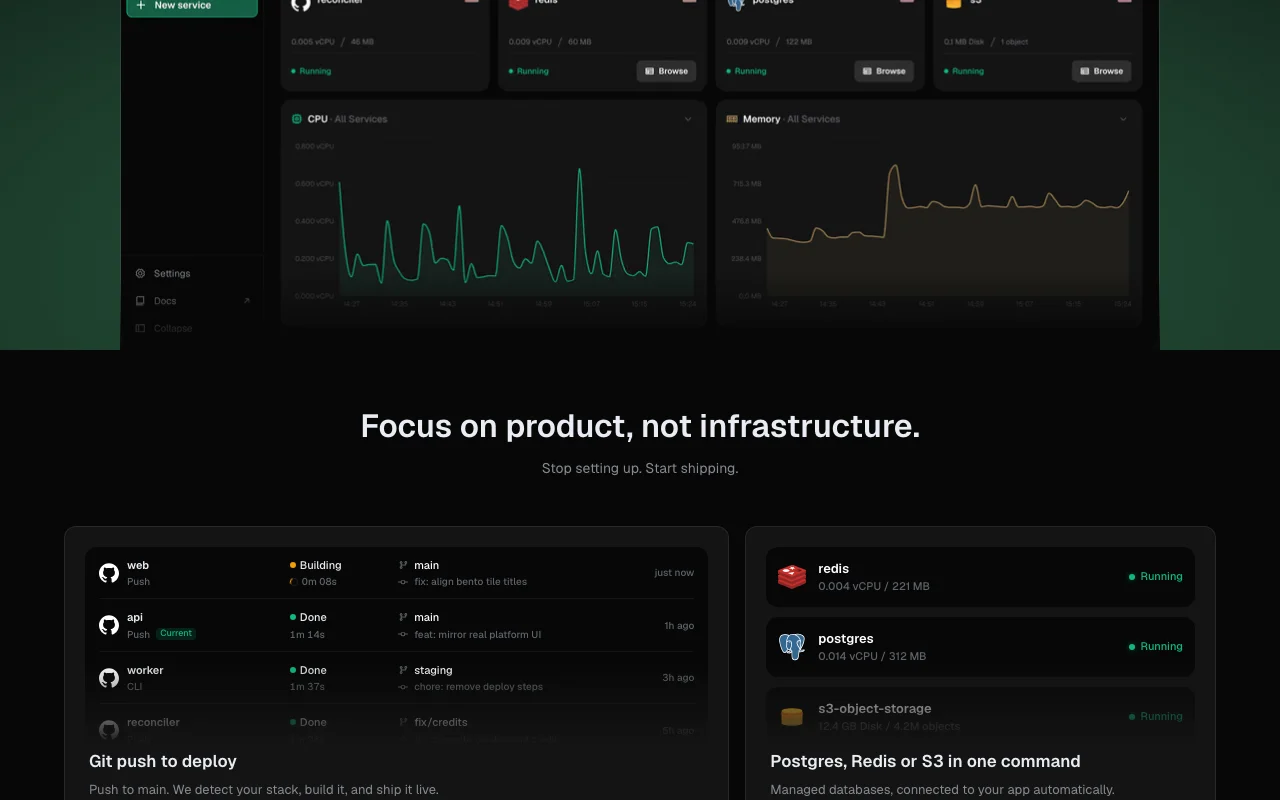
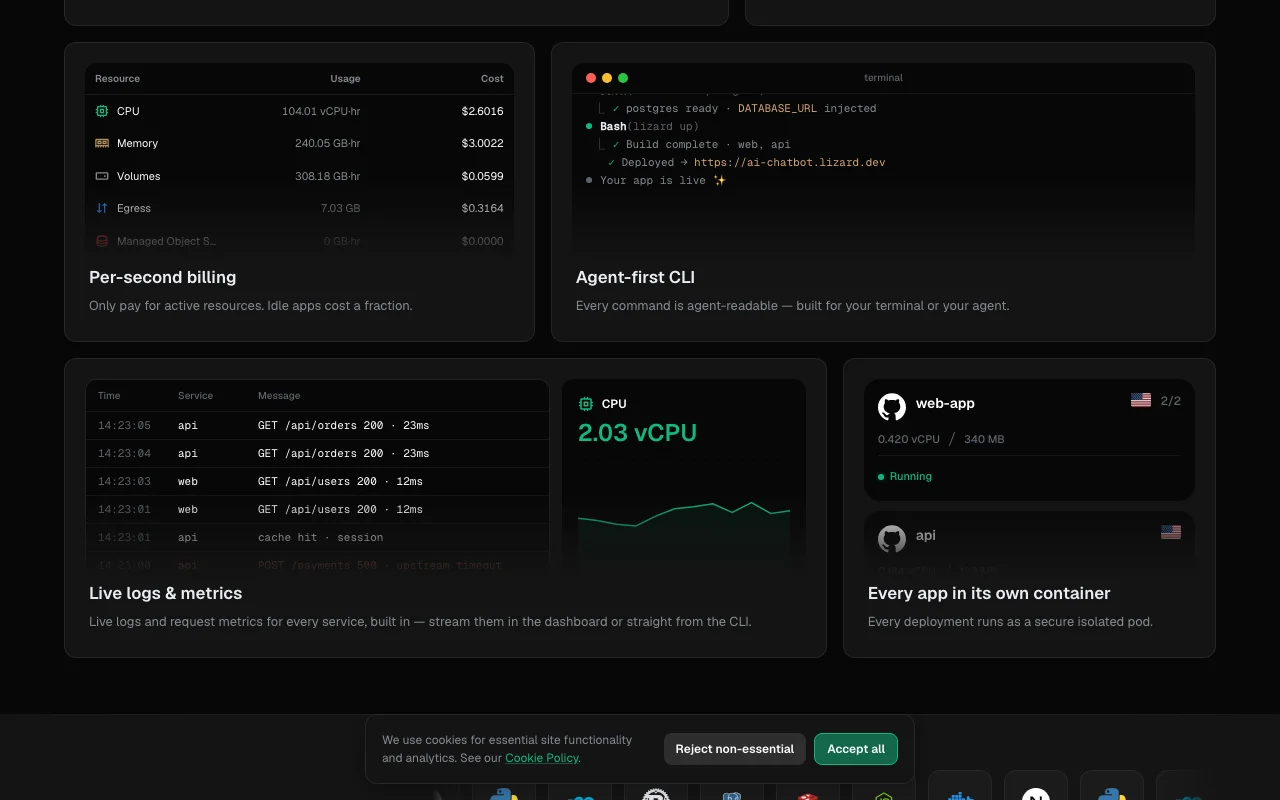
Lizard is a cloud deployment platform designed for coding agents such as Claude Code, Codex and Cursor. Apps deploy from a GitHub repo or local folder via git push or the Lizard CLI, and every command emits machine-readable output so agents can read deploy events and logs and fix failures themselves. Managed Postgres, Redis and S3-compatible object storage attach in one command, and an SDK creates Sandboxes for isolated code execution.
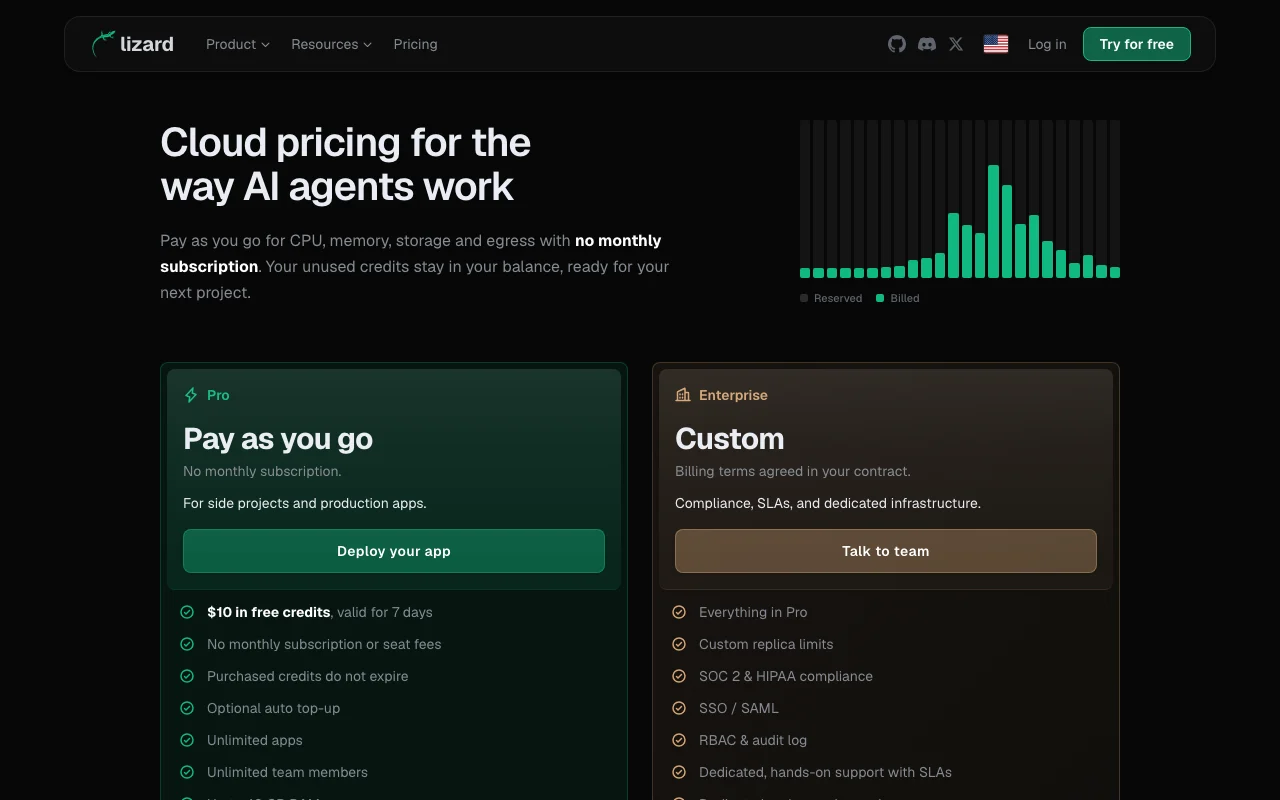
Billing is pay-as-you-go by the second for measured CPU, memory, storage and egress with no monthly subscription. New accounts get $10 in credits valid for 31 days; purchased credits do not expire. An Enterprise tier adds SOC 2/HIPAA compliance, SSO and SLAs.
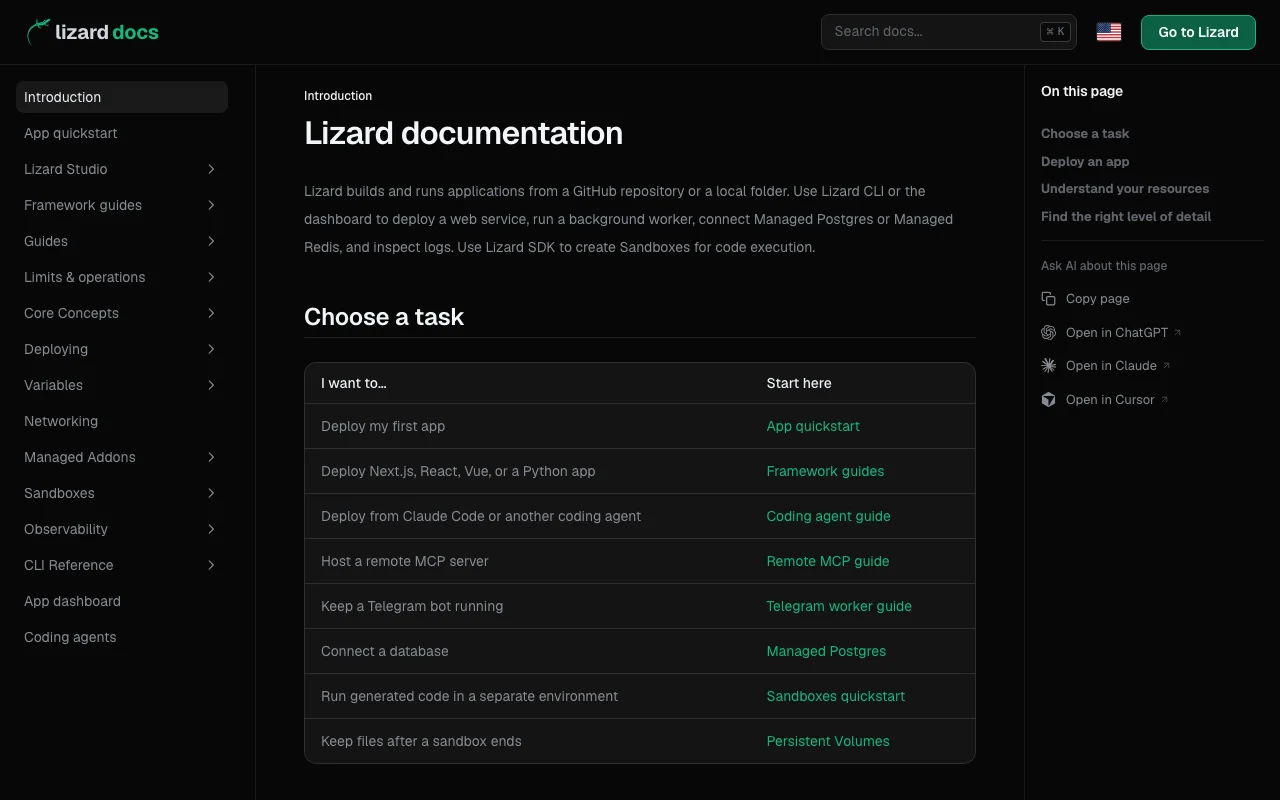
Lizard's official site: how the product presents itself. lizard.build, captured Oct 1, 2026
What you provide and what you get back
What you give Lizard and what comes back, from its documentation
You provide
GitHub repo or local folder
Git push or CLI commands
Environment variables and service settings
You get back
Running web services and workers
Managed Postgres, Redis and S3-compatible storage
Machine-readable deploy events and logs
Where you can use it
Platforms
Web, API
Account
Required
Where Lizard is most useful
Scenarios are worked out by our editors from the documentation; the actual result depends on your input and plan.
Letting a coding agent deploy and debug an app end to end
Who
Developers using coding agents
You provide
App repo and deploy command
Expected result
Agent reads JSON logs and fixes a failing deploy itself
$10 free trial credits for new accounts You can try it with free creditdocumentedsource (opens in a new tab)
Restore deleted services, databases and projects You can recover from accidental deletiondocumentedsource (opens in a new tab)
Check before paying for Lizard
Trial credits expire after 31 days Free credit must be used within about a monthdocumentedsource (opens in a new tab)
Idle apps and stored data continue to accrue charges Forgotten resources keep billingdocumentedsource (opens in a new tab)
Per-account limits (up to 20 vCPU, 40 GB RAM, 5 replicas per app) on the standard tier Large workloads need an Enterprise talkdocumentedsource (opens in a new tab)
Egress billed from the first byte at $0.045/GB Traffic-heavy sites pay from the first gigabytedocumentedsource (opens in a new tab)
How to use Lizard for deploying an app with a coding agent
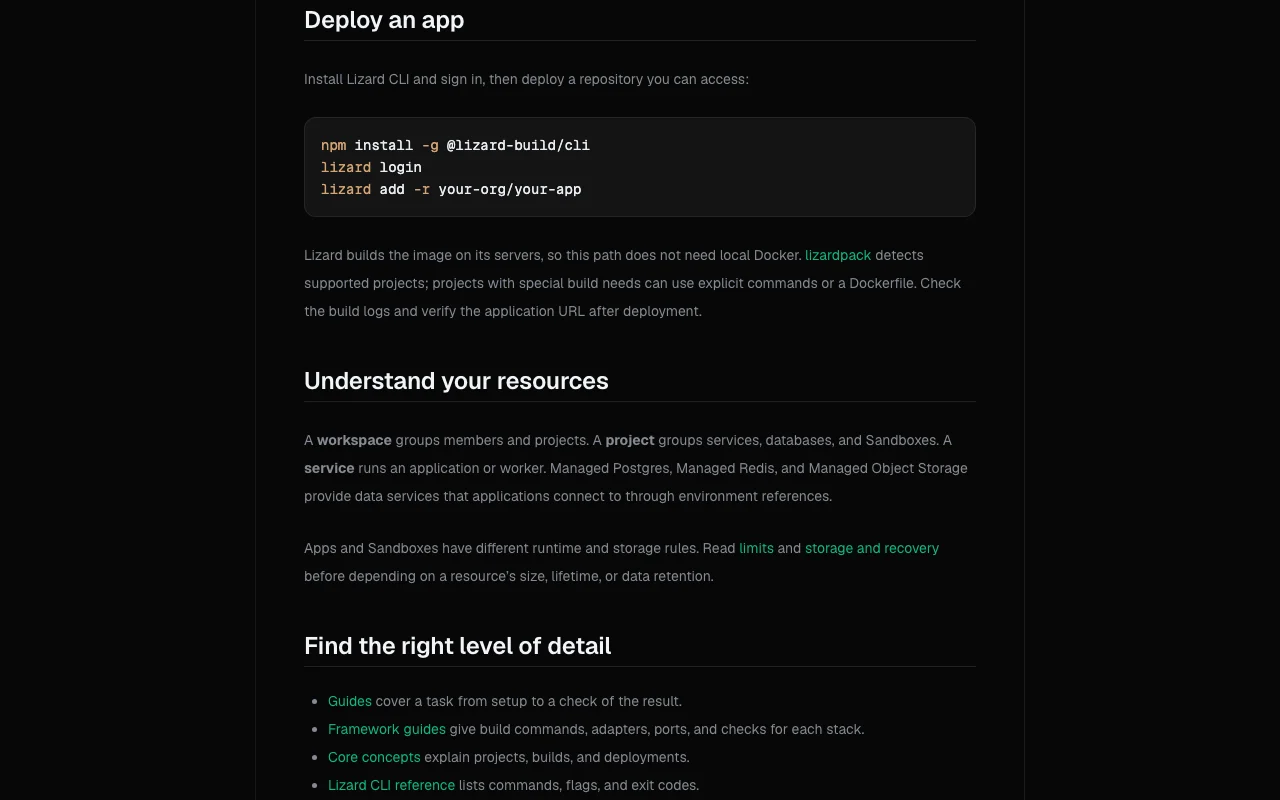
Lizard documentation: where the steps below come from. lizard.build, captured Oct 1, 2026
Set up Lizard
Create a Lizard account and claim the $10 trial credit
Install the Lizard CLI from npm and log in
Connect a GitHub repo or choose a local folder
Example: deploying an app with a coding agent
Run the deploy command or git push your project
Let your coding agent read the JSON deploy events
Attach Managed Postgres with one command
Let the agent redeploy after fixing any build error
Review and export the result
Check the Credits page for the remaining balance and expiry
Stop or delete unused services to avoid idle charges
Example prompt suggested by our editors (not a recorded output of the product)
Deploy this repo to Lizard, attach a Postgres database, read the deploy logs, and fix any build failures until the service is healthy.
Lizard API
Lizard documentation (continued). lizard.build, captured Oct 1, 2026
API access and separate billing
Lizard has no public API in its official documentation. CLI and SDK for Sandboxes API documentation ↗
Privacy, data use and commercial rights
Summarized from the vendor's current policies; this is not legal advice and a vendor's badge is not an independent audit.
How your inputs and outputs are handled
Deployment metadata such as timestamps, commit hashes, status and region assignments is held by the platform
unknown
Deleted services, databases and projects can be restored
It is pay as you go with no monthly subscription: CPU, memory, storage and egress are deducted from a credit balance by the second. source (opens in a new tab)
Do free credits expire?
New accounts get $10 in credits valid for 31 days, while purchased credits do not expire. source (opens in a new tab)
Do I pay for stopped apps?
Stopping an app stops its compute charges, but persistent volumes and object storage keep accruing while you keep the data. source (opens in a new tab)
What do Sandboxes cost?
Small is $0.009 per hour, Medium $0.018 and Large $0.036, billed per second while running. source (opens in a new tab)
Is there a seat fee?
No, inviting team members adds no seat fee and usage draws from the workspace owner's balance. source (opens in a new tab)
Not verified: Supported customer countries; Training and retention terms.
How we documented and maintain this page
Every fact about Lizard above comes from the 5 official pages listed here, last compared on Oct 1, 2026; we have not run Lizard ourselves, so it has no editorial score. How we check and re-check pages.
Article updated Oct 10, 2026; prices checked Oct 1, 2026. Outbound links to vendors are plain links; we do not earn commissions. How we review · Report an error