Our take: Apify combines a low-barrier free plan with 77,000+ ready-to-use Actors and MCP integration for AI agents, making it ideal for developers and AI teams who need web data without building from scratch.
Main limitation: All platform usage is metered as compute units at $0.13–$0.20 per unit on top of subscription fees, and free plan blocks access if overage is incurred
By the AI Tool Atlas editors.
Based on the vendor's official documentation; we have not tested this product hands-on. What “documented overview” means
Is Apify right for you?
Apify combines a low-barrier free plan with 77,000+ ready-to-use Actors and MCP integration for AI agents, making it ideal for developers and AI teams who need web data without building from scratch. Based on the vendor's documentation, not on a hands-on test.
Best for: Developers
Also a good fit for
Data teams
AI agent builders
Growth marketers
Consider another tool if need fixed-cost, unlimited usage without overage billing
Or if
Require managed support on free tier
Avoid dependency on Marketplace pricing for third-party Actors
Apify pricing and usage limits
Prices checked Oct 1, 2026 on the official US pricing page. Official pricing ↗ Prices and limits change often.
Vendor pricing page re-checked automatically 12 days ago: no changes detected.
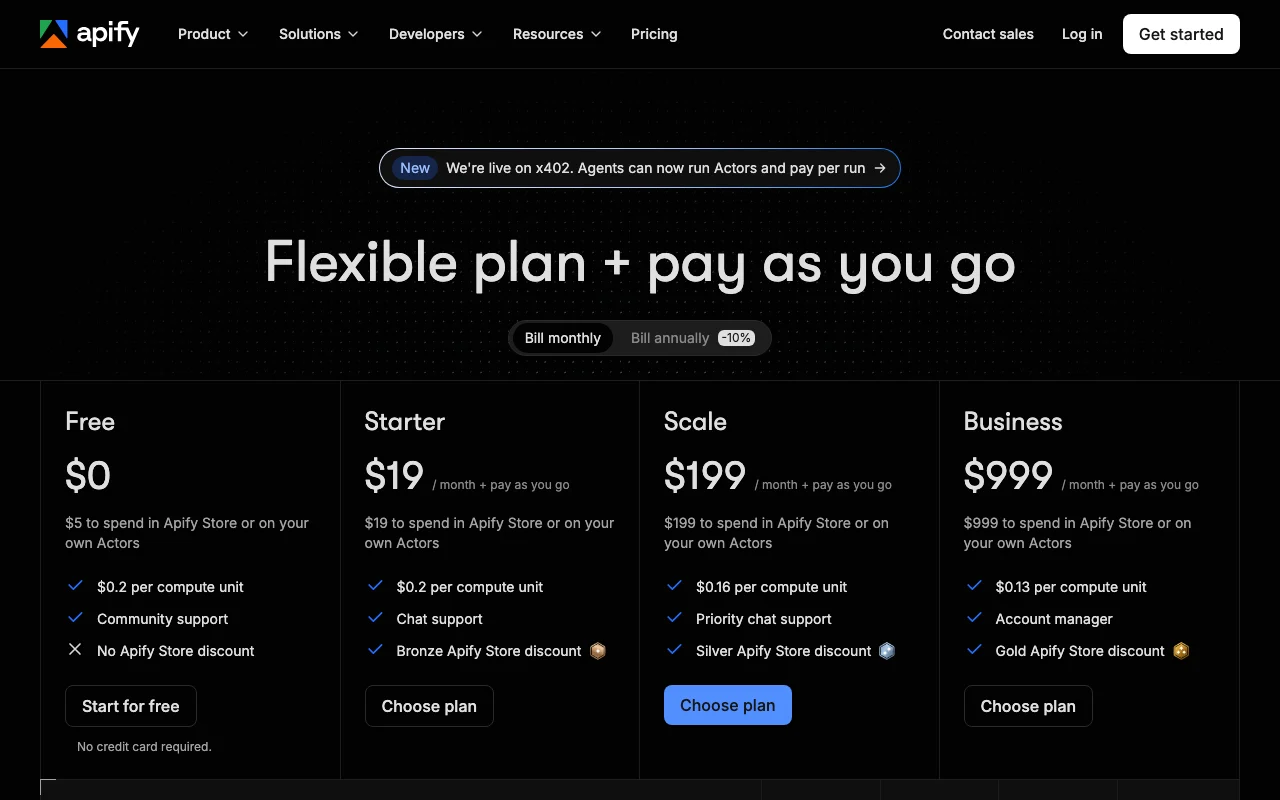
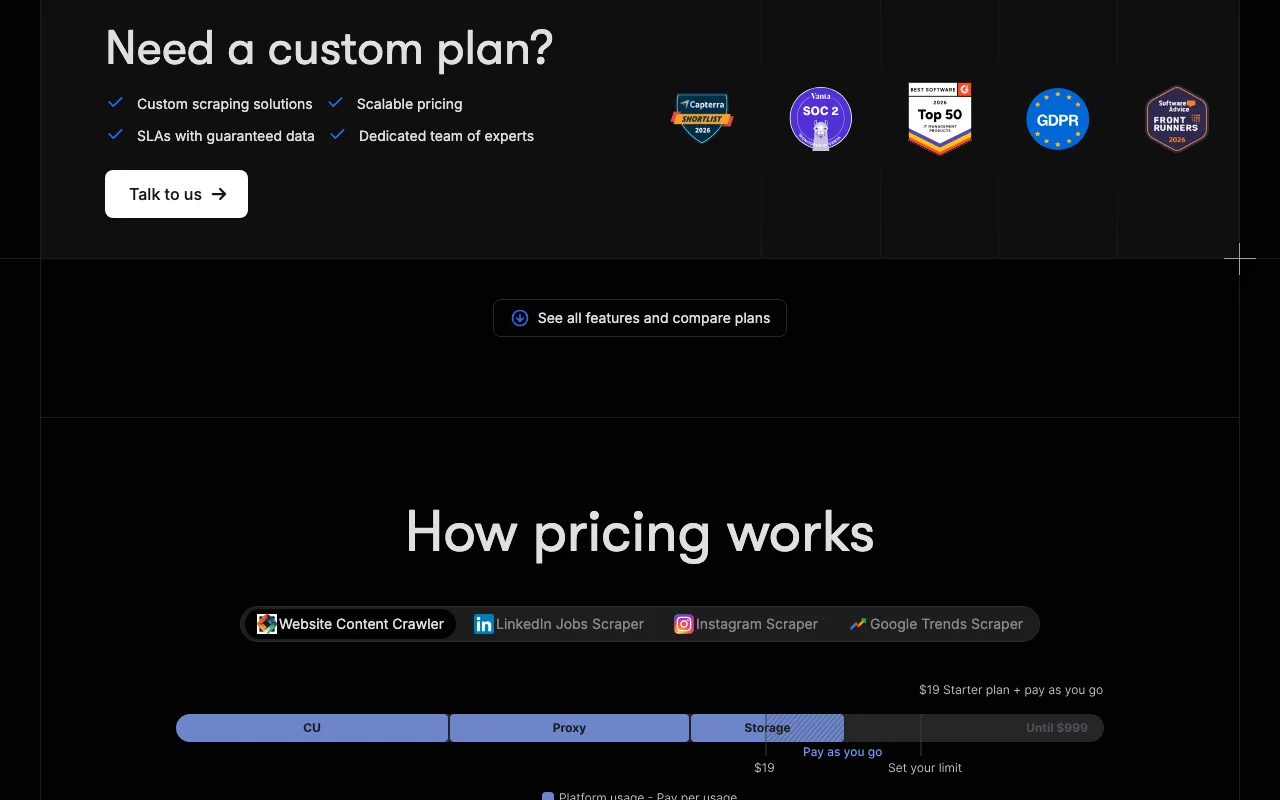
The official Apify pricing page as we saw it. apify.com, captured Oct 1, 2026
Free access and trial conditions
Free plan: $0 base + $5 monthly prepaid credit, no credit card required, $0.2 per compute unit; community support only
Startups program: $500 free usage for 6 months to build Actors and integrate agents
Custom SLAs, guaranteed data, scalable pricing, dedicated team
For: Large enterprises, custom integrations, guaranteed uptime
Limits
Unlimited compute units at custom rate
Custom Actor RAM and concurrency
1 more
Dedicated team support
Includes
Custom scraping solutions
Scalable pricing model
2 more
SLAs with guaranteed data
Dedicated experts
API included
Usage caps, credits and extra costs
Compute units $0.13–$0.20 per unit (plan-dependent) in addition to prepaid credit; proxy add-ons (residential $7–$8/GB, Google SERP $1.7–$2.5/1,000, Unblocker $1–$1.5/1,000 requests); concurrent runs $5/run; Actor RAM $1/GB; storage operations $0.0004–$0.05 per 1,000 ops; data transfer $0.18–$0.20/GB; personal training $150/hour
Not documented on pages fetched
What is Apify, and how does it work?
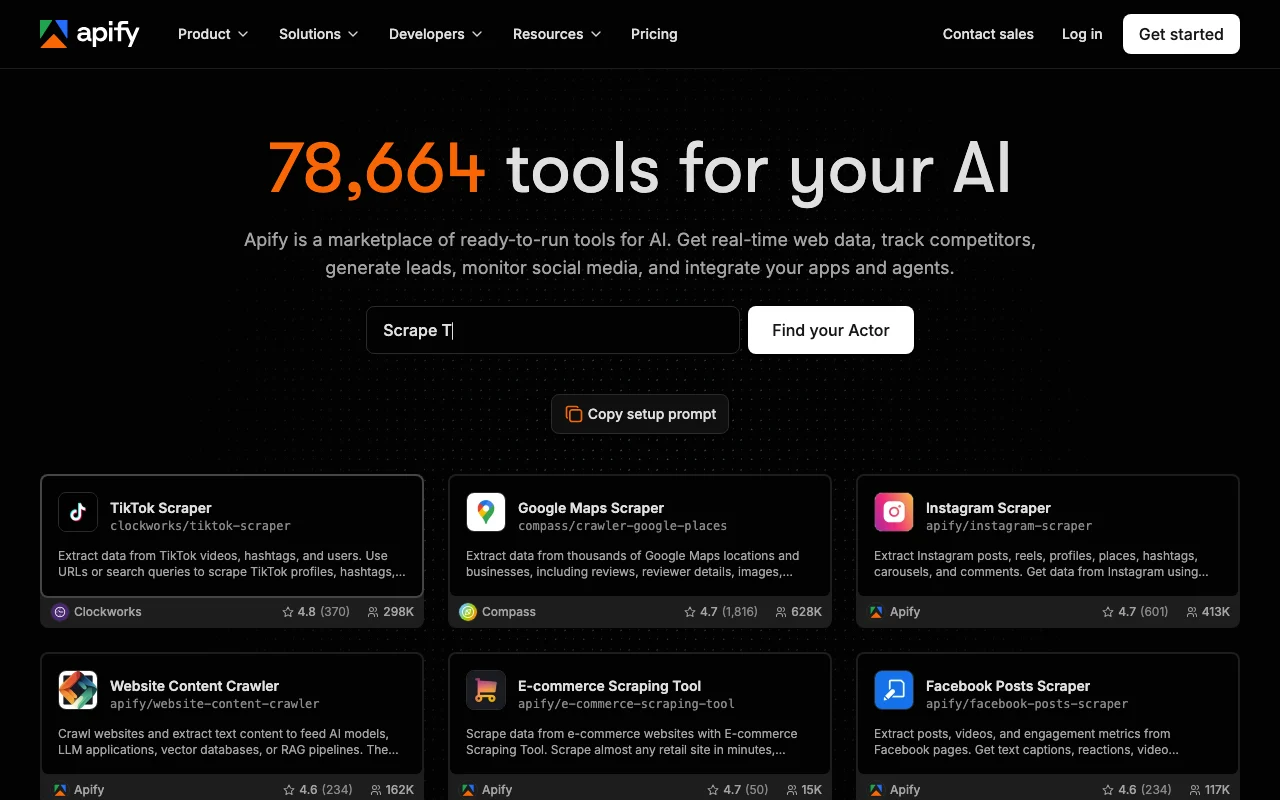
Apify is a platform and marketplace of more than 77,000 ready-to-run tools called Actors that extract web data, monitor social media, generate leads and automate web tasks. Actors can be run from the web console, via API, on a schedule, or connected to AI agents through Apify's MCP server.
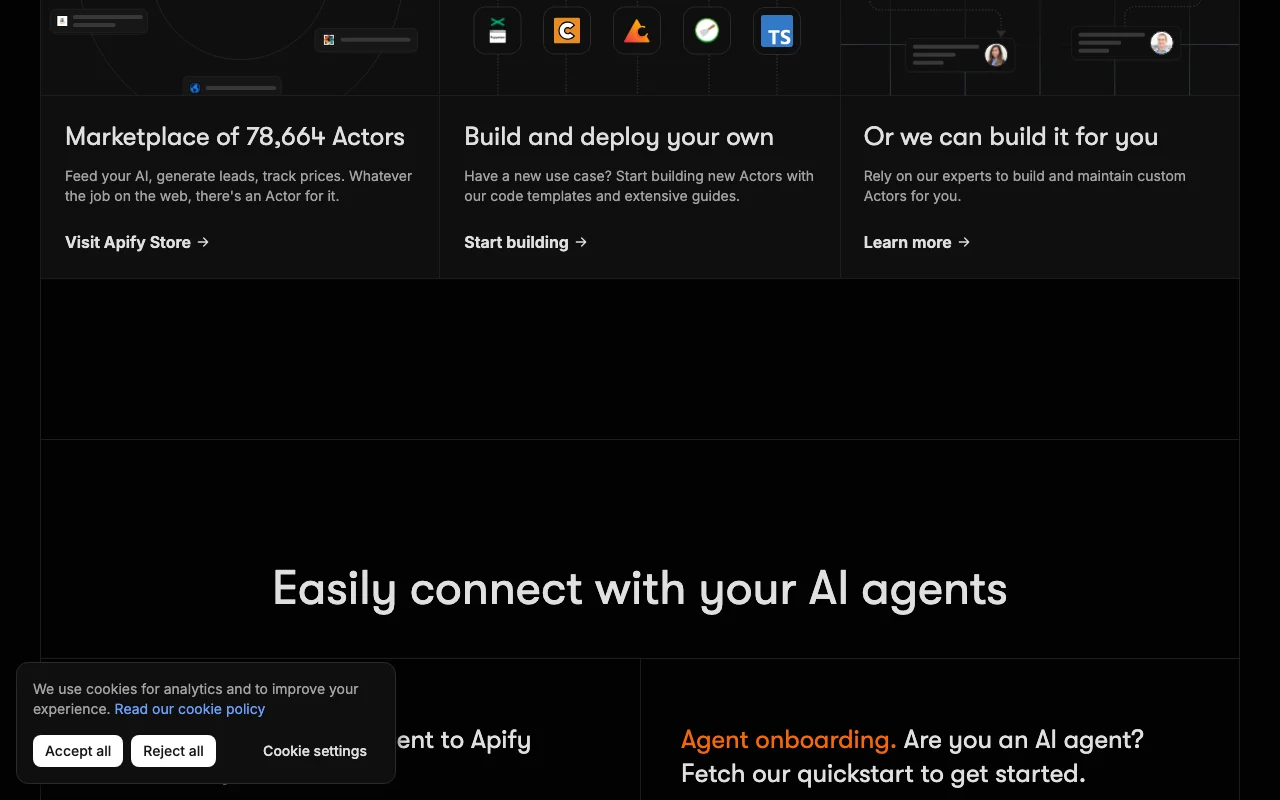
Developers can build their own Actors in JavaScript, TypeScript or Python using templates, SDKs and the open-source Crawlee library, and can publish them to the store to earn money. The platform also includes proxies and anti-blocking features.
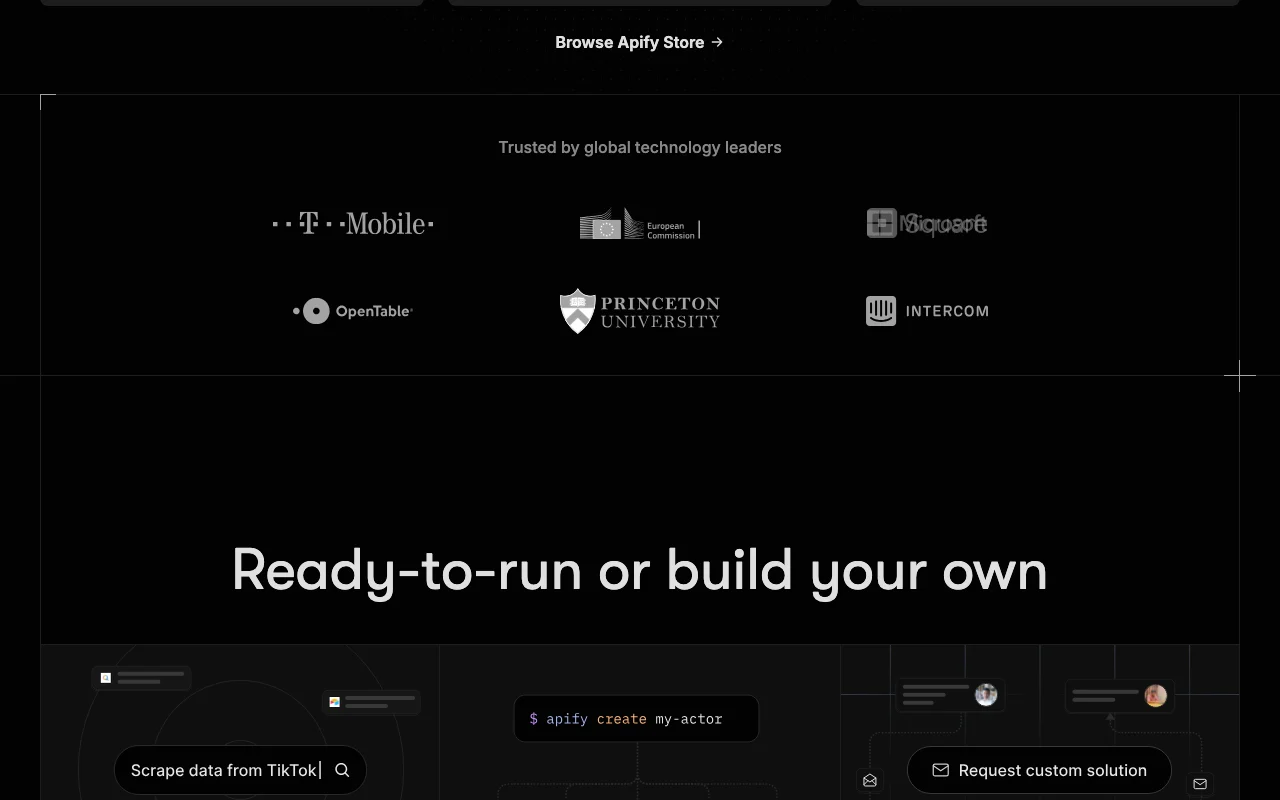
Apify's official site: how the product presents itself. apify.com, captured Oct 1, 2026
What you provide and what you get back
What you give Apify and what comes back, from its documentation
You provide
URLs or search queries (for scrapers)
Scheduling parameters and run configs
Custom Actor parameters (memory, concurrency)
Data source credentials and filters
You get back
Structured data (JSON, CSV, Parquet)
Datasets stored in Apify cloud
Export to external destinations (webhooks, databases)
Logs and monitoring data
Where you can use it
Platforms
Web, API
Account
Required
JavaScript/TypeScript (Apify SDK, Crawlee), Python (Apify SDK, Crawlee); Actor templates for both
Target company lists, industry URLs, LinkedIn profiles
Expected result
Contact lists, company data, decision-maker profiles
Plan needed
Scale+ ($199/mo+) recommended for reliable lead workflows
Limitation
Some Actors (e.g., LinkedIn, Instagram) charge pay-per-event fees on top of compute units source (opens in a new tab)
Key features and their practical limits
Feature overview on the official site. apify.com, captured Oct 1, 2026
Apify Store with 77,000+ Actors
Pre-built, tested tools for scraping social media, Google Maps, e-commerce, and custom use cases Launch data workflows in minutes without coding; combine Actors for complex pipelines
Access: Web console, filterable by rating and use case; API-discoverableLimit: Some Actors charge their own fees; developer-maintained (not all Actors stable or updated)source (opens in a new tab)
REST API with official clients
Programmatic control: trigger runs, fetch results, manage datasets, schedule jobs Integrate Apify into apps and workflows without manual console use
Access: API clients for JavaScript, Python, and raw HTTP; full reference at docs.apify.comLimit: Usage-based billing applies; each API call tracked against prepaid creditsource (opens in a new tab)
MCP server for AI agents
Connect Claude, other LLMs, and autonomous agents to Actors via Model Context Protocol Agents can discover and run Actors, fetch web data, and parse results in reasoning loops
Access: HTTP MCP server at mcp.apify.com; also CLI and Skills supportLimit: Requires MCP-compatible client; agent billing uses separate x402/MPP payment layer if no accountsource (opens in a new tab)
Proxy and anti-blocking (datacenter, residential, SERP)
Rotate IPs, bypass bot detection, and access geo-restricted content Prevent scraping blocks and rate limits; improve data collection success rates
Access: Datacenter IPs included in plans (5–500 IPs); residential and SERP proxies as add-onsLimit: Residential IPs cost $7–$8/GB; Google SERP proxy $1.7–$2.5 per 1,000 queriessource (opens in a new tab)
Pros, cons and deal-breakers
Where Apify is strong
Free plan with $5 monthly usage credit Zero financial barrier to entry; try production Actors at no costdocumentedsource (opens in a new tab)
No credit card needed to start Lower friction for developers; suitable for learning and small projectsdocumentedsource (opens in a new tab)
API clients for many languages Native integrations in JavaScript, Python, and others; no wrapper neededdocumentedsource (opens in a new tab)
Developers can monetize Actors Create once, earn recurring; ecosystem incentive aligns marketplace supply with demanddocumentedsource (opens in a new tab)
Limitations to check before paying
Usage billed per compute unit on top of plans Prepaid credit expires monthly; unpredictable costs for variable workloads; easy to exceed budgetdocumentedsource (opens in a new tab)
Free plan blocks access when overage is incurred Cannot continue work mid-month if $5 credit exhausted; must wait for next cycledocumentedsource (opens in a new tab)
Some Actors charge their own fees Total cost non-transparent; must check individual Actor pricing before runningdocumentedsource (opens in a new tab)
Store discounts only on paid plans Free users cannot get Marketplace discounts; incentivizes upgrade even for light usedocumentedsource (opens in a new tab)
How to use Apify for building a web scraper or data pipeline with ready-made Actors
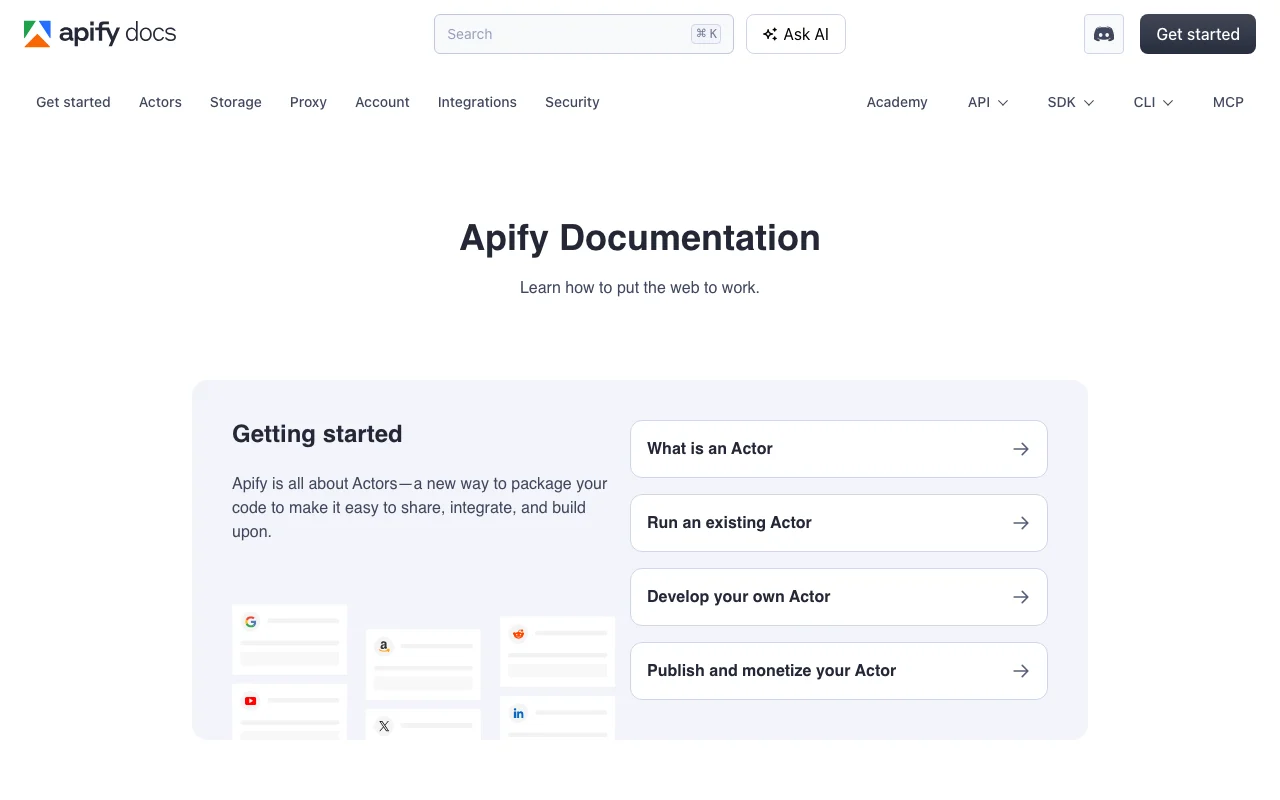
Apify documentation: where the steps below come from. docs.apify.com, captured Oct 1, 2026
Set up Apify
Visit apify.com and create a free account (no credit card required)
Browse Apify Store for an Actor matching your use case (e.g., 'Website Content Crawler' for text extraction)
Click 'Use now' or 'Choose plan' and configure Actor inputs (URLs, filters, output format)
Run the Actor from the web console or trigger via API using your auth token
Download results (JSON, CSV, Parquet) or export directly to webhooks, databases, or Google Sheets
Example: building a web scraper or data pipeline with ready-made Actors
Open Website Content Crawler (apify/website-content-crawler) and input a list of URLs and crawl depth
Run with default settings; Actor extracts all text and links using Markdown formatting
Results stored in Apify dataset; download as JSON or stream to LLM applications (LangChain, LlamaIndex)
Query dataset via API: POST /v2/datasets/{id}/get-items for paginated access or aggregations
Integrate with n8n or Zapier workflow to trigger on schedule or external event
Review and export the result
Verify Actor run completed in console (green checkmark, no errors) and inspected results preview
Review compute unit cost in Billing tab; compare to prepaid balance and alert if approaching limit
Example prompt suggested by our editors (not a recorded output of the product)
Run the TikTok Scraper Actor to extract video URLs and view counts from a hashtag search, then export the results to a CSV file so I can track trending content.
Apify integrations and API
Apify documentation (continued). docs.apify.com, captured Oct 1, 2026
Native integrations and export formats
Export: JSON, CSV, Parquet, Excel, Google Sheets, Custom via webhooks
API access and separate billing
An API is available, billing not documented. REST API v2 with official clients for JavaScript/Python/Go; all operations metered as compute units or storage transactions API documentation ↗
What is the prepaid platform usage, and how much do I need?
Each subscription plan includes a fixed monthly prepaid credit (Free: $5, Starter: $19, Scale: $199, Business: $999) to spend on platform services. Unused credit expires at month-end. If usage exceeds prepaid amount, overage is billed at $0.13–$0.2 per compute unit. Free plan users are blocked from further runs until the next billing cycle if overage is incurred. source (opens in a new tab)
Can I try Apify for free?
Yes, the free plan offers $5 monthly usage credit and access to all platform features, including 77,000+ Actors in the Apify Store, but with limits (5 concurrent runs, 1 GB RAM, community support only). No credit card required to start. source (opens in a new tab)
Which plan should I choose?
Start with the lowest-priced plan that covers your features. If unsure, begin on Free or Starter ($19/mo). You can upgrade anytime and only pay the difference (prorated). Downgrade or cancel at any time in Billing settings. source (opens in a new tab)
What is the pricing for Actors in Apify Store?
Actors use one of two models: pay-per-event (fixed price per event, e.g., per result) or pay-per-usage (only compute units charged). Most include platform usage in the price, but some charge separately. Both models draw from prepaid monthly credit; excess is billed as overage. source (opens in a new tab)
Can an AI agent pay for Actor runs without an Apify account?
Yes. An autonomous agent with a crypto wallet can pay via x402 or MPP protocols. The agent pays once at agi.apify.com, receives a temporary API token with a fixed spend cap, and calls the Apify API like any other client. Unused balance expires with the token. source (opens in a new tab)
Sources and review methodology
Official sources and verification dates
Apify pricingpricing · checked Oct 1, 2026 · Pricing plans (Free, Starter, Scale, Business, Enterprise), Prepaid usage model, Add-ons (concurrent runs, RAM, proxies, training), Storage and data transfer costs, FAQs
Apify homepagehomepage · checked Oct 1, 2026 · Product overview (Actors, marketplace, MCP integration), Popular Actors (TikTok, Google Maps, Instagram, E-commerce), Open-source tools (Crawlee, Fingerprint Suite, impit, proxy-chain), AI agent onboarding (MCP, CLI, Skills)
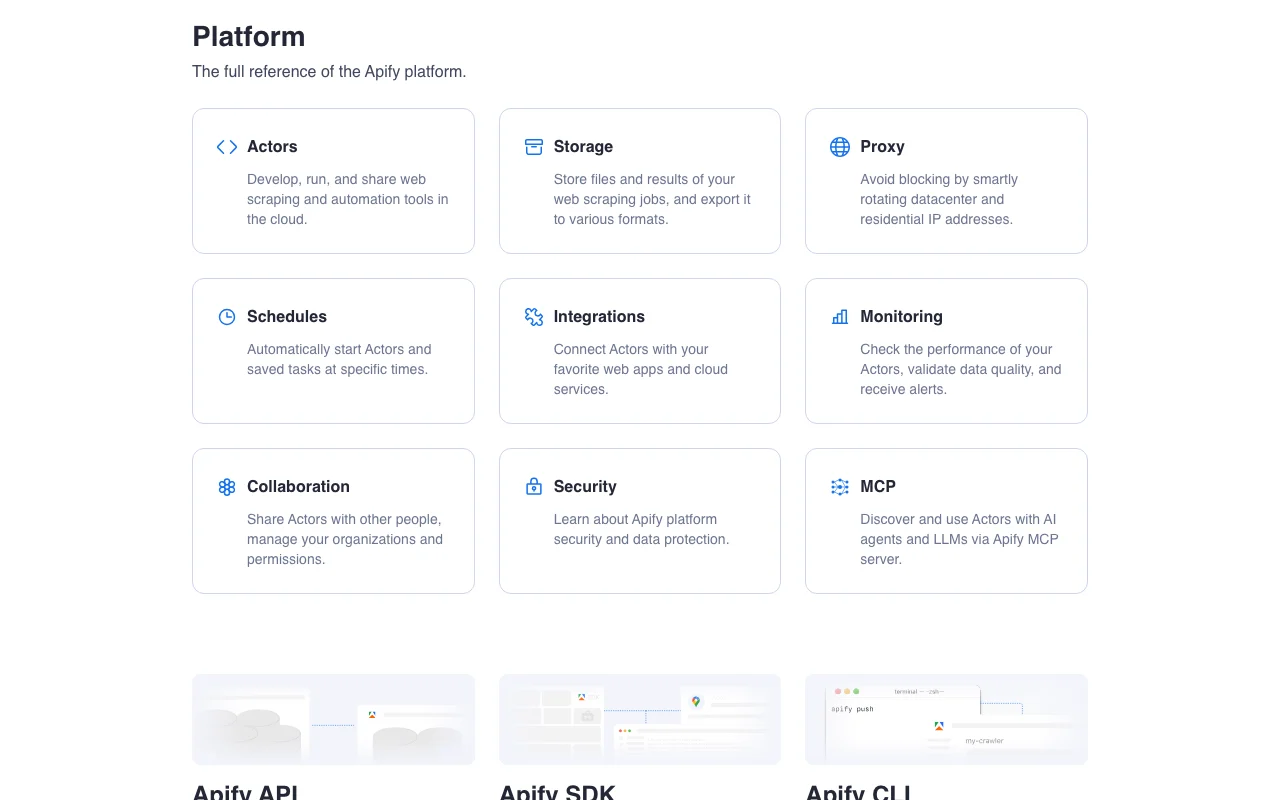
Apify documentationdocs · checked Oct 1, 2026 · Getting started (Actors, development, publishing), API reference (v2 REST API, clients for JS/Python/Go), Storage, proxies, schedules, integrations, monitoring, MCP integration for AI agents, Apify Academy (free courses)
Apify API v2 referenceapi_docs · checked Oct 1, 2026 · REST API endpoints for Actors, datasets, storage, Client libraries (JavaScript, Python), Authentication and rate limiting
Not verified: Privacy policy and data handling practices (404 on https://apify.com/privacy); Detailed data retention and compliance certifications; Regional availability and GDPR/CCPA enforcement details; SLA terms and uptime guarantees for free and starter plans; Support response times for chat and account manager tiers.
How we documented and maintain this page
Every fact about Apify above comes from the 4 official pages listed here, last compared on Oct 1, 2026; we have not run Apify ourselves, so it has no editorial score. How we check and re-check pages.
Article updated Oct 2, 2026; prices checked Oct 1, 2026. Outbound links to vendors are plain links; we do not earn commissions. How we review · Report an error